


About Mourning: An Exercise in Being and Love for Others
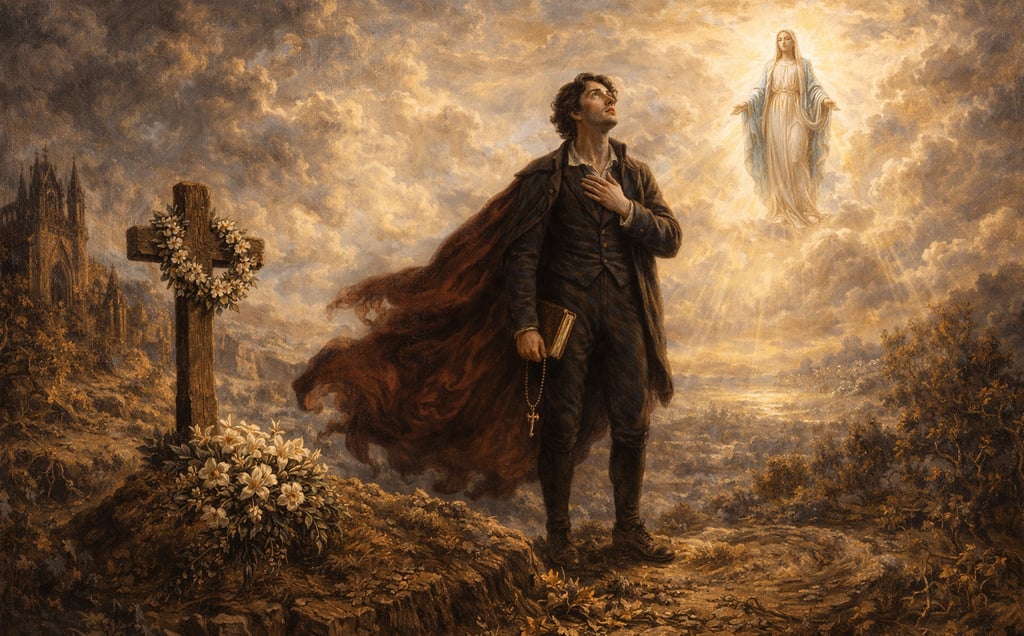
Here in this text, I approach grief not as a collapse, but as a spiritual, moral, and metaphysical experience that reveals what truly sustains the human being, navigating between the pain of loss and the continuity of meaning. He suggests that merely suffering is not enough: it is necessary to understand the reason to move forward and to transform the pain into a commitment to good, love, and purpose.
Gabriel G. Oliveira
3/30/20269 min read
The Hope to Keep Living
Since childhood, mourning has always seemed to me something misunderstood. In my childhood, I used to watch funerals and was struck by the excessive despair, the uncontrollable crying, and the feeling of absolute annihilation that took over people. This was clear in my family. Generally speaking, my aunts faced death more discreetly. However, over time, my mother ended up becoming the person the family informally began to call "the aunt of funerals." Not because she wished for death, but because she was constantly present, bringing sad news or getting involved in tragic events. For her, death almost acquired its own language. So far, her conversation has focused on loss, tragedy, and the negative aspect. Not out of malice, but due to a lack of skill in dealing with grief in an organized manner.
This contrast has always bothered me. Even before any theological or philosophical formulation, I already had the intuition that death could not be just a brutal annihilation. As my spiritual life progressed along a long, confusing, and, in various situations, risky path, this intuition began to take clearer forms. In my adolescence, I experienced various religious and esoteric traditions, participating in Wicca, Quimbanda, and Umbanda rituals, as well as getting involved with Kabbalistic practices, components of ritual Buddhism, and other manifestations of pagan religiosity. I do not express myself as a superficial curious person, but as someone who was present, observed, experienced, and witnessed phenomena that, although they may not be true in their essence, were real in the realm of subjective and symbolic experience.
This journey led me to a significant conclusion: reality transcends the material world. The existence of a spiritual dimension, whether seen as metaphysical, symbolic, or ontological, was not established as a transmitted belief, but as an inevitable philosophical inquiry. In The Varieties of Religious Experience, William James had already emphasized that the religious experience, even when critically examined, cannot be considered insignificant without leading to a impoverished human understanding. From that moment on, it became intellectually dishonest for me to uphold a worldview that, from the beginning, denied any kind of transcendence.
This process eventually led, years later, to a conscious adherence to Catholicism. Not as an emotional escape, but as a logical and spiritual synthesis. In Thomas Aquinas, I discovered what Aristotle merely hinted at and Plato intuited: a metaphysics of being that preserves the mystery without compromising reason. Instead of being refuted, the Five Ways remain a significant topic of debate in contemporary philosophy of religion, as demonstrated by writers such as Edward Feser and Étienne Gilson. However, Christian faith transcends the mere demonstration of God's existence; it addresses a question that reason cannot fully answer: who is this God and what is His connection to human suffering, death, and hope.
It was this understanding that transformed my relationship with grief. Unlike other people, I did not feel despair when my father passed away. It is true that there was pain, but there was no disintegration. The farewell was sincere, but not lasting. The same happened with my grandmother, uncles, and other loved ones. I didn't cry at funerals not out of coldness, but out of conviction. If human life does not end in the grave, as affirmed by Christianity, classical philosophy, and some intuitions present in various religious traditions, then mourning cannot be seen as a complete denial of meaning. C. S. Lewis, who went thru profound grief, wrote in A Grief Observed that pain does not disappear with explanations, but becomes bearable when it finds meaning.
It is precisely at this moment that many get confused. There is a mix between spirituality and extreme literalism when considering heaven, hell, and purgatory as physical places that can be located in space. However, from Augustine to Thomas, classical theology has always considered these concepts as states of being, metaphysical planes, and modes of existence. Treating these realities as if they were geographical objects does not reflect faith, but rather a diminishment of intellect. In order to avoid this simplification, the Christian tradition has always engaged with metaphysics.
Understanding this considerably alters the way one experiences grief. It is not about dismissing the psychological stages — denial, anger, bargaining, depression, and acceptance — proposed by Elisabeth Kübler-Ross, which remain significant in the clinical field. It refers to something deeper: integrating the pain into a coherent perception of reality. Philosophy, reflection, learning, and spiritual life offer the individual resources to not succumb to the pain of loss. Seneca stated: "It is not because things are difficult that we do not dare; it is because we do not dare that they are difficult."
For a long time, I believed that religion served only as a comfort for those who couldn't cope with death. Today, I realize that it is precisely the opposite. Faith, when allied with reason, does not extinguish pain, but orders it. It teaches that death is not the end and that, although mourning is inevitable, it does not need to become an existential prison. Facing loss without losing oneself is possible when one understands deeply. This can be one of the most challenging and fundamental lessons of life: only those who understand being can remain whole in the face of death.

A resposta de Neo "porque eu escolhi" não possui um caráter romântico, mas sim metafísico. Nesse caso, a escolha não é um capricho, mas uma decisão deliberada com um propósito específico. Aristóteles chamaria isso de prohairesis, enquanto Tomás o denominaria ato humano pleno. Quem escolhe padecer por algo maior do que si mesmo deixa de ser refém do destino. O luto começa a se transformar quando você entende que sua dor não é uma falha do sistema, mas o preço de ter amado algo genuíno.
No livro O Retorno do Rei, de J. R. R. Tolkien entende isso melhor que a maioria dos departamentos de psicologia ao redor do mundo. Após a completa aniquilação de Mordor, Frodo indaga: "Lutar pelo quê?". Sam declara que luta "pelo que ainda é bom neste mundo". Tolkien, um católico devoto, transmitiu essa ideia em uma confissão metafísica disfarçada de fantasia: o bem não é garantido, mas merece ser protegido. E apenas aqueles que amam o bem persistem quando tudo parece estar desmoronando.

The same dilemma is presented in the film Paul, Apostle of Christ, which is based on the Acts of the Apostles. The Roman commander observes that Paul has power, but does not seek recognition; he is a leader, but defines himself as a slave. Paul responds with words that echo the First Letter to the Corinthians, chapter 13, where Saint Paul describes love (agápē) not as a feeling, but as a decision of sacrifice. Love that suffers, that does not exalt itself nor seek its own benefit. Love that does not elevate self-esteem, but leads to crucifixion. And that's exactly why it works.
Modernity despises this idea. It prefers happiness as a right and comfort as a characteristic. When not influenced by anything, the human will tends to want to sleep, eat, enjoy, and complain about the world. Aristotle would call this a vegetative life with a university degree. In the Gospel of Matthew, Christ is emphatic: "Whoever wants to save their life will lose it." It is not a mystical threat, but an anthropological diagnosis. Man does not destroy himself by surrendering, but by holding back. This is the essence of all genuine ethics.
The saints took this extremely literally. Saint Lucy, who had her eyes gouged out; Saint Agatha, who had her breasts mutilated; Saint Maximilian Kolbe, who was murdered in Auschwitz while sacrificing his life to save a father of a family. This is not about political extremism, but about metaphysical consistency. Christianity is seen as radical due to the radicality of its founder: he was born in a manger instead of a palace; he was received with thorns instead of gold. The Incarnation is the scandal of a God who surrenders without hesitation. Whoever finds this exaggerated has already chosen to serve another master.

The story of Icarus, told by Ovid in his Metamorphoses, is often used as a warning against audacity. Absurd moralism. Icarus fell while flying, after a brief moment of contemplating the world from a divine perspective. The mediocre man lives in safety and dies without ever having experienced true life. The danger is not in falling; it is in never taking off.
In the essay The Myth of Sisyphus (1942), Albert Camus admitted the absurdity of life, but he was wrong in the final diagnosis. He believed that only the awareness of the absurd was enough. By accepting the lack of meaning, Sisyphus would find happiness in pushing the stone eternally. The issue is that, although Camus describes the pain accurately, he refuses to question the telos. Thomas Aquinas would have been relentless: accepting the absurd without purpose is merely a refined resignation. Even so, Camus presents an uncomfortable truth: life cannot be understood before it is lived.
Curiously, Camus died in a car accident, carrying in his pocket a train ticket he had decided not to use. Tragic irony that harkens back to Greek mythology. However, his intuition was correct: the struggle itself reveals something about man. A common mistake nowadays is thinking that the struggle is enough. It is not appropriate. You have to fight for something; otherwise, the stone just becomes a burden, not a sacrifice.

But I see Sisyphus in a version more coherent with human reality as he contemplates, in Christianity it is called "turning each day into a heroic verse" as you ask me, I see it like this:
Thus, Sisyphus pushes his stone up the mountain, and it rolls down again, forever. However, he does not fall into despair. He does not surrender to the absurd as an unbearable weight. Before, he saw in repetition a rhythm, in the journey a path, and in the stone a purpose.
As he returns to the foothills, his eyes explore the horizon. The desert, immense and silent, invites reflection. The sun painting the sands in gold, the wind playing among the stones, the sky stretching endlessly; there is beauty in life, even when it repeats itself. And in that beauty, there is a touch of transcendence.
Sisyphus understands that he is not only a prisoner of fate but also an artist of his own burden. With each ascent, he shapes a new meaning. With each descent, a new vision. If life is a constant restart, let it also be a constant rediscovery.
In this way, the absurd does not annihilate him. On the contrary, it teaches that the search itself, the very journey, constitutes an act of resistance and a gesture of creation. For, if existence has art and repetition has beauty, there is also something sacred in what seems meaningless. True heroism does not consist in reaching the peak, but in making each step a heroic verse and each effort a prayer.
In mourning, you carry a burden you did not choose to bear. The difference lies in the decision to be an altar or a curse. In chapter 6 of the Gospel of John, Christ states that He came to fulfilll the will of the Father and that nothing entrusted to Him will be lost. This is not religious poetry; it is ontology in action. Nothing that was truly loved ever extinguishes. True love creates ontological marks, not emotional memories.
Man is constantly bound to something. Aristotle said that those who do not control their desires are not free, but rather dominated by them. The man who seeks pleasure, approval, and comfort will never earn respect, not even from himself. The man who abdicates himself to maintain his essence is feared, for he cannot be manipulated. Freedom begins when you can refuse what you desire the most.
If you want to overcome grief, don't start by trying to feel better. Start by being essential. Help someone. Not everyone, but there are those who interpret this as messianic vanity. The duty to restore identity to the shattered man. Thomas Aquinas argued that action directed toward the good perfects the agent. In a direct translation: acting is more healing than discussing feelings indefinitely.
Grief does not end when the pain disappears; it comes to an end when the pain finds its place in life. You are still alive. Therefore, there is still an obligation to the world. And as long as there is obligation, there is purpose. It is not psychology that saves the human being, but the logic of their existence in the world. Not the impersonal logic of schemes, but the tragic and beautiful logic of those who choose to persist not because it is simple, but because it is true.
BIBLIOGRAPHIC REFERENCES
AUGUSTINE, Saint. Cidade de Deus. Londres: Penguin, 2003.
AQUINO, Thomas of. Summa Theologica. Westminster, Md.: Christian Classics, 1981. 5 v.
ARISTOTLE. Ética a Nicómaco. 2ª ed. Indianapolis: Hackett Pub. Co., 1999.
BIBLE. Portuguese. Jerusalem Bible. New revised and expanded edition. São Paulo: Paulus, 2002.
CAMUS, Albert. El mito de Sísifo. Londres: Penguin Books, 2013.
FESER, Edward. Cinco pruebas de la existencia de Dios. San Francisco: Ignatius Press, 2017.
GILSON, Étienne. La filosofía cristiana de Santo Tomás de Aquino. Nueva York: Random House, 1956.
JAMES, William. Las variedades de la experiencia religiosa: un estudio sobre la naturaleza humana. Nueva York: Barnes & Noble Classics, 2004.
KÜBLER-ROSS, Elisabeth. Sobre la muerte y el morir. Nueva York: Collier, 1969.
LEWIS, C. S. Una pena observada. Nueva York: Seabury Press, 1964.
MATRIX revolutions, The. Direction: Lana Wachowski; Lilly Wachowski. Burbank, CA: Warner Home Video, [2004], c2003. 1 DVD.
OVID. Metamorphoses. Oxford: Oxford University Press, 1986.
PAUL, Apostle of Christ. Direction: Andrew Hyatt. [S.l.]: Affirm Films; ODB Films; Sony Pictures Releasing, 2018. 1 film (106 min).
PLATO. Phaedo. Oxford: Oxford University Press, 2009.
SENECA. Letters from a Stoic: Moral Epistles to Lucilius. Harmondsworth: Penguin Books, 1969.
TOLKIEN, J. R. R. El retorno del rey: siendo la tercera parte de El Señor de los Anillos. Londres: Allen & Unwin, 1955.