
Because Feeling God is Crazy
There was a gap in the set of terms that describe the verifiable signs that occur when the human acts as a point of manifestation of the divine, such as theophany, theurgy, and sacrament. "Sintomata" emerges as this concept: the grammar of the symptoms of the sacred in the body, in the symbol, and in events, differentiating a genuine spiritual experience from mere emotion or insanity.
Gabriel G. Oliveira
3/29/202620 min read
Why is this so strange that it needs a new term?
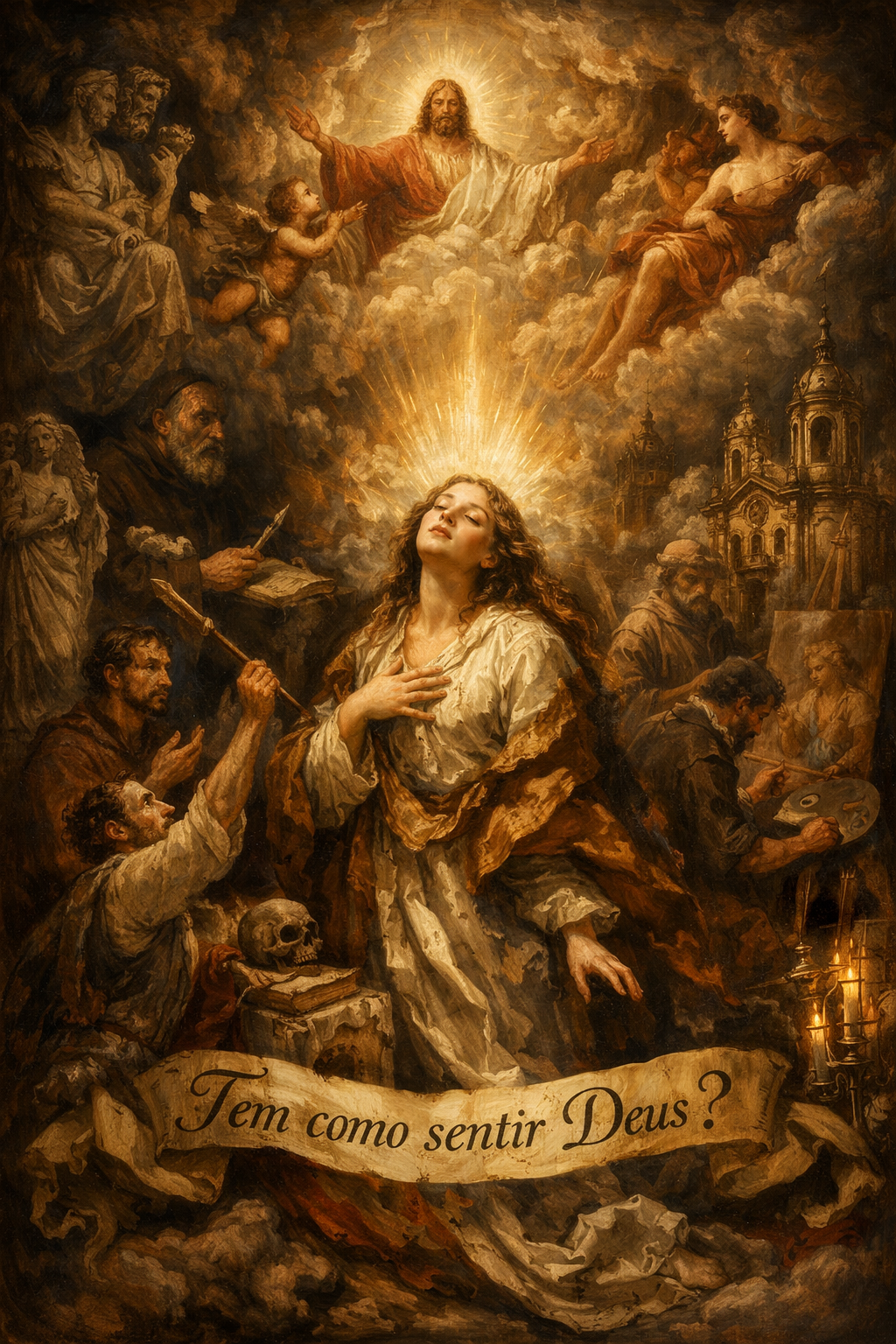
The idea that someone "felt God" is one of the most common and least questioned statements. It is curious to observe that the more a person insists on having had this experience, the less reflection they seem to have dedicated to what they are truly asserting. If you take this at least somewhat seriously, the statement is not trivial: it implies that a human being, with a body, nervous system, memory, and imagination, managed to directly perceive something that, by definition, is not a body, is not an object, and cannot be reduced to anything the mind can conceive.
It is at this moment that things start to fall apart.
The issue is not the experience itself; people tremble, cry, enter ecstasy, feel presence, get goosebumps, and lose control of their bodies — this is undeniable. The problem lies in the hasty interpretation that follows, as if the shift from feeling something to declaring "this is God" were a natural step. In fact, it is a blind leap, full of assumptions that no one makes an effort to investigate.
Centuries ago, Eckhart had already deconstructed this idea with a statement that is still seen as offensive to fervent religious believers: "everything that can be named, felt, or imagined is not God, but merely an image." And there is no way to avoid this without mental gymnastics. If you felt it, it passed thru your senses or your psyche; having gone thru these filters, it has already been interpreted, processed, and shaped, that is, it is not what you say it is, but what you can bear.
The body has no organ to perceive the spiritual; this is not an opinion, but a structure. You perceive light, hear sounds, feel pressure, heat, pain, and pleasure. None of these channels capture "spirit." Therefore, when someone reports having felt an angel, a demon, or even God, what is being described is not a direct contact, but an internal experience that later received a religious designation.
And here appears a detail that dismantles half of the popular convictions: the name changes according to the context.
William James made this statement without criticizing anyone: "religious experiences are shaped by the tradition in which they occur." The Catholic feels the presence of the Holy Spirit, the practitioner of Umbanda connects with a caboclo, the pagan worships a goddess, and they are all convinced that they are experiencing something authentic. However, in the literal sense, it is not feasible for everyone to be correct simultaneously. Therefore, what remains constant is not the object of sensation, but the structure of the experience.
In other words, the phenomenon is human, but the interpretation is cultural.
Lévi-Strauss was even more explicit when dealing with witchcraft: the power is not in an objective entity that invades the body, but in what he called symbolic efficacy. Belief shapes experience, and the body responds as if it were true. And, upon closer examination, this is precisely what happens in incorporation rituals: no one "sees" the entity entering; there is only a gradual change in behavior, posture, voice, and bodily rhythm. The body has a role, but it is a role that has been acquired.
This does not diminish the intensity of the experience; on the contrary, it clarifies the reason for its persuasion.
In Candomblé, Umbanda, Quimbanda, and pagan practices, the so-called "descent" is not perceived as a tangible physical event, as if someone were crossing an invisible door. This change in the medium's state follows recognizable, identifiable, and almost choreographed patterns. The person does not describe the entry as clear perception; they begin to act as if something has taken their place.
And that "as if" is fundamental.
When neuroscience is mentioned, the situation becomes even more uncomfortable and less mystical. When examining these experiences, Newberg shows that states of "union with the divine" occur alongside specific changes in the brain, especially in the temporal lobe and the circuits linked to emotion and reward. It's not a detector of God; it's that certain neurological configurations create the sensation of presence, unity, and transcendence.
The experience is genuine. The mentioned object not necessarily.
And here arises the aspect that few are ready to face: traditional Christianity has never assured this type of direct sensory experience. On the contrary, it has always been suspicious of it. This is due to the fact that, if God is transcendent, absolute, and cannot be reduced to the physical world, the idea of "God entering the body" is theologically erroneous even before it becomes an experience.
Paganism addresses this simply by employing immanent gods, which are forces inherent to nature and, therefore, can manifest physically. This is in accordance with the internal logic of these religions. However, when trying to apply this to Christianity, it is like trying to put water in an unsuitable container; it will end up overflowing, distorting, or transforming into something different.
And that is exactly what is observed when examining some contemporary movements.
Pentecostalism and neo-Pentecostalism employ these manifestations of trance, collective catharsis, and symbolic incorporation, using biblical language to cloak them. Speaking in tongues, falling, trembling, shouting, casting out demons: none of this is new or particular. When comparing esoteric or Afro-religious practices, the similarity is structural, not just superficial.
The vocabulary changes, but the mechanism remains the same.
Glossolalia, for example, is not a unique phenomenon; there are clear parallels in various ritual contexts where vocal trance manifests. The "falls in the Spirit" function as a collective emotional release, induced by rhythm, expectation, and environment. Moreover, when examined objectively, exorcism demonstrates patterns found in cultures that have never had contact with the Bible.
Interpreting this as a "direct action of God" is, at the very least, a convenient explanation.
Eckhart would return with the same impatience as before: if you feel, it is not God, it is you feeling something. And this is not an offense to faith, but a correction of precision. Mixing what happens in the mind with the Absolute does not represent a deep spirituality, but rather a lack of discernment.
Ultimately, what people call "feeling God" is an intense mix of emotion, symbolism, culture, and highly intense brain activity. It is persuasive, sometimes transformative, sometimes risky, but it does not represent a direct perception of the divine.
It is about the body dramatically symbolizing what the mind has learned to consider sacred.
And perhaps the most sincere attitude someone can adopt is not to deny the experience, but to stop falsifying what it truly is. This happens because, while the person claims to have reached the absolute, they fail to realize that, at most, they are merely touching their own capacity for belief.
The question begins exactly where everyone thinks it ends: when someone says "I felt God" and thinks that's enough. It doesn't solve anything, it just shifts the issue to a more convenient place, where no one needs to explain what they are saying. Because everyone feels. The question is another. The problem arises when what happens doesn't fit the word feel, but it also can't be simply dismissed as a hallucination without reality being altered to make it seem false.
It is at this point that the conversation stops being devotional and becomes uncomfortable.
That's because, when followed sincerely, a phenomenon appears that doesn't fit either superficial religious sentimentality or the simplistic explanation of "it's just the brain." Not due to a lack of brain involvement, it undoubtedly is, but because reducing everything to that seems as lazy as attributing any shiver to a miracle.
And the curious thing is that it always presents itself in the same way: not as an isolated sensation, but as a whole.
It's not just the person who transforms. The response is not limited to the body alone. The reorganization goes beyond language. The simultaneous combination of all these elements creates a kind of strange coherence, which is difficult to ignore and even more challenging to explain without resorting to extremes. The person not only experiences a sensation; they also begin to behave differently, express themselves uniquely, and navigate a symbolic field that seems denser than usual.
And this starts to become bothersome because you can't call it anything.
If it were just emotion, it wouldn't have longevity. If it were just imagination, it wouldn't leave marks. If it were just collective hysteria, it wouldn't exhibit a recurring structure beyond the immediate context. However, in some situations, what manifests shows persistence, pattern, and consequence. It does not refer only to the person's "interior." There is something that overflows.
At this moment, language begins to fail.
For everything we possess are words that capture parts of the phenomenon and pretend to have understood the whole. When something more ceremonial happens, it is called embodiment. When it happens in a Christian environment, it becomes "grace," "anointing," or "action of the Spirit." When seen from the outside, it becomes "trance," "dissociation," or "altered state of consciousness." Each name addresses the speaker rather than the phenomenon itself.
And, in this game, everyone makes mistakes with elegance.
The religious person believes they named God. The scientist believes he named the brain. The anthropologist believes he has named culture. And the phenomenon continues, passing thru all of them, without fully fitting into any. This should serve as a warning, but it has ended up becoming common.
What emerges, therefore, is not an unprecedented solution, but a new demand: to stop treating everything as equivalent.
Because it doesn't work that way.
There is a considerable difference between an individual in collective catharsis, who reproduces assimilated emotional patterns, and another whose experience provokes restructurings that escape this pattern. There is a difference between someone who interprets any coincidence as a divine sign and someone whose actions begin to generate results that others also notice, even without sharing that belief.
And this difference is quite subtle for contemporary vocabulary.
It is at this point that the situation begins to get truly tense. This happens because, without a term for this middle ground, the tendency is always to choose the two simplest extremes: either everything is a divine manifestation or everything is a psychological illusion. And, in the end, both are just different forms of the same intellectual laziness.
One exaggerates, while the other minimizes.
Neither of them calmly observes what is happening.
And, upon careful analysis, an unsettling pattern emerges: certain experiences cannot be reduced to feeling, but they also do not present themselves as a direct perception of something transcendent. They occupy an intermediate space, where the human seems to be the point of expression of something that is not fully understood, but that also cannot simply be attributed to an external "other" without generating distortions.
This is a point of contention.
And it is in this conflict that thot begins to demand precision.
Because, without this, any analysis will be superficial. Depending on who is observing, the person going thru something more intense is quickly considered either a saint or sick. In both cases, the real phenomenon is replaced by a reassuring designation.
Theology responds that it is grace or temptation. Psychiatry justifies it by saying it is a disorder or an episode. Culture responds by saying it is a symbolic manifestation. And no one discusses the central question: what actually happens when this set of effects manifests?
Because it involves more than just internal issues. Moreover, it does not refer only to something external.
This refers to a configuration.
A type of environment where body, language, symbol, and action begin to operate together in a more intense, organized, or bold manner than usual. And the most frustrating thing is that one cannot simply ignore this as irrelevant without harming the experience, but one also cannot accept this as "God in itself" without falling into gross naivett.
So, what remains?
The discomfort of admitting that a word is missing still persists.
And this may seem irrelevant until you realize the damage caused by its absence. For, in the absence of a minimally precise term, everything tends to dissolve into old categories, and thot is led back into the same cycle: emotion, interpretation, exaggeration, denial.
It's a closed circuit.
And perhaps the most sincere point is to recognize that the mistake is not only in theology, psychology, or popular religion. The problem lies in the language we have inherited, which was not designed to deal with this type of phenomenon without modifying something in the process.
And as long as this is not addressed, the discussion will not progress.
Calling it "feeling God" something that transcends a mere sensation and considering as "illusion" that which, in certain cases, leaves such deep marks that they cannot be discarded so easily.
It is in this brief, uncomfortable, and inevitable period that the real problem begins to manifest.
It took me a while to realize that the problem wasn't just theological. It was the era of language. And this may seem like a detail until the moment you try to describe something you are sure you are perceiving, reasoning, and distinguishing, but simply cannot find the right word. The lack of terms not only makes the conversation more difficult but also hinders reasoning. Half of human problems arise when we try to fit experience into a vocabulary that was not made for it. And that's exactly what happened here. I wasn't trying to create a metaphysical perfume to impress anyone. I was trying to attribute a technical void. A considerable flaw in the language.
The starting point was simple, but explosive. To claim that someone "felt God" and to say that something manifested in such a palpable way that common language cannot encompass it are two very different things. I wasn't referring to a generic emotion, nor to that religious sentimentality that makes people confuse catharsis with transcendence. I was trying to isolate something distinct. Something more severe. Colder. More susceptible to verification. It does not refer to the psychological feeling of comfort, peace, thrill, or enthusiasm that any religious propaganda or nervous breakdown can simulate, but to the question of when the human seems to function as a channel for an operation that transcends them, yet still leaves marks on the world.
Tradition has a thousand words for the edges, but almost none for the center. Hierophany is the manifestation of the sacred. The manifestation of God is called theophany. The "in persona Christi" is revealed when the priest performs his role in the liturgy. In Afro-religious traditions, the body is seen as a horse. In mystical language, the person becomes a vessel, container, or instrument. Theurgy emerges within the Neoplatonic and Hermetic realms, being a concept used to describe the operator who acts in harmony with the divine, rather than violating nature like a young sorcerer trying to pass himself off as a neighborhood demiurge. All of this plays an important role. None of this has value.
It is not effective, as each term addresses one part and ignores the rest. One refers to the event. Another from the spokesperson. Another aspect of the ritual. Another aspect of the activity. Another aspect of the analysis. And I was precisely looking for what was between those parts, that uncomfortable region where the divine operation cannot be reduced to either the rite, the agent, the isolated sign, or the simple discourse of the observer. There was a lack of a term for the complex, simultaneous, ambiguous, and verifiable mark of something that, even without being perceived as hunger or sadness, affects the body, gesture, language, and the dynamics of events.
It was at that moment that the conversation began to revolve around various names that, to be honest, are quite appropriate for specific contexts. Theophorus is efficient for the bearer. Teurgo is efficient for the operator. A sign acts as a mark for an invisible reality. In a deeper technical sense, the sacrament functions as a visible sign of a grace that cannot be seen. Discernment is valuable for the external interpretation of these signs. Infusion is effective for conveying knowledge without the need for discursive mediation. Deification, or theosis, occurs when the tradition seeks to understand an intense participation in the divine without a crude fusion. All of this is beneficial. However, it was precisely this excess of partial utility that highlighted the main need.
Because, fundamentally, what I was trying to describe was not limited to the manifestation of God, nor to man acting as an instrument, nor to the effect revealing itself in matter. I was trying to name the group of symptoms of this. And I use "symptomatic" intentionally, since the symptom is a unique category for dealing with what is not explicitly presented, but leaves organized clues. A symptom is not the cause of the problem, but it is also not simply an illusion. It symbolizes the moment when an invisible cause manifests on a visible surface. This structure is much more efficient than one might imagine for dealing with the problem.
It was for this reason that the term began to appear almost spontaneously, as a logical necessity, and not out of inventive vanity. I did not place myself in the position of an internet alchemist, inventing strange terms to seem profound. The term emerged because the existing language led me to it. No symptoms. And what really matters to me is not the appearance of the coinage, but its purpose. Sintomata is the term used to describe the set of verifiable, bodily, symbolic, operative, and real symptoms that indicate that an individual is serving as a point of manifestation of a divine intervention or something considered sacred in a specific theological context.
The most beautiful thing is that he organizes what was messy. Theurgist becomes the agent. The theophany, the event. The sign or sacrament is the particular sensitive expression. And Symptomatic, the integral symptomatic field. Not just a signal, but the very logic of signals. It is not just a manifestation, but the system that makes this manifestation visible in the body and in the world. It functions almost like a grammar of the friction between eternity and time. And I understand that this may sound exaggerated, but that is exactly the problem: when language does not depict the phenomenon, reality seems exaggerated.
The term also offers an advantage that I consider fundamental: it diverts the discussion from superficial sentimentality. This is of utmost importance. This happens because, whenever someone talks about "feeling God," contemporary culture, marked by laziness and narcissism, immediately transforms it into an expression of subjective emotions. Inner peace, warmth in the chest, comfort, expansion, positive energy—this complete zoo of emotional banalities that the spiritual coach and the pharmaceutical lab can provide, each in their own way. However, what I was trying to think did not fit into that. The point was precisely the opposite: not being able to experience God as a common emotional object and yet noticing in reality certain effects, coherences, pressures, displacements, and signs that point to an operation beyond the ordinary.
Sintomata is useful because it shifts attention from confessional fantasy to the question of verifiable manifestation. It is not about proving the existence of God academically, nor about giving mysticism a scientific character just so that the positivist feels included. It is necessary to recognize that some traditions, over the centuries, have faced the same challenge: how to communicate something that is not limited to internal feeling, but also does not become abstract. What I did was try to give a functional name to this problem. A name that would unite limit sensation, body mark, practical effectiveness, symbolic reconfiguration, and visible result.
This is relevant because the term allows for distinctions that would otherwise be confusing. One thing is for a person to enter a trance that was socially learned. Another issue is the individual being seen as a ritual vehicle. Another possibility is that a relevant symbolic effect occurs without factual alteration. Another is the propensity of religious imagination to consider any coincidence as a divine intervention. Moreover, there is a tradition that establishes certain states as the manifestation of the divine. Without an appropriate vocabulary, all of this ends up being confusing. The debate, at least, gains structure with a term like Sintomata. The question that arises is: "Did this person feel God?" almost naive formulation and becomes "is there a specific, reiterable, and discernible symptomatic field that tradition, the body, and the real identify as a sign of this manifestation?".
And here arises a significant logical consequence: if Sintomata is a solid concept, then religion, theology, psychiatry, anthropology, and phenomenology would stop acting like drunks fighting on the sidewalk. Nowadays, each field appropriates a part of the phenomenon and ignores the rest. Psychiatry uses reference breakdown. Spiritual interpretation is adopted by theology. The ritual context is the subject of study in anthropology. Sociology deals with the collective function. When it is not dormant in a German lexicon, philosophy takes the form of discourse. What is rarely considered is the possibility of creating an intermediate, interface, or linking category. Sintomata would be useful for that purpose.
And it is precisely by playing the role of intermediary that he also causes discomfort. It disturbs because it affects the comfort of both sides. It disrupts the mind of the naive religious person who seeks to classify any intense feeling as a divine manifestation. And it disorganizes the simplistic materialist, who seeks to label any manifestation of the sacred as delusion, neurochemistry, or lack of a father figure. Both live in diminishment. One acts as if they are superior to the other, who in turn feels inferior. One believes that everything is a miracle. The other thinks that everything boils down to brain circuitry.
None support a category that requires greater intellectual effort.
The need for the term becomes clearer, in my opinion, when the conversation approaches what, in our reality, would be immediately associated with schizophrenia. And this is not a secondary detail; it is one of the main reasons for the need for the term. This is because, if there is a symptomatic field of divine or theophanic manifestation, it ends up impacting areas that our contemporary medical culture classifies as outbreak, delirium, disorganization, hyperassociation, and breakdown of shared reference. It wasn't supposed to be this way, but it ended up being so. We inhabit a society in which the clinical, and not the metaphysical, is the predominant language for limit experiences.
Thus, the connection between Sintomata and schizophrenia would be almost inevitable in our future. Not because they are the same, but because, from the perspective of the common observer, they are situated in nearby areas. Both can involve the sensation of invasion, alteration in perception, intensive use of symbolic language, breaking of usual filters, subjective restructuring of the world, belief in a higher entity, and interpretation of signs and synchronicities. The point is that modern psychiatry, in its role, must protect the everyday world from anything that might suggest a considerable break in reference. Thus, it tends to classify as pathology what it cannot measure as operation.
It is at this point that Sintomata reintegrates, as it imposes the fundamental question: the difference between a psychosis and a Sintomata is not only in the subjective content of the experience but in the effect on the real. This distinction is fundamental. In common psychosis, the external world does not reorganize in a comprehensible and verifiable manner for the individual; the rupture largely remains confined to their experience and the intersubjective conflict it generates. If we were to take the concept of the Symptom seriously, there would be external efficacy, a sign, a perceptible reconfiguration, and an observable consequence, albeit open to interpretation. The bridge is destroyed by madness. In this model, the Sintomata is overloaded.
I am aware that this involves risks. And it is precisely because it is risky that it should be said with care. No, that does not mean romanticizing mental suffering. It's not about turning illness into mysticism to satisfy religious vanity. That would be unacceptable. This simply implies recognizing a real conceptual challenge: our current language tends to classify any intense experience of the sacred as pathology or any pathology as sacred, depending on the interpreter's fanaticism. In both scenarios, a superficial interpretation makes the real individual become a hostage. Symptomatically, it would contribute, among other things, to preventing this immediate collapse.
Because the term requires discernment, not hysteria. He does not explain the difference between a saint, medium, priest, madman, charlatan, neurotic, and creative criminal. However, he organizes the board more equitably. It allows one to inquire: is there a sign? is there effectiveness? Is there coherence between tradition, body, action, and result? Is there structured repetition? Is there moral clarity? Is there true fruit? Is there an external effect or just self-delusion? Without this type of tool, every debate ends up turning into moralism or mockery, which are the two preferred forms of stupidity when trying to appear courageous.
Another logical consequence: if a concept like Sintomata were taken seriously, it would be necessary to develop a new science or, at least, a more respectable interdisciplinary perspective than the existing one. If someone wanted to adopt a provocative term, they could call it theophysics. Not to measure God, which would be a naive simplification, but to examine the field of effects, correlates, manifestations, and visible signatures associated with certain states, rituals, operators, and contexts. This would enable a more precise differentiation between effective ritual, collective hysteria, suggestion, symbolic performance, psychopathology, and what a tradition recognizes as a legitimate manifestation.
It is evident that this would sound absurd to many people. However, it is common for many people to live in a society where a spreadsheet determines the value of a forest and an algorithm determines the magnitude of a lie. The modern man is quite discerning about what he considers absurd, as long as the absurd is dressed in a tunic and not a suit. For this type of selectivity, I honestly have little tolerance. If we accept new categories to describe particles, traumas, markets, systems, networks, distributed cognition, and the entire current analytical circus, there is no reason to restrict liminal experiences of the sacred to imprecise terms like "energy," "anointing," "presence," or "delirium."
Symptoms, therefore, should exist for a reason much less ornamental than it seems. It should exist because it facilitates the understanding of a specific problem. It names a field that is currently scattered in improper terms. It prevents everything from being reduced to sentimental devotion or automatic psychopathology. It allows the manifestation of what, despite being impossible as a shared feeling, becomes visible thru its symptoms in the body, in gesture, in ritual, in efficacy, and in the real. In other words, it structures what, until now, has only manifested as a disordered intuition.
And there is beauty in that. To be philosophically useful, the concept does not need to prove the existence of the phenomenon. This is another point that people forget, as they have been educated thru slogans. To be intellectually indispensable, a concept does not need to have its empirical reference limited. It can appear to organize options, improve analysis, prevent misunderstandings, and indicate a gap in the language that is already causing theoretical errors. The idea of something impossible can also be indispensable. In certain circumstances, particularly in these cases, it becomes even more essential. For what is impossible and nameless ends up transforming into superstition, ridicule, or propaganda. When something receives a name, what was once impossible becomes a thinkable problem.
And, once it becomes conceivable, it starts to have effects. If Sintomata exists, even as a strong hypothesis, then it is no longer possible to treat all intense religious manifestations as equivalent. It is not possible to compare sacrament to an outburst, theurgy to fantasy, symbol to lifeless metaphor, rite to theater, charisma to propaganda, or holy madness to any kind of disorganization. We can no longer fail to recognize that all language of the sacred is merely emotional language. We can no longer treat the body as if it were merely a repository of what traditional biology has already recognized and cataloged. The term requires an expansion of the map.
At the same time, it demands caution. And that is essential for me. That's because, if one of these categories is misused, it quickly becomes a tool of charlatanism. It would only take a handful of condo messiahs claiming that any discomfort, coincidence, or feeling of persecution is Sintomata for the idea to be ridiculed to exhaustion. Therefore, it is only useful if accompanied by rigor, discernment, and the courage to eliminate false cases. A concept that encompasses everything is useless. If it has any theoretical dignity, symptomatology should be used to distinguish, not to accommodate delusions.
At the heart of the matter, that was what I was gradually, almost forcefully, developing during the conversation itself: the notion that there was an absent word for the set of symptoms of the divine as an active manifestation, and not just an affective one. A term that encompassed not only the name of the presence, the name of the agent, the name of the rite, or the name of the proof, but also the name of the space where all of this is. Sintomata originated from this. Not as a lexical luxury, but as a necessity for precision.
And I see this as indicative for another reason. It shows that, in some cases, deep thinking does not begin by finding the answer, but by identifying what cannot yet be defined. Most people never reach this level, as they quickly settle for ready-made answers. Uses expressions like "mystique," "ecstasy," "energy," "grace," "madness," "anointing," "schizophrenia," "presence" and believes it has been resolved. It had no impact. He just covered the crack with a cloth. Intellectual work begins when you resist laziness.
It was for this reason that I insisted so much. Because I knew that the core of the issue had not yet been addressed. And when it emerged, it came like every fundamental word: not as decoration, but as a tool. Symptomata is not the definitive solution to the problem. It is far from that. However, this is the first work that, indeed, seemed capable of integrating, without collapse, the body, the sign, the manifestation, the efficacy, the discernment, and the risk of confusing with pathology. And this already surpasses what most of the available vocabulary is capable of achieving.
Tomorrow, perhaps, I will refine the expression. Only the intuition can be maintained; perhaps I will abandon the form. It is possible that a more suitable word will emerge. This happens when one truly reflects, and not when one erects an altar to their own phrase. For now, Sintomata performs an atypical function: it emphasizes an absence. And the illuminated absence already represents an advance in serious thought.
Because, in the end, that's what it was all about. It's not a matter of giving a beautiful name to the ineffable, but of preventing the ineffable from continuing to be a refuge for confusion. Symptom, for me, has value precisely for that reason. He designates the occasion when the invisible ceases to be a reason and becomes an obstacle. And this, in fact, is the only form of mysticism that still deserves to be considered.
REFERÊNCIAS BIBLIOGRÁFICAS
ASOCIACIÓN AMERICANA DE PSIQUIATRÍA. Manual diagnóstico y estadístico de los trastornos mentales: DSM-5-TR. 5.ª ed., revisión de texto. Washington, DC: American Psychiatric Association Publishing, 2022.
AQUINAS, Thomas. Summa Theologica. Westminster, Md.: Christian Classics, 1981. 5 v.
ATHANASIUS. Sobre la Encarnación. Yonkers, N.Y.: St Vladimir’s Seminary Press, 2011.
BLEULER, Eugen. Dementia praecox or the group of schizophrenias. Nueva York: International Universities Press, 1950.
IGLESIA CATÓLICA. Catecismo de la Iglesia Católica. Washington, D.C.: United States Catholic Conference, 1994.
ECKHART, Meister. Los sermones, comentarios, tratados y defensa esenciales. Nueva York: Paulist Press, 1981.
ELIADE, Mircea. Lo sagrado y lo profano: la naturaleza de la religión. Nueva York: Harcourt, Brace & World, 1959.
IAMBLICHUS. On the Mysteries. Atlanta: Society of Biblical Literature, 2003.
JAMES, William. Las variedades de la experiencia religiosa: un estudio sobre la naturaleza humana. Nueva York: Longmans, Green, and Co., 1902.
LÉVI-STRAUSS, Claude. Structural Anthropology. Paris: Plon, 1958.
NEWBERG, Andrew B.; D’AQUILI, Eugene G.; RAUSE, Vince. Por qué Dios no se irá: la ciencia del cerebro y la biología de la creencia. Nueva York: Ballantine Books, 2001.
PLATO. Timeo. Indianapolis: Hackett Publishing Company, 2000.