

"Know thyself"
A sacred maxim turned into a self-help slogan is a reflection of contemporary decadence: the authentic "know thyself" does not exalt the ego, but places the human being in their proper position in relation to being, God, tradition, and truth. Based on this key, the text deconstructs contemporary spiritual narcissism and demonstrates, in a concrete scenario of religious debate, that the rejection of philosophy and history does not result in pure faith, but in intellectual amnesia.
Gabriel G. Oliveira
4/1/202611 min read
At the Feet of the Gods, You Are Nothing
The phrase "know thyself," inscribed on the pediment of the Temple of Apollo at Delphi, has become one of those expressions that modernity reproduces with the obscene lightness of someone who doesn't realize they are treating a sacred bone as if it were a simple motivational gum. Nowadays, it is common to hear advice like going to therapy, listing virtues and flaws, organizing traumas, or learning to "manage emotions." It is such an insignificant reduction that it becomes humiliating. Delphi was not a self-esteem clinic with air fresheners; it was a religious center, immersed in fear, mystery, and cosmic harmony. The oracles did not inhale the vapors that emanated from the fissures of the volcanic soil to instruct the anxious citizen of the 21st century. That existed to remind man, with the severity of the sacred, that he is not the core of reality.
Just like almost everything the modern man touches, Apollo has also been domesticated by contemporary imagination. The Apollonian god did not represent this sentimental caricature of perfection seen as self-validation or narcissistic exaltation. He represented measure, form, order, and limit. It was the force that gives shape to excess, brings light to disorder, and defines the figure in what tends to dissolve. Therefore, the inscription "gnōthi seautón" was not a call for personal growth, but a demand for ontological location. It did not tell man to marvel at his reflection in the mirror; it told him to know his dimensions. There was more metaphysical warning than moral affection there. It is risky to enter the temple without knowing who you are; to do so without knowing, above all, who you are not, is almost an act of insolence.
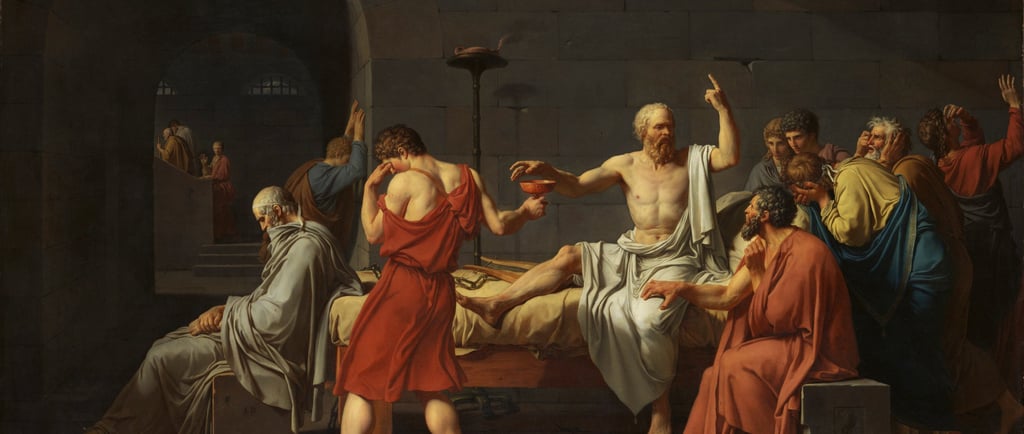
It was at this point that Socrates understood something that therapeutic culture neither captures nor presents explicitly. In the Apology, Plato recounts that the Oracle of Delphi had declared him the wisest man in Athens, and he did not see this as a badge of vanity to flaunt. He turned the statement in question into a wound, into an inquiry. If he was the wisest, it could only indicate one thing: that he was aware of his own ignorance. And this aspect is crucial. Socratic self-knowledge does not arise from emotional reflection on the self, but from the objective perception of one's own limitations. Socrates evaluates himself before the gods, the polis, tradition, and his daimōn. He does not seek a mirror that reassures him, but an instance that restrains him. The serious man is not content merely with understanding his emotions; he wishes to comprehend what is permissible to be without exposing himself to ridicule.
This daimōn was almost as sabotaged by contemporary vulgarity as Delphi. Many people interpret it as the "inner god," a narcissistic spark, spiritual permission to turn their whims into a personal revelation. It wasn't like that. It was mediation, warning, limit, a principle that did not exalt the self, but adjusted it. In many ways, it resembles more what the Christian tradition considers as a conscience illuminated by grace, akin to a Guardian Angel, than that mystique of the mirror in which the individual kisses their own image and calls it transcendence. Therefore, it is not surprising that Christianity has engaged so deeply with Socrates, Plato, and Aristotle. In Acts 17, when Paul addresses the Areopagus, he points to the altar dedicated "to the unknown God" and declares, "This is the one I proclaim to you." The phrase is brief, but it contains an entire world. It's not a matter of cultural flattery. It is about recognizing that, in the best pagan philosophy, there was a search for the transcendent that went beyond the anthropomorphic theater of the pantheon.
That's why self-knowledge has never been about discovering that you are extraordinary, limitless, irresistible, or "the god of your own world." This phrase is a metaphysical blasphemy disguised as beauty. The essence of the Delphic maxim is distinct: to admit oneself as a creature. And that's it. Dependent. It's over. Small in relation to the cosmos and insignificant before God. What is currently promoted as strengthening identity is often nothing more than an exaggeration of illusion. Saint Augustine, in his Confessions, expressed this incisively by stating that man is "a great question for himself." However, he does not stop there, and this detail is very important. Man only becomes a concrete question when confronted with the light of the Creator. Outside of this reference, interiority does not generate truth; it generates a labyrinth. The person observes themselves, describes themselves, analyzes themselves, names themselves, reorganizes themselves, and in the end, only revolves around themselves, using a more sophisticated vocabulary.
Whenever an ancient proverb is turned into a motivational slogan, some fundamental notion of balance is eliminated in the process. Classical philosophy never separated ethics and metaphysics, unlike the modern world, which does so to preserve its vices. Self-knowledge has always required understanding one's position in the hierarchy of being. Man is neither mere insignificant dust nor a deity in formation; he stands between the ant and God, with enough elevation to know and enough limitation to not consider himself absolute. Thomas Aquinas expresses this so clearly that it still humbles much of contemporary psychology by stating that every created being participates in Being, but is not Being itself, ipsum esse subsistens. Disregarding this difference is the path to spiritual arrogance, which often disguises itself as enlightenment but exudes confusion.
Hence the almost comical aspect, if it weren't so harmful, of some occultist trends and so many contemporary discourses in which someone proclaims, with the seriousness of an adolescent dominated by their own fantasy, that "I have become a god" or "I have created my own universe." No, it was not created. You can barely organize your own schedule without getting it wrong, but somehow, you wish to manage the real ontologically. The philosophical tradition would see this as a direct denial of the Delphic commandment. There is no hierarchy. The measure is lacking. Lack of a sense of proportion, and without it, all greatness turns into delirium. The Greeks referred to this as sōphrosynē, a virtue of moderation that arises from the recognition of one's own limitations. And, with the elegance of one who knows how to wound without shouting, Pascal summarized the drama by stating: "Man is but a reed, the weakest in nature, but he is a thinking reed." His misery without greatness transforms into animalistic despair. His greatness without misery becomes madness.
Socrates based his entire philosophical life on this intuition that, nowadays, might seem excessively unfriendly to the self-image market: self-reflection not to exalt oneself, but to align with the truth. His inner examination was not aimed at providing comfort, but rather at aligning with reality. He evaluated himself in relation to the gods, the city, tradition, reason, and what transcended him, thus allowing him to judge himself. None of this resembles that superficial discourse about personal success, emotional intelligence, or the management of feelings. Of course, virtues and vises are important, but they represent only the most apparent layer of the problem. The fundamental question remains almost painfully simple: who am I in relation to the whole? What is my property? What definitely does not belong to me? The contemporary individual seeks immediate answers out of fear of the authentic response. He knows that, deep down, it rarely gives compliments.
As a practical rule of life, because philosophy that does not touch the flesh is nothing more than verbal decoration, the Delphic maxim teaches something austere and clean: before demanding from the world, know what you are; before imagining yourself as the center, understand the order; before speaking of power, learn the name of the limit. True self-knowledge begins when a person understands that they are not the reference for everything. And perhaps the most subtle irony of all is this: a man only becomes great when he stops playing with the idea of being infinite.
I remember the episode that taught me this with the clarity with which one remembers certain wounds that have already healed: not because they still cause pain, but because they precisely marked the place where one should no longer tread. Like so many intellectual tragedies of our time, it all began with politeness. A calm, almost friendly conversation, until the facade crumbled and the abyss was revealed. A friend of mine, a sincere and convinced Protestant, declared with the firmness of someone who has never questioned his convictions that only the Bible was relevant; philosophy, history, and tradition should be eliminated like objects no longer needed during a spiritual cleansing. He asserted that faith must be pure, without intermediaries. The involuntary beauty of the scene lay in the fact that, by asserting this, he was already doing philosophy — bad, confused, and misunderstood philosophy, but philosophy nonetheless. The man who claims to detest thinking actually just detests acknowledging that he thinks incorrectly.
The conversation became more enlightening when his pastor joined the debate. He was a respected man, aware of his role, and he stated with conviction that the history of the Church and philosophy had no relevance to the Christian faith. There, I saw not only a theological error but also a form of mental disorder often found in religious environments that confuse intensity with truth. From the beginning, theology is intelligence in action before the mystery. Saint Anselm expressed this with the phrase "fides quaerens intellectum." And it is a magnificent formula precisely because it rejects both blind faith and arrogant reason. What kind of faith escapes understanding as if thot were a demonic trap? And why do so many men disregard logic when it challenges them, but accept it without hesitation when it comes from the leader they choose to follow?
It was at that moment that I tightened the screw with irony, without the intention of humiliating, even tho the truth, on some occasions, does that work on its own. I asked how he would interpret the episode in chapter 17 of the Acts of the Apostles, where Paul mentions the altar "to the unknown God" at the Areopagus and states, "This is the one I proclaim to you," if tradition and intellectual heritage were not important. That altar did not appear on the ground by spontaneous combustion. It is embedded in a narrative, in an Athenian philosophical context, in a quest that precedes Christian preaching. It is no coincidence that Christian writers such as Justin Martyr, Clement of Alexandria, and later, Thomas Aquinas identified in Socrates and Plato the germs of the Logos, the logos spermatikos. The early Christians did not possess the childish fear of intellectual contamination that many contemporaries cultivate as a virtue. Maintaining their faith, they engaged in dialog with the wisest pagans of their time. So, why should I ignore two thousand years of reflection to embrace the dogmatic solitude of a recent sect that considers itself the restorer of Christianity?
When reality began to demand, my friend reacted like most of those who confuse fervent belief with consistent thinking: by denying the obvious. He claimed that the Catholic Church never taught that the God of classical philosophy is the same God of the Bible. The mere mention of Thomas Aquinas' Summa Theologiae, particularly the five ways in ST I, q.2, a.3, was enough for the statement to start crumbling without me needing to make much effort. Starting from Aristotle, Aquinas employs reason rigorously, philosophically demonstrating the existence of God and associating this God with what is revealed in the Scriptures. Reason advances as far as it is able; Revelation does not contradict it, only transcends it. If this does not represent a deep connection between faith and philosophy, then I no longer know what words mean. When words lose their meaning, the debate comes to an end, as only noise remains.
Next, I asked an even more basic question: where does the Bible, by itself and in a self-sufficient manner, define the biblical canon? The silence that followed was not empty; it was instructive. The list of sacred books was not presented in a ready and organized manner, with binding, index, and pagination. It is the result of history, councils, controversies, and living tradition, as demonstrated by Hippo in 393 and Carthage in 397. Denying tradition while holding a Bible, whose very existence depends on that tradition, is an almost didactic example of intellectual amputation. It's cutting the branch and sitting on it with a look of pity. Faced with the impasse, my friend turned to the authority of the pastor, as if authority could resolve the contradiction. However, Aristotle had already warned in Book Γ of the Metaphysics that the principle of non-contradiction is the most firm of all. If opposing statements can be true simultaneously, the word truth no longer has meaning. And if it no longer has meaning, faith transforms into esthetic preference with sacred garments.
This type of relativism, which generally presents itself as compassion, tolerance, or humility, is not a private matter of conversation between friends. It makes history, and history sometimes bleeds. When it is declared that all Christian "revelations" are equally valid, objective truth disintegrates into an emotional tangle in which any creation can claim transcendent authority. It is no coincidence that movements like Theosophy emerged in the 19th century, criticized by René Guénon in Theosophy: History of a Pseudo-Religion, precisely for this chaotic combination of beliefs, esotericism, and spiritual subjectivism. The belief that all religious intuitions deserve the same metaphysical status does not bring peace; it provokes a structured confusion.
And structured confusion, when faced with ambition, delirious imagination, and a thirst for power, tends to generate very concrete creatures. It is not surprising that theosophy exerted influence over occult and racial currents present in the intellectual context that led to the emergence of totalitarian ideologies. This is evidenced by historians such as Nicholas Goodrick-Clarke in his work "The Occult Roots of Nazism." This displeases many people, as it ruins the innocent appearance of the ideas. People often play with symbols, esotericism, small metaphysical lies, and spiritual subjectivisms, treating all of this as if it were harmless entertainment. It's not true. Ideas have the uncomfortable tendency to materialize. Ideas transform into institutions, liturgies, laws, persecutions, cults, and corpses. Those who deal with mistakes lightly often end up transferring the moral cost to the future.
At the end of the conversation, my friend tried to change the subject. Not because he had learned, but perhaps because he had noticed, even if for a brief moment, that logic was not on his side. And that taught me more than many prolonged discussions. There are occasions when a person does not abandon a thesis out of conviction, but simply because they realize there is no longer room to continue pretending it is valid. It was at that moment that the ancient lesson of Delphi resurfaced for me, maintaining its rigidity: knowing oneself does not mean protecting fragile beliefs with emotional courage or safeguarding one's own ignorance with devotional fervor; it is about admitting limits, hierarchy, and intellectual responsibility. Chesterton summarized our era with the phrase that I reiterate for the thousandth time in this work, as it remains relevant: "the problem of our time is not that people believe in nothing, but that they believe in anything." And perhaps the true spiritual challenge today is accepting the notion that not everything can be true simultaneously.
The practical lesson I draw from this remains simple and uncomfortable, like almost every truth worth having. Beware both of simple certainties that ignore reason and of arrogant reason that considers faith a regression. Tradition is not debris, it is not a burden, nor a historical ornament for a solemn ceremony. It is the intelligent memory of humanity, the accumulation of the conceptual struggles carried out before us, the record of the issues that have already been too dear to ignore. Disregarding it is not a demonstration of spiritual purity. It is intellectual amnesia with a moral veneer. And no one builds a stable life from the discipline of forgetting.
BIBLIOGRAPHIC REFERENCES
AUGUSTINE, Saint. Confessions. 4th ed. São Paulo: Paulus, 2024.
ANSELMO, Saint. Santo El Proslogio de Anselmo: con una respuesta en nombre del necio por Gaunilo y la respuesta del autor a Gaunilo. Notre Dame, IN: University of Notre Dame Press, 1979.
AQUINO, Thomas of. Theological Summa. v. 1: Part I, questions 1-43. 5th ed. São Paulo: Edições Loyola, 2001.
ARISTOTLE. Nicomachean Ethics. Bauru: Edipro, 2002.
ARISTOTLE. Metaphysics. 2nd ed. São Paulo: Edições Loyola, 2002. 3 v.
BIBLE. Portuguese. Jerusalem Bible. New revised and expanded edition. São Paulo: Paulus, 2002.
CHESTERTON, Gilbert Keith. Ortodoxia. Nueva York: John Lane Company, 1909.
CHESTERTON, Gilbert Keith. La incredulidad del padre Brown. Nueva York: Dodd, Mead and Company, 1926.
CLEMENT OF ALEXANDRIA. Exhortation to the Greeks. São Paulo: É Realizações, 2013.
DENZINGER, Heinrich. Compendium of Symbols, Definitions, and Declarations of Faith and Morals. 3rd ed. São Paulo: Paulinas; Loyola, 2015.
GOODRICK-CLARKE, Nicholas. Las raíces ocultas del nazismo: cultos arios secretos y su influencia en la ideología nazi. Nueva York: New York University Press, 1992.
GUÉNON, René. Theosophy: History of a Pseudo-Religion. Paris: Nouvelle Librairie Nationale, 1921.
JUSTIN MARTYR. I and II Apologies: Dialog with Trypho. 2nd ed. São Paulo: Paulus, 1995.
PASCAL, Blaise. Thoughts. 2nd ed. São Paulo: Martins Fontes, 2005.
PAUSANIAS. Description of Greece. v. 1: Libros 1-2. Cambridge, MA: Harvard University Press, 1918.
PLATO. Apology of Socrates. 3rd ed. São Paulo: Edipro, 2019.
PLATO. Dialogs VI: Cratylus, Charmides, Laches, Ion, Menexenus. 2nd ed. São Paulo: Edipro, 2021.
PLUTARCH. Moralia. vol. 5: Isis and Osiris; The E at Delphi; The Oracles at Delphi No Longer Given in Verse; The Obsolescence of Oracles. Cambridge, MA: Harvard University Press, 1936.
