

Profound reflections for curious and critical minds.
Then he said to me, 'I am the Devil, the beast of the final judgment, that from which nothing escapes and which destroys all darkness at the end of everything.' And I replied, 'I am Hope.'"
Gabriel. G. Oliveira
3/12/202617 min read

My Meeting with Billy
When people accept living like domesticated animals and accept pre-made interpretations, curiosity and creativity start to fade. It's not when you're not smart. That's when cowardice takes over. The person who consumes information merely to appear interesting in a conversation—as if they were changing clothes—is not truly curious. It is the person who still has the capacity for surprise, which is far less common than it first appears. Nowadays, very few people think things through and nearly everyone expresses their opinions. Furthermore, without introspection, intelligence is reduced to a dry gear making noise.
Compared to most people, Chesterton grasped this early on and with greater clarity. Because he had a quality that most modern writers have lost—metaphysical joy—he left a lasting impression on my childhood that is uncommon among writers. It's not the innocent happiness of someone who thinks everything is easy, nor is it the optimism of a motivational pamphlet that aims to make human suffering into a catchphrase for a refrigerator. No. Because it wasn't serious, it was a far deeper joy. The joy of a person who observes the world and acknowledges that it is strange, dangerous, vast, frequently frightening, but still deserving of love. This is more difficult than it first appears. Much more than that.
Chesterton argues in Orthodoxy that faith in the small things in life and enchantment with reality are more than just sentimental embellishments. They are what keep man from deteriorating on the inside. The person continues to live in this corrupt society because they still believe that suffering is worthwhile. To suffer for something is a word that modern man hates. He puts up with suffering because of his conceit, addiction, status, unbridled sexual desire, ideology, career, and pointless online rivalry. But he believes that suffering for something other than oneself is too archaic. It's interesting to see how modernity acts like a child who wants reward without effort, even though it considers itself mature.
Hope has never been a sensitive emotion. The tension aimed at an unfulfilled good is called hope. Fighting for something bigger than yourself is what it is all about. It might be a god. It might be your family members. It might be your people. It might be your nation. It might be your moral duty to people who depend on you. It might be a soul's redemption. It may be devotion to a reality that the entire world has chosen to denigrate. Beyond one's own navel, there will always be something. Modern man has been indoctrinated to reject anything that pushes him away from the center.
Samwise Gamgee is still regarded as one of the most remarkable and human characters in modern literature because of this. It is not a theory that rallies Frodo when he has already been vanquished, deserted, submerged in darkness, and when everything appears ridiculous and unsolvable. A system is not the issue. It is not a self-esteem treatise. It is a harsh and straightforward reminder that, Mr. Frodo, there are still worthwhile causes to fight for. That is heartbreaking because it is true. Man is sustained by more than just analysis. He has a purpose that supports him. He starts to rot with education, a diploma, and the appearance of a sophisticated skeptic when he loses his purpose.
In fact, one of the biggest moral farces of the modern world is peace. The peace imposed by emotional blackmail, the peace of cowards, the peace of "don't say that so no one gets sad," "don't criticize that so no one gets offended," and "don't speak the truth so the idiot doesn't get angry" is not the true peace that arises from order, justice, and the common good; rather, it is a peace intended to dull men until they completely lose the desire to fight. Furthermore, a man who lacks the desire to fight is merely a docile consumer. This was well understood in Fahrenheit 451. A society that no longer accepts quiet, introspection, nighttime, unrestricted wandering, or any form of human expression that isn't supervised entertainment is already apparent. The state adopts a policy of satisfaction. Every society that prioritizes pleasure ultimately demands censorship in order to safeguard its own vulnerability.
This is where my critique of Machiavelli emerges; it is neither a moralistic outburst nor a teenage outburst. It is a critique of ontology. Machiavelli elevates humans to the throne and removes God from the center of the moral order. The haughty man, the one who believes he is the creator of reality, the one who believes he can reorganize the entire world at his own volition, is not the real man, who is weak, contradictory, and reliant. Objective ethics becomes fragmented after that. Because what's left if the ultimate symbol of perfection is removed? imperfect beings' desire to compete to see who can more successfully force their flaws on others.
The bifurcation that most ethics eventually encounter—despite the claims of many—arises from this point. Either you take the Dionysian path, in which man becomes the center, desire becomes the criterion, and pleasure becomes absolution, or you take the Apollonian path, which has measure, order, purpose, hierarchy of being, virtue, form, and human improvement toward an objective good. This cannot be eliminated by academic artifice. A thousand psychologists, a thousand sociologists, a thousand boutique revolutionaries can be mentioned, the vocabulary can be changed, names can be substituted, complex terminology can be used, but ultimately the argument stays the same. Either everything becomes armed will, or there is a proper way to arrange the soul.
Everything can be justified when a man starts living only for his own enjoyment. The primary fallacy of subjective ethics is that it starts out promising freedom but ultimately leads to atrocities. Because an impulse with a diploma is not freedom; it is a formless desire. Furthermore, tribal barbarism is not nearly as dangerous as the impulse that comes with a diploma. Tribal barbarism, at the very least, does not think of itself as morally superior. Indeed, the contemporary one. She demands respect for the diversity of her own delusions after killing, relativizing, and destroying with a smile.
For this reason, the question of God becomes unavoidable. As a logical link, not as a devotional ornament. Either God is the ultimate good, the primary cause, the foundation of existence, the ultimate perfection, or everything falls apart. Additionally, two deteriorated paths typically emerge when it collapses. The first is vulgar atheism, which holds that it has eradicated God from the world but, in fact, has only deprived humanity of any clear benchmark for progress. Gnosticism is the second, which is even worse. This occurs because people tend to think that reality was created by an evil, incompetent, or inferior being when the world's order no longer reflects a creative good. Then time becomes a trap, matter becomes a fall, the body becomes a jail, the world becomes a prison, and hope is abandoned.
This is precisely why, as time went on, I started to see how many spiritual movements and religions fall apart inside this framework. Some clearly fit into this category. Others fall while better hiding it. Some still hold onto bits of the truth, but as a result, they deteriorate. Some talk about transcendence, but they don't offer any specific hope. Others make reference to God, but they so severely restrict free will that they turn God into a ruthless demiurge. The God that remains is not the ideal God if God is the direct cause of moral evil, if humans lack the ability to make decisions, if all falls have already been predetermined, and if freedom is merely a façade. He is the labyrinth's lord. The Supreme Good is not a demiurge. And when this occurs, Thomas Aquinas's paths start to corrode from the inside out because the path of perfection cannot accept an imperfect god without the entire structure exhibiting massive cracks.
As a result, I declare unequivocally that many perverted theologies ultimately function as gnosis factories. Protestants are free to complain, create false free will, half free will, semi-free will, proto-free will, facade freedom, and choose lies. The problem remains unchanged. Perfection has already been undermined if God is the direct author of evil. And the logical world as a whole starts to decay if perfection is violated. This and the Nag Hammadi manuscripts differ primarily in presentation rather than structure.
Most religions eventually run into this issue in one way or another. Some turn transcendence into a way to avoid being created. The idea of freedom is ruined by others. Desire is absolute when it comes to other people. Some people adopt a mysterious spiritualism that appears profound at first, but upon closer inspection, it turns out to have no basis at all. Islam has some transcendence, but it also has an impact on the structure of free will. The tendency to turn the world's purification into a historical engineering, an economic or political gnosis, or even a project of impending redemption is a question that emerges in different branches of Judaism and which I will discuss later. Ethical subjectivation tends to escalate dramatically in paganism. This is practically a given in occultism. The ontological vise does not change in appearance.
And for the straightforward reason that gnosis can never bring man true peace, it destroys hope. Salvation becomes a game of metaphysical passwords if the world is the creation of an evil god, matter is an inferior shell, the soul is imprisoned, and everything depends on hidden knowledge, an initiatory degree, a formula, a symbol, an order, an invisible and perpetually unstable ladder. If you are there, you never know. You never know if you got it. You're never sure if that order is right or if there's a better one. You never know if he simply went methodically insane or if he truly transcended. Sophisticated language is a nightmare.
Because of this, I have encountered many different religions and practices throughout my life in an effort to rationally confirm the existence of God and the system that upheld it. This was not the result of spiritual romanticism. It resulted from a strong desire for coherence. I had no faith in anything when I was younger. Around the age of twelve or thirteen, my father had already introduced me to Thomas Aquinas, but he correctly believed that I wasn't yet prepared for all of that. But even before that, I had a strong desire to learn more. Furthermore, when I was younger, I started taking part in some practical Kabbalistic rituals with my father, which made this impulse stronger. There was nothing theatrical or scandalous in the vulgar sense, and what transpired in them has already been described in grimoires and other works, so I won't go into specifics. They were simple rituals. However, unexplainable events occurred.
I decided to experiment as a result. I had to find out if there was a reason for that. I had to give other religions a try if they could account for what I witnessed. I had to dissect it if it was all just an interpretive illusion. And I did just that. When I was sixteen or seventeen, I traveled to São Paulo and began going to temples. Several, not just one or two. And I carried on when I got back to Primavera. I visited Wicca covens, Umbanda, Quimbanda centers, Candomblé, local orders, Buddhist temples, evangelical cults, and a number of other systems and practices. In general, I would say that I have attended all of the world's major religions as well as a few smaller ones. I approached them as someone who wanted to comprehend philosophy, metaphysics, theology, or at the very least a proto-theology where reflection was still in its infancy and entwined with myth and practice, rather than as a naive spiritual tourist.
Despite being Catholic, my father kept up his knowledge of Jewish customs because the family had Jewish ancestors many generations ago. He practiced a lot of things on his own and kept some of that knowledge. I observed. I took part. And I began to look into it further just because I had seen it. However, logic was the criterion that I was starting to apply more and more strictly. Not the sensation, not the experience, not the ecstasy, not the solitary ritual, but the reasoning and the examination of what did and did not result in gnosis.
I discovered something horrible when I really studied gnosis: it is a structure devoid of hope. That's already what classical gnosis is. Even though they spoke different languages, the majority of these religions ultimately descended into gnosis. Some were more overt, some more covert, and some passed off as higher spirituality. However, they collapsed. A thorough analysis using logic, comparative religion, gnosiology, and other techniques will lead you back to that Nag Hammadi structure. It seems as though all of the world's religions, each in their own unique way, keep circling the same pit, and very few manage to get out of it.
Before all of this developed in me, my father used to say that I would still spin like a top, run into everything, and then go back to the Church. I thought it was an exaggeration at the time. I discovered it wasn't after his passing. And that did indeed occur. If my memory serves me correctly, I went back to church at the beginning of 2018. I started to see reality almost like an X-ray after going through all of that, reading as much as I did, and navigating systems, rites, authors, traditions, and absurdities. That figure has always seemed a little absurd to me, not because I became enlightened, but rather because reading, experience, and intellectual hardship begin to reveal patterns that one was previously blind to.
Over half of the 2,135 books I've read have been about academic topics. Everything that could support a serious analysis, including philosophy, theology, metaphysics, history, sociology, symbolism, religion, and cultural criticism. Along the way, I also gained a deeper understanding of Chesterton's remarks regarding joy, hope, the contemplation of creation, and the illness of modern man, who refuses to accept hope in favor of accepting inflation. The modern man aspires to be more than a man, not to be saved. aspires to be a strong being. desires to be at the center. aspires to be the highest level of intelligence. One method is used by the atheist. The Gnostic takes a different approach. Projecting transcendence onto aliens is a common practice among ufologists. With the same underlying belief, the agnostic does this with less rhetorical bravery. Nowadays, practically everything leads to some kind of twisted transcendence. Not wanting transcendence is the issue. Desiring the incorrect transcendence is the issue.
And this is where contemplation serves as a remedy for contemporary madness. Passively staring at the world like a contented cow staring at grass is not contemplation. Realizing the wonder of creation and the fact that the world is not fundamentally evil are two aspects of contemplation. The issue is not the world. People who distort order, betray purpose, and substitute ideological imagination for reality are the problem. I vehemently disagree with the fatalistic and foolish notion that reality is cyclical. No, just because a fool made a mistake in a particular century doesn't mean that it will always happen again as a metaphysical fate. This is a justification used by indolent individuals to transform incomplete observation into a depressing ideology. History exists. Data are available. There is education. Correction is a possibility. Just because there was a fall doesn't mean that everything has to happen again. It's not reality itself that repeats; it's the ignorant fool.
Another mental cancer of modernity is the mindset of "oh, I found the ultimate truth, I took my red pill, everyone else is cattle and I'm the only one awake." The individual shows up with the attitude of someone who figured everything out on their own in three videos, two forums, and an unresolved anger against their own childhood, ignoring billions of hours of human reflection, centuries of tradition, and the accumulated experience of the entire civilization. Intellectual development is not what this is. This is soundtracked narcissism.
Chesterton specifically alludes to this proper attitude of the soul toward creation when he talks about children's joy in the face of the world. The child in good health views the world as a marvel. She is aware of the risks, but she is still able to recognize beauty. The sick adult refers to this lack of beauty as lucidity and takes pride in it. In his heart, he has only turned into a spiritually disfigured person. And what's left for a man who has been spiritually disfigured? Cynicism, sarcasm, pride, and that desperate need to ridicule those who still love something.
Perhaps this is why discovering that the simple old woman, whom the haughty atheist labels as ignorant, may have discovered the truth more deeply than he did is one of life's biggest intellectual humiliations. Perhaps that woman, lacking a degree, polish, pretense, and spectacles, discovered what he, with all his critical affectation, was unable to. Perhaps he just has rationalized despair while she has genuine hope. Perhaps he merely hovers around his own conceit, while she strives for true transcendence. Many people are devastated by that. And reason causes it to break.
Because love for others is the foundation of true hope. Furthermore, love for one's neighbor goes beyond sentimentality or promoting charity. In a way, love and hope for one's neighbor are synonymous. Hope is the conviction that one can get better. It is having faith in your ability to get better. It is the conviction that life is not limited to its present state of deterioration. It's reaching out to someone who's stuck in the mud and pretending that their soul is still worthwhile. It's love. This is optimism. Since you are the next in line, this also applies to you. A man who doesn't think he can be elevated is unlikely to genuinely believe that others can be elevated.
I claim that contemplation is not an intellectual luxury because of this. It is a framework for moral survival. Through it, you come to understand that the world is full of wonder and that you are more than just a piece of a meaningless machine. When Tolkien describes man as a subcreator—a creature able to participate in the work through intelligence, language, form, and disciplined imagination—he does so with an almost prophetic strength. You are more than what other people think of you. You are more than the label they apply to you. Just because a few mistakes have chosen to happen again does not mean that you are incapable. You work as a historical agent. You create reality. creates effects. has repercussions. It makes marks. Sometimes it's much larger than you think.
When a straightforward concept is written, lived, and sacrificed properly, it has the power to transform the entire world. This is not a romanticization of the author. It's a fundamental historical fact. Ideas shaped civilizations. Ideas caused empires to fall. Ideas were the foundation of churches. Ideas caused revolutions to decay. Ideas destroyed families. Ideas have saved souls. Therefore, whether or not your intelligence is valuable is not the question. Why do you use so little of it for the things that truly matter?
Making money is not the only thing that matters, even though, when used wisely, the right knowledge can also have tangible effects, including financial ones. However, to reduce intelligence to that level would be to reduce man to the size of a spreadsheet. That was never the only question I had. The point is far more important. The intellect was given for the purpose of soul salvation, holiness, proper life guidance, conscious involvement in God's work, and preventing the loss of other souls. The purpose of all this intellectual endeavor I mention is not to adorn the discourse of conceited individuals. It exists because the soul is too important to entrust to idiots.
For this reason, I insist that you use your intellect to seek your soul's salvation. Use it for discernment. Make use of it to prevent gnosis. Use it to avoid substituting fantasy for reality. Make use of it so that despair doesn't become a deep pose. Use it to defend goodness, order, truth, and beauty. Indeed, fighting for the salvation of other souls is part of this. It should be viewed as a tangible obligation rather than as a power project, personal messianism, or foolish millenarianism. It is unlikely that the "total improvement of the world" that many movements have envisioned will ever materialize as promised. There is a genuine and modest need to save as many souls as you can, beginning with your own, even if it means sacrificing your own life, comfort, status, or peace of mind.
Ultimately, a man who still has the ability to reflect is the only one whose creativity and curiosity survive. And to contemplate is to look at creation and acknowledge that it is still worthy of wonder, that good is still possible, that truth still merits sacrifice, and that hope is a moral weapon rather than a childish lie. Without it, intelligence cannot develop into greatness. It simply turns into a neat cemetery.
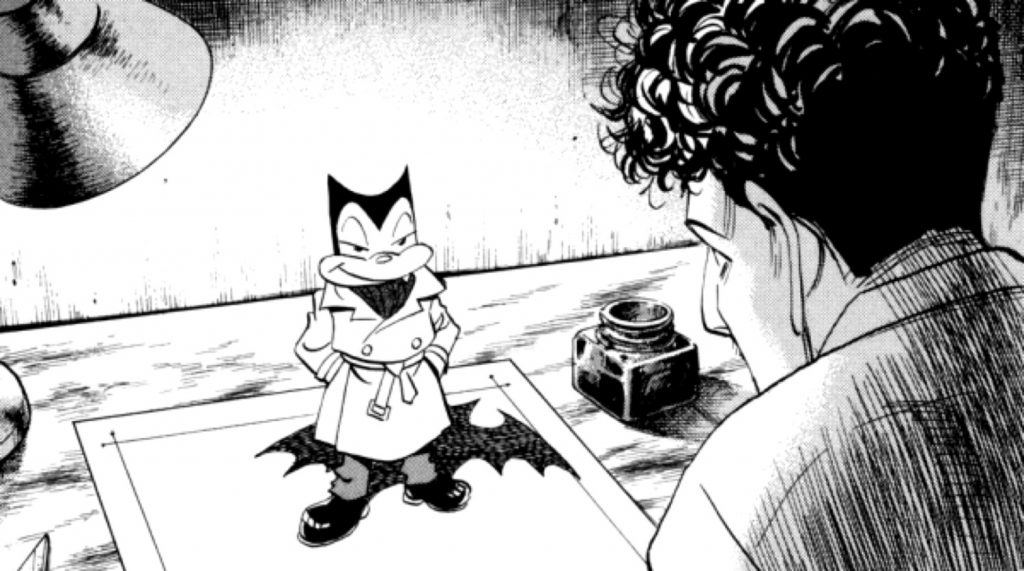
It all began with one of those odd moments when the mind recognizes something that had always existed but had never been clearly perceived. It wasn't reading a bulky academic manual or an old philosophical treatise. It involved reading a manga. Billy Bat. And it wasn't just any part of the narrative; it was specifically the scene in which Kevin Goodman converses with Billy, the Billy from that universe who resembles a god.
On the surface, the scene appears straightforward, but when you consider it calmly, it becomes peculiar. Kevin essentially tells Billy that he is mistaken as he looks at him. It is neither a childish act of rebellion nor an attempt to pose a challenge to God. It's more subdued. Kevin declares his desire to see the world. He wants to discover the true nature of the world. wants to examine reality before embracing any prefabricated solutions.
Additionally, this seemingly insignificant choice in the manga conceals a profound concept.
Because at that point, the discussion starts to touch on something much more profound: the dream. Not the empty fantasy people use to escape reality, nor the childlike dream. However, Kevin refers to it as the art of dreaming. Dreams that come to you when you're alone. That vision of the future that already exists in the soul but is not yet visible in the world.
These dreams frequently occur without the person having any plans, which makes them intriguing. They just exist. like a potentiality.
They can be absurd at times. They are not always feasible. They can appear totally detached from reality at times. Nevertheless, human hope frequently starts to exist in these exact locations.
Kevin comes to the realization that dreams are a sort of laboratory of hope, something that many people overlook. that which has not yet occurred but is already conceivable to the human mind. And such an imagination can spread throughout the entire world when it finds time, discipline, and action.
Such instances abound in human history.
Decades later, an idea that seemed completely pointless when it first emerged in someone's mind ends up reorganizing entire civilizations. It is occasionally a scientific finding. Sometimes it's a piece of art. It can be a philosophy at times. It can be a religion at times. Sometimes it's a small, straightforward act of morality that catches on like wildfire.
Billy Bat is a perfect fit for that concept.
Kevin and Billy's exchange is more than just a dialogue between a fictional god and a character. It is a meditation on the essence of human creativity. Kevin comes to the realization that dreams, despite their seeming absurdity, can have a great deal of potential. They are things that have already started to exist in someone's mind but do not yet exist in the real world.
The narrative may alter if that dream finds someone who is prepared to see it through to the very end.
The story reaches a nearly symbolic point at the end, following that scene of devastation caused by war. A boy and two men remain. The world has been devastated. The future appears to be empty. Nevertheless, the boy says something that appears juvenile at first.
He claims to be able to save the world.
In an academic debate, someone would likely be made fun of if they said that. Someone would be viewed as naive if they said that at a political gathering. However, there is something very human in that scene.
Because, deep down, this is how nearly every major historical change started. with someone having faith in an unrealized concept.
This is explored in an interesting way by the Billy Bat manga, which incorporates symbolism, metaphysics, conspiracy, and actual history into a single story. Billy's persona endures across generations as though it were a symbol of humanity. Occasionally, as motivation. Occasionally, as a tactic. Occasionally, as hope.
Kevin ultimately reveals something significant by challenging this symbol: humanity is not limited to concrete facts. Additionally, it survives on stories, symbols, and dreams.
However, a dream that has the potential to come true differs greatly from an empty fantasy.
The desire of fantasy is to get away from reality. The dream aims to change the world.
Anesthesia is what fantasy is. The dream is an undertaking.
Kevin understands that if a dream is communicated, it can become a reality when it originates from the deepest part of the soul. if it's written. if it's shared. if it is experienced. This is how human history frequently proceeds: someone imagines something that doesn't yet exist, and over time, other people start to believe in that possibility.
The impossible starts to lose its power when this occurs.
For this reason, I began to look at that Billy Bat scene with a certain amount of surprise. not only as a piece of fiction but also as a potent allegory for humanity. the notion that there is always a place in the human mind where future events are sketched before they actually happen.
Kevin refers to this as a dream.
However, that can also be referred to as hope when viewed calmly.
Furthermore, genuine hope is never merely an emotion. It's a choice. It's someone who, despite the state of the world, believes that there is still something worth fighting for.
Perhaps that's precisely what that final picture implies. In front of a world in ruins, two men and a boy. Additionally, the boy promises to save it.
Not because he is so powerful.
However, why is it still necessary for someone to think that the world can be saved? Perhaps it can.
