


The Day Life Made Sense: My Encounter with True Evil
It was neither a blind ecstasy nor a sentimental consolation, but the moment when logic and soul finally ceased to contradict each other and revealed that truth can also hurt before it saves. This is the story of a conversion that did not arise from the escape of reason, but from the clash between the most intimate human experience and the uncomfortable evidence that life only finds meaning when reality is taken to its end.
Gabriel G. Oliveira
3/31/202644 min read
The Day Life Made Sense: A Conversion from Logic and the Human Soul
I clearly remember the day when life finally began to make sense. It wasn't a mystical flash tearing thru the sky, nor an immersive soundtrack, much less that sentimental theater that many like to call a spiritual experience. It was even worse. It was logic manifesting itself at a moment when I was already exhausted from ignoring it. Up to that point, my journey had been similar to that of many honest people who try to believe without being deluded: a kind of unresolved spiritual tourism, where one participates in a ritual, makes a sincere request, waits for a sign, a minimal noise from the other side, and nothing. Try again. Wait more. Nothing more. After traversing this circuit countless times, the soul begins to whisper what the mouth still hesitates to assert aloud: perhaps all of this is nothing more than chance disguised as religiosity. And this was not considered blasphemy. It was mental fatigue. I had never witnessed anything from the spiritual world in such a way that the material reality could be considered at the same time, and without this foundation, faith began to resemble an emotional bill delivered without a receipt.
For a long period, the position was simple, straightforward, and even sensible: if nothing manifests, perhaps nothing exists. It is a severe conclusion, but severity is not a flaw when the available evidence seems to lead to it. What changed this did not arise from abstract theory, a desire for belonging, or an emotional need disguised as devotion. It originated from practical and concrete experiences, shared with my father in specific rituals. I won't embellish the situation to make it spiritually sophisticated. It was not pleasant. It was not a pleasant experience. It didn't have a cinematic quality. It was strange, uncomfortable, and almost offensive to our expectation of normalcy, and it was precisely for this reason that it became difficult to deny. That's where it began for me, something that has always held more value than any automatic religious fervor: investigation. Not the attitude of someone who investigates to validate what they already desired, but genuine research, the kind that shakes everything up.
I began the study of religions as if I were disassembling an old clock. Without haste, without hatred, without the vulgarity of wanting to finish before understanding. I have experienced Buddhism, Hinduism, ascetic practices, monks who mutilate their own bodies in methodical silence, altered mental states, disciplines that push biology to the brink of collapse and then call it enlightenment. Without a doubt, all of this is remarkable. In certain cases, it is even admirable from a technical standpoint. However, it still seemed to fit, with more or less difficulty, into a field that biology, psychology, and the humanities can at least attempt to understand. Nothing there compelled me to tear apart science books or declare reason bankrupt. The cases that really started to bother me were those that disrespected the agreement of a quick explanation and intellectual comfort.
It was at that moment that the incorruptible bodies of the Catholic Church dealt the first more elaborate blow to my skepticism. The standard explanation always carried the lazy arrogance of those who believe that understanding a problem is the same as solving it in two sentences: temperature, humidity, soil, favorable conditions, period. However, the problem did not end there. Some of these bodies are in hot places, others have been moved, manipulated, and exposed to different environments, and even after decades and centuries, they persist in disobeying in a nearly didactic manner what human flesh should do. Not even iron possesses this heroic resistance. The minerals wear out. Wood surrenders. The meat deteriorates. When the explanation remains unchanged despite changes in the facts, that is not science. It's stubbornness disguised as technical language.
The discomfort grew with the emergence of documented reports of tissues with living cells and bones that exhibited characteristics of flesh. The subject quickly left folklore and entered a more risky field, as doctors, experts, and researchers were called to investigate such cases, and some ended up converting. Not because they were seeking a miracle to fill an emotional void, but because they did not find a solid scientific explanation that did not seem improvised. At that moment, the usual skeptic reacts predictably: they minimize, relativize, create an ad hoc hypothesis, adjust the language, and leave with the feeling of having won. The curious, and at the same time sad, thing is that, in the absence of a complete explanation, the skeptic usually transforms into the person who starts creating conspiracy theories with the same intensity with which, five minutes earlier, they claimed to detest anything of the sort.
The same pattern was observed again with the Eucharistic miracles. The host transformed into flesh, the blood classified as human, usually type AB, the evaluation conducted by independent laboratories, the gathered documentation, the rising embarrassment. And then the automatic response would emerge: illusionism, contamination, methodological error, excessively creative microorganisms, unidentified fraud, some hastily created fantasy to avoid an undesirable conclusion. A possible explanation, but never a sufficient explanation. The bitter irony is that, over time, many well-meaning pagans have seemed more sincere to me regarding the idea of miracles than some Christians who dedicate their lives to asserting that "only the Bible matters." When reality begins to challenge the individual's personal theology, it is considered false. It is impressive how the human being can label as fidelity something that is actually just an attachment to their own interpretation.
It was at that moment that I realized something unpleasant: in many cases, the problem was not a lack of faith, but an excess of intellectual pride disguised as piety. The automatic resistance to everything that strengthens the Catholic Church did not result from a thorough investigation, but from an emotional need for denial. Tradition became an enemy before it was even read, the miracle was considered a fraud before it was analyzed, and any serious study became suspect the moment its conclusion went against the observer's desire. This is called zeal, doctrinal purity, and critical spirit. Often, it is just metaphysical obstinacy. Metaphysical stubbornness is one of the most sophisticated manifestations of vanity, as it manages to appear virtuous while ignoring reality.
It was at that moment that the study became more serious, bringing with it the classical trail from which Western thot tries to distance itself, but without success: Socrates, Plato, Aristotle, and inevitably, Thomas Aquinas. Not as a museum or an erudite decorative element, but as an analytical approach. In this context, philosophy ceases to be a club of intelligent opinions and resumes its true function: to be an instrument of discernment. The five ways are neither devotional artifices nor magical demonstrations to impress impressionable young people; they are rigorous deductions based on act, potency, cause, contingency, and purpose. So far, when someone tries to "refute" them seriously on social media, there is almost always some basic conceptual error, a confusion between essence and accidentality, or a mix-up between the nature of what it is and the way it can be used.
This confusion is more frequent than one might imagine and is present in various contexts, especially in the superficial moralism of our time. The example of the atomic bomb is instructive precisely because it is impactful. The individual considers it an absolute evil, as if the very matter possessed an intrinsic morality, as if the object already arrived in the world with an intention. However, the same components can be used both in cancer treatment and in protecting the Earth from an asteroid. The error does not lie in the thing itself, but in human action, intention, application, and the will that directs it. Aristotle addressed this type of issue more than two thousand years ago, but contemporary man tends to simulate complexity where, in reality, there is only mental disorder and philosophical laziness.
The same happens when someone states, with the solemnity of someone who believes they have said something brilliant, that "guns kill." No. Individuals commit homicides. Weapons also protect innocent people, support families, preserve lives, and prevent attacks. Evil does not reside hidden as an essence within the object, waiting for the opportunity to emerge like a cartoon demon. The disorder in human actions is what causes evil. Denying this distinction is not a demonstration of superior compassion, but rather a lack of intellectual effort. When morality is reduced to pure subjectivism, everything becomes a mere emotional accident, and intelligence begins to operate against reality. Man begins to feel instead of judge and subsequently calls this feeling a universal criterion. It is a sophisticated machine of self-deception.
Following this line to the end, the conclusion became almost irritatingly predictable. If you take Socrates seriously, you will eventually bump into Plato. If Plato is taken seriously, Aristotle is reached. By taking Aristotle seriously, one encounters Thomas Aquinas. And, if you take Thomas seriously, sooner or later you will encounter Christianity, whether you like it or not. Not for social convention, nor for family influence, nor for community necessity, but for intellectual solidity. Chesterton stated that "a heresy is a truth that has lost its mind," and many contemporary criticisms of faith seem to be exactly that: a truth decontextualized and isolated until it becomes a caricature. The individual preserves one half, eliminates the other, and then is surprised to realize that the body is dead.
Therefore, my conversion was not a blind leap into the void. It was even more humiliating. It was an inescapable slip into reality. Faith did not eliminate reason; it gave it a new foundation. It did not make me less discerning, less inquisitive, or less attentive to errors. Instead. And the simplest advice I can offer, precisely because it is unpopular, is the following: be wary of easy answers, whether they are of a religious or skeptical nature. In general, when someone rejects a conclusion without first evaluating it, it is because it comes too close to the truth and begins to touch the part of the soul that prefers to maintain control of the show.
It's no wonder that many people approach this topic already showing fatigue. Nowadays, the word "miracle" has become almost an automatic joke, one of those that the materialist repeats without thinking. Even so, there is an almost comical curiosity when the subject turns to bodies that do not decay and hosts that bleed: even the most confident start to cough. It is not, of course, a refutation. It is merely the noise of that moment when reality deviates from the plan and forces the individual to improvise.
The contemporary atheist tends to assert, with the tranquility of someone who considers themselves capable of unraveling the cosmos, that everything is natural and merely awaits an appropriate scientific explanation. It is a curious faith: to trust more in the science that is yet to come than in the science that already exists. The question arises when certain facts persist in remaining where they are, being analyzed, measured, photographed, reexamined, and remain there as a displaced element, a scene error that no one can eliminate without dismantling the entire stage. If everything can be explained, why are the explanations never complete? And why do many of them seem to arise more from the fear of the conclusion than from the analysis of the facts?
When it performs its work effectively, science describes the "how" with impressive precision. That's already quite enough. However, it rarely dares to address the why, and it is precisely at this point that the pain begins. Regarding the incorruptible bodies, the reports mention the lack of embalming, preservation of tissues, surprising flexibility, and integrity that defies the notion of elapsed time. They record events, not miracles. And the Church, instead of behaving like the caricature that society has created, tends to be more cautious than critics would like to acknowledge. The term "miracle" is not bandied about indiscriminately; it is usually the result of years of research. It is deliciously ironic that many men who consider faith irrational fully trust negatives that they cannot prove.
Consider Saint Bernadette Soubirous, who passed away in 1879. The body was exhumed in the years 1909, 1919, and 1925. In all these situations, he was found preserved, even after being buried in moist soil. Medical examinations found no artificial preservatives, and skin and muscles remained intact. The skeptical explanation mentions favorable natural conditions, as if nature had decided to do a selective courtesy exactly at that point, with a precision that almost suggests intention. If that doesn't raise even a single eyebrow, it's hard to imagine what could truly awaken intelligence.
The same discomfort is observed in Saint Catherine Labouré, whose body was exhumed in 1933 and found with preserved eyes, nails, and tissues, without a truly satisfactory pathological explanation being presented. Or in Saint John Vianney, whose body, when exhumed in 1904, showed preserved soft tissues, despite not having been embalmed. Science documents, describes, and classifies. And then it remains silent. The subsequent silence is often filled not by a serious conclusion, but by a hasty assumption, as if it were enough to utter something in a technical tone for the mystery to dissipate out of embarrassment.
Saint Teresa of Ávila further complicates the situation. In 2024, after 442 years, her body was re-evaluated and found in the same condition described in 1914. Four centuries generally do not show this kind of mercy toward human flesh. Still, there it was, like an argument that refuses to age. Saint Francis Xavier, who passed away in 1552, shows partial preservation even in a humid tropical climate, which would already be enough to challenge any basic decomposition manual. Moreover, there is the recent case of Sister Wilhelmina Lancaster, who passed away in 2019 and was exhumed in 2023, showing no signs of putrefaction, even in a simple and unsealed coffin. When a phenomenon manifests over centuries, crossing continents and different conditions, the word "coincidence" begins to seem like a sophisticated outfit worn by a completely worn-out idea.
The tension increases even more as it moves from the silence of bodies to the scandal of blood. Eucharistic miracles have always posed a particular challenge to Protestantism, as they directly address the issue of transubstantiation. It is not just a symbol, but a concrete presence, and this is the idea that leads a person to choose between thinking it thru to the end or returning to the more comfortable ground of metaphor. In the 8th century, in Lanciano, a host supposedly transformed into flesh and blood. In 1971, the doctor Odoardo Linoli detected human myocardial tissue and blood type AB, without the addition of preservatives. These discoveries were confirmed by the World Health Organization in 1976. And the most disturbing fact remains unchanged: the material remains preserved after more than a thousand years. If this is true, why do so many people still act as if the only elegant solution is to ignore it?
Frederick Zugibe, forensic pathologist, examined similar cases in Buenos Aires from 1992 to 1996, identifying human heart tissue under stress, live white blood cells, and AB type blood. In 2006, Tixtla, Mexico, exhibited human blood containing DNA and hemoglobin. Sokólka presented, in 2008, human heart muscle intertwined with bread. In 2013, Legnica presented heart tissue in a state of agony. In all these circumstances, science did what it was supposed to do: it recorded the fact. What was not possible was to justify the reason why that happened. And denying that it is a miracle can be a viable option, but it is important to call things by their name: it is, at the very least, a philosophical choice, not a definitive scientific conclusion.
There are those who consider all of this a devotional exaggeration, as if faith tends to create problems for serious people to solve later. It is interesting to note that it is usually the same people who accept improvised explanations without question, when the option would be to acknowledge something that contradicts their personal theology. The materialist dismisses it because it doesn't fit into their worldview. The Protestant refuses because it interferes with his symbolic interpretation of the Eucharist. Both seem to agree on a very specific point: if something is advantageous for the Catholic Church, there must be some trick. This does not represent neutrality. It is a prior decision disguised as analysis.
The set of miracles accepted or at least analyzed by the Church strictly maintains this standard of cautious prudence that various critics pretend to ignore. Lanciano, Buenos Aires, Tixtla, Sokólka, Legnica. Bernadette and the other incorrupt bodies. In Lourdes, more than seven thousand cures have been documented, of which seventy were considered miraculous after rigorous medical examinations. The tilma of Our Lady of Guadalupe has remained intact for almost five hundred years, without the identifiable presence of pigments. The Miracle of the Sun in Fatima was witnessed by approximately seventy thousand people, including secular journalists. In all these cases, the sequence was as follows: observation, examination, factual confirmation, and finally, theological interpretation. It is a more intelligent order than the caricature of fanaticism generally recognizes.
No one is obligated to have faith. This must be emphasized to prevent the hysteria of those who confuse the recognition of the problem with the imposition of a conclusion. However, denying without investigating is also an act of faith, just inverted and less honest with oneself. Chesterton noted that "the modern world is full of old Christian virtues that have gone mad." The phrase is quite explanatory. Distrust, without caution, turns into cynicism. Caution, without courage, turns into automatic refusal. And we continue to demand proof while ignoring the existing evidence, like petulant children who demand confirmation that the sun has risen, looking at the ground.
The life lesson, and not just in theology, that I took from this is very simple to please the sophisticated: if a fact persists for centuries, crosses cultures, survives different methods of analysis, and withstands hasty dismantling, perhaps the problem is not with the fact, but with the way we insist on interpreting it. Reality, on some occasions, is more obstinate than theories. And this, instead of being a scandal, can be an invitation. The problem is that the invitation to the truth is rarely made delicately. Almost always, it arrives interfering with mental organization.
And, in mentioning Chesterton, I admit that I do so as one makes space in the room for someone greater than the environment itself. Not out of adoration. Out of caution. Some men demand that intelligence reassess the dimensions of the environment before passing judgment on them. Chesterton fit this profile: apologist, novelist, essayist, polemicist, and, to the constant irritation of his critics, a dangerously cheerful individual. While much of contemporary thot sees reality as a statistical error to be corrected by intellect, he started from a more unsettling suspicion: if the world seems too strange, perhaps the problem lies in our way of looking at it, not in the world itself. Just that is enough to wound half of contemporary pride.
Generally, we consider intellectual maturity to be equivalent to universal suspicion. The person starts to distrust everything and believes they have matured. Chesterton noted that, often, this is nothing more than a sophisticated form of laziness. The modern man, conditioned by a superficial version of critical thinking, finds himself entangled in the tensions between faith and reason, order and freedom, discipline and joy, concluding that everything is incoherent. On the other hand, Chesterton observed these tensions with the wonder of a child before a well-executed magic trick. In Orthodoxy, he asserts that modern rationalism loses its reason by trying to accommodate the infinite within its own mind, while the poet merely asks that the mind grow enough to reach the heavens. The phrase seems almost too simplistic. And that's exactly why it hurts. If this is true, why do we spend so much time restricting the sky instead of expanding the mind?
For this reason, Chesterton considered fairy tales more serious than some historical books written by people who, before investigating anything, had already decided that nothing extraordinary could be true. He noticed something disconcerting: legends generally arise from the healthy common sense of entire communities, whereas many books considered scientific are merely the exaggerated solitude of an individual overly confident in their own ideas. It was not an attack on reason. It was an attack on pride camouflaged as logic. And by stating that fairy tales do not teach children that dragons exist, for they already have that certainty, but rather that dragons can be defeated, he exposes something that our society strives to conceal. We call this naivett precisely when we abandon the fight against any real dragon, whether it be of a moral, spiritual, or intellectual nature.
For Chesterton, the ability to laugh at oneself was not a personality adornment, but an indication of sanity. Long before popular motivation turned self-confidence into a product, he had already understood that excessive confidence is not a virtue, but a symptom. In The Eternal Man, he asserts that the madman is not the one who has lost reason, but rather the one who has lost everything except reason. It is a splendid description of the intellect that bends upon itself, closed to correction, tradition, and reality. In this state, intelligence is not lost due to a lack of information, but due to an excess of arrogance. And just look around to see that this is not a rhetorical exaggeration. When did healthy self-doubt become considered a sin, while mental arrogance came to be seen as independence?
This criticism, which is one of Chesterton's most sincere characteristics, spares no one. Neither professional skeptics nor poorly prepared religious individuals. He showed particular impatience toward what he called the "ill-mannered Christian," an individual who never understood his own faith, abandons it out of pure hereditary boredom, and begins to attack it with arguments he does not understand now and would not have understood even when they were new. It is the deteriorated middle ground that corrupts everything. The sincere pagan, according to him, tends to be more capable of fairly evaluating Christianity than one who is caught between poorly assimilated catechesis and resentful disbelief. And his conception that "a heresy is a truth that has gone mad" helps to understand the reason. An isolated virtue is extremely dangerous. The truth becomes cruel when there is no charity. Charity devoid of truth turns into sentimentality. And no one lives solely at the extremes without eventually becoming a caricature of themselves.
In The Man Who Was Thursday, this perspective transforms from argument into adventure. The book begins with a quest against anarchist chaos and concludes with a lesson on humility, friendship, and the almost agonizing revelation that the true terror was not the danger, but the solitude. Gabriel Syme believes he is surrounded by enemies until he understands that the difference between being alone and having a single ally is an almost indescribable abyss. Chesterton employs this to defend, in a surprisingly unsentimental way, fidelity, monogamy, and communal living. In contrast to the current illusion of infinite choices, he suggests a surprisingly simple mathematics: two is a thousand times one. And if this sounds like a limitation to contemporary sensibility, it is pertinent to question why all societies, at some point, return to fidelity as a requirement and not merely a whim.
Whoever thinks that Chesterton despised modernity actually did not understand either modernity or him. He had a profound understanding of modernity, even more than many of its enthusiasts. It was observed how distorted Christian virtues, such as humility, were displaced from their original position. The contemporary man has stopped questioning himself to question the truth, coming to trust blindly in his own person. It is a fatal inversion. Despite its historical flaws, the religious tradition has acted for centuries as a brake against something more serious than common error: the ability of intelligence to self-destruct. When language is dismantled, grammar made relative, and reality seen as an arbitrary social construct, the result is not freedom. It is a mental disorder applauded by the public. Orwell warned that language not only corrupts thought, but thot also corrupts language. And yet we continue to play with dismantling words as if we were taking apart a toy, not the tools with which we evaluate the world.
In the end, Chesterton presents a rule too simple to please those addicted to empty sophistication: love reality before trying to change it. The small man detests the world and seeks refuge in abstractions. The great man loves creation, including its imperfections, and that is why he is able to transform it without destroying it. One lives in denial. The other lives in gratitude. Dostoevsky stated that hell is the anguish of being unable to love again. Chesterton chose the opposite path: to love the world with clarity, to laugh at his own pretension, and to remember, amidst the hysteria of time, that everyday life is the true miracle. And perhaps the most difficult thing to accept is precisely this: the truth does not always come like a bolt of lightning. Sometimes, it presents itself as logic. Sometimes, it appears as a body that does not decay, blood that should not be there, an argument that does not yield, an author who dismantles the reader's vanity, or that uncomfortable feeling that, after fighting intensely against the real, the real triumphed with the tranquility of someone who was never in a hurry.
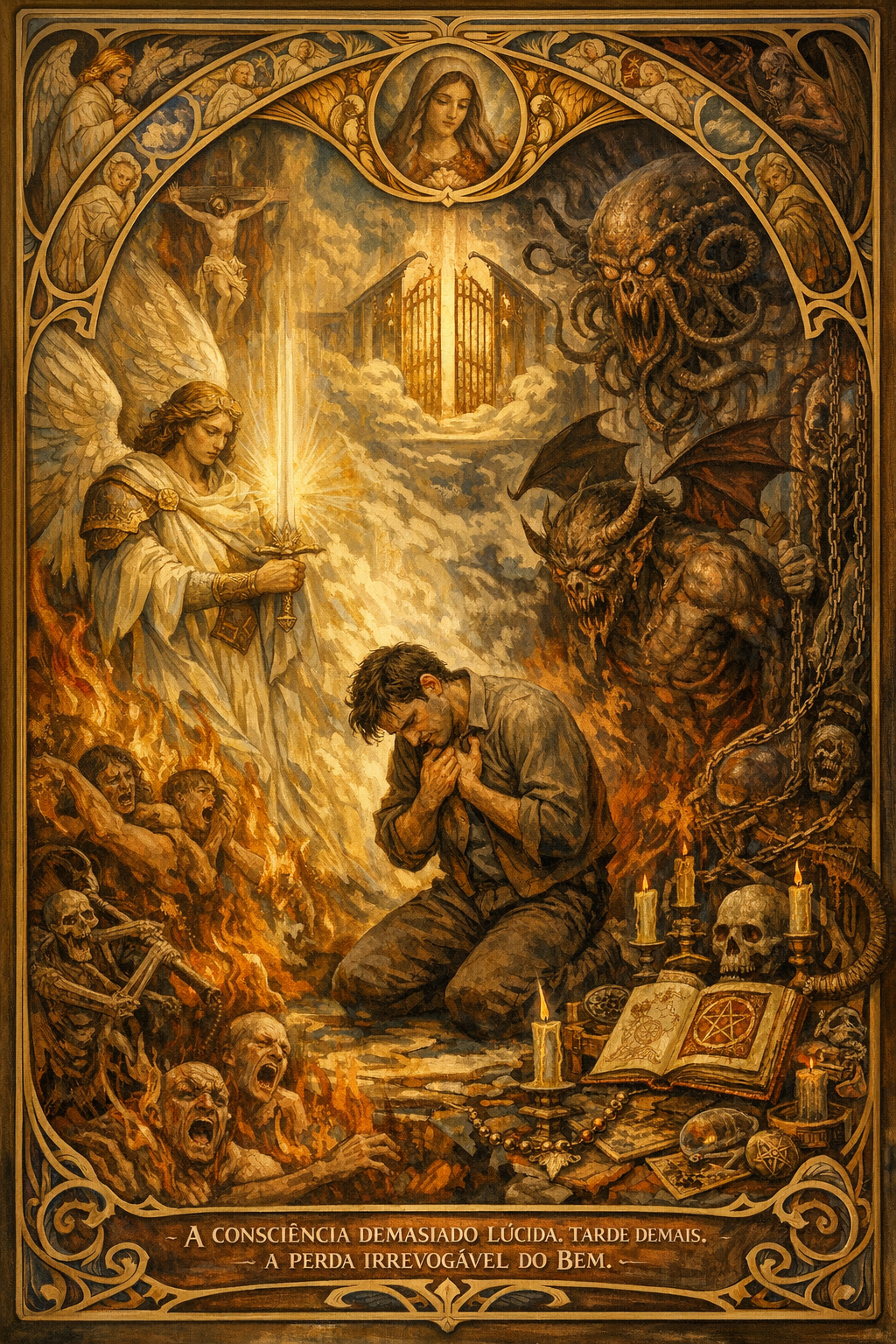
There are subjects that do not tolerate superficiality, and evil is one of them. There are things that, when said with excessive delicacy, begin to rot in the mouth before they are even heard. Catholic doctrine, at least in this aspect, had the dignity not to turn hell into a therapeutic metaphor for contemporary souls who need to simplify everything into symbols to avoid succumbing to reality. In numbers 1033 to 1035, the Catechism of the Catholic Church presents hell as a reality, not as a literary device or an educational image for impressionable children. It is not an allegory, nor a psychological projection, nor a disciplinary creation of clerics with punitive imagination. A truth. A permanent state of separation from God is chosen by the rational creature who dies in mortal sin without repentance. And the greatest pain, that is the part that the weak spirit always tries to hide. It is not the fire, although tradition mentions it seriously, as if one does not joke with such images; the greatest pain is the loss. It is the clear but belated awareness of having chosen to reject the Absolute Good of one's own accord. If this seems severe, it may be because human freedom is much more serious than current sensibilities are willing to accept.
Christ mentioned hell so frequently that it would scandalize many of today's domesticated Christians. He mentioned weeping and gnashing of teeth, eternal fire, and irreversible exclusion. He did not express himself in a threatening manner to impose control. He spoke like a doctor who rejects superficial sentimentality in the face of a lethal disease. The classical perspective never considered the main horror in arbitrary punishment as if God were inflicting torment on a whim, but rather in the logic of unrequited love. In the Summa Theologiae, Saint Thomas Aquinas states that, once determined to its ultimate end, the will does not change anymore. The eternity of hell is not an act of cosmic sadism. It is about the irreversibility of the decision. And here arises the first practical truth, which many would prefer to replace with a superficial motivational slogan: considering evil as folklore is one of the most effective ways to prepare the soul for irresponsibility.
The exorcists, men generally less tolerant of fantasy than internet critics assume, defend something even more shocking to contemporary imagination: the devil is not a symbol. It is not a metaphor for the inner shadow. It's not about poetry with a moral. It is a personal entity. A fallen angel, true, intelligent, dynamic, and hostile. Acts under divine permission, not as a rival to God, which would be theologically absurd, but as a parasite of human freedom. The Catechism clearly states that Satan "opposes God and His plan of salvation" (CCC 395). And the demons, immersed in the state of hell, detest themselves, detest God, detest good, and any sign of order. This hatred serves not only as a means of their punishment. It is the punishment itself. It is interesting to note that the same society that mocks the notion of personal evil is scandalized to find that evil in the real world does not manifest merely as an accident, but also as a method, a persistence, and an organization.
The mystical tradition, approached by the Church with due caution, characterizes hell as a state of conscious suffering, spiritual and, after the resurrection of the dead, also physical. Dante, despite his immense greatness, is considered didactic in comparison with some ascetic and hagiographic accounts. The center of horror does not lie in the visual spectacle of suffering, but in the irreversible nature of loss. The soul knows. That is the intolerable point. He knows he could have chosen the good. He knows he had autonomy. He knows that he rejected what supported him. And is aware that he lost everything. C. S. Lewis summarized this with the elegant coldness of someone who understood the essence of the problem: "the doors of hell are locked from the inside." If this is true, and I see no reason to consider it just a catchphrase, why do we still reduce moral decisions to administrative details of life, as if they were simple modifications to the spiritual curriculum?
It is at this moment that the modern imagination, which cannot approach theology seriously, generally resorts to cosmic horror. And not without reason. H. P. Lovecraft, despite not being a theologian and being far from it, approached, albeit in a distorted way, a true intuition: there are experiences in which the human being encounters something so hostile, so disproportionate, and so metaphysically wrong that the mind cannot process it without eventually breaking. Cthulhu, Nyarlathotep, Azathoth, and all that abyssal fauna are not demons, obviously, but literary representations of the notion that there are horrors beyond human comprehension. The main distinction is that, in Christianity, evil is personal, moral, and responsible; whereas in Lovecraft, it is amoral, indifferent, and blind. August Derleth sought to moralize this chaos, categorizing it into good and evil, almost as if he were organizing a morgue with labels. Lovecraft never had faith in that. His gods were indifferent entities. On the other hand, Christian theology faces something even more serious: evil is not indifferent. Evil hates.
Even classical angelology shocks the sweet sensibility of contemporary imagination. The angels present in the Scriptures and in the patristic tradition share much more in common with cosmic awe than with the ornamental cherubs of late religious art. Isaiah is terrified before the seraphim. Ezekiel submits before entities that defy any zoological, esthetic, or psychological categorization. The main difference does not lie in the peculiarity of the form, but in the orientation of the intention. Angels are formidable because of their goodness. The demons are terrible because of their wickedness. Some oppress man in the name of holiness. Others, due to corruption. The beauty of the first purifies; the ugliness of the second deforms. What the modern imagination lacks is not the acceptance of horror. It is about the category of the sacred. And without the category of the sacred, everything becomes just strangeness, which is a particularly foolish form of blindness.
For this reason, the Church always approaches occult practices found in grimoires such as Picatrix, the Book of Raziel, the Sword of Moses, Grimorium Verum, and the classical Goetia with seriousness. Not out of hysterical moralism, nor out of ignorant fear of the unknown, but out of a realism of anthropological and metaphysical nature. The condemnation of Enochian operations linked to John Dee precisely indicates this point: it is not about denying the occurrence of certain phenomena, but about warning about the consequences of their pursuit without a legitimate order, without authority, without moral purification, and, above all, without humility. Human experience, before being completely corrupted by the superficial psychologization of everything, is aware of this: intentional exposure to evil fragments, depersonalizes, and makes one ill. Theologians and psychiatrists, each in their own language, have already addressed cases of mental collapse after participation in rituals. There are doors that were not designed for curiosity. There are thresholds that, once crossed, do not close without inner blood. Uncritical spiritual curiosity is not courage. It is recklessness disguised with sophisticated vocabulary.
This also explains why hell is not a place for divine sadism, just as heaven is not a golden monotony created by exhausted and spiritually empty minds. In Catholic theology, beatitude represents the complete fulfillment of being, the beatific vision, and unlimited participation in the Good. It is not about possessing everything like someone who accumulates objects. It's about being complete. And when someone claims that this seems tedious, it says nothing about heaven, but a lot about the size of their own emptiness. On the other hand, hell represents total loss, where the creature exists without the foundation of its own meaning, immersed in hatred, despair, and the constant awareness that it chose to amputate its own destiny. Dante crafted the map with mastery. Christian tradition indicates that the real topography is even deeper and more terrifying. And it is not the product of a sick imagination. It is about seriously considering what freedom represents when it ceases to be a mere verbal expression.
In the end, it all comes down to such a simple guideline that, for that reason, it is often ignored: take good seriously and treat evil with caution. Not because of some forbidden charm of evil, that superficial seduction that attracts teenagers and adults who remain teenagers inside, but rather because its essence is destructive. The universe is not morally neutral, the human soul is not a useful metaphor, and Fyodor Dostoevsky captured with surgical precision the consequences of removing God from the ontological horizon: "if God does not exist, everything is permitted." And the result of this is not freedom. It's disaster. Christian faith does not require flirting with the abyss to demonstrate bravery. It calls for the choice of life. And this decision, reiterated in daily life, is the only concrete barrier between the human being and unmasked horror.
I write this with the altered sensitivity of someone who has been where many still pass thru with the apparent calm of the untouched. Everyone starts the same way. No one starts a process with the intention of being destroyed. Initially, we call this curiosity, search, or intellectual courage. It's always that way. When it has not yet been confronted by reality, intelligence tends to believe it operates like a spiritual helmet. The individual believes that method protects, that bibliography shields, that internal structure replaces virtue. It is an almost charming error in its innocence. The abyss tends to attract organized men. He is not intimidated by either remissive indices or a good memory.
There was a time when I confused erudition with immunity. Today, that phrase seems so absurd to me that it almost becomes funny, but at the time I lived it, it was no laughing matter. I was convinced that ancient systems, when properly understood and combined, could be treated as rigorous equations and obedient architectures. I started without resentment toward the good. This is relevant. I did not start out of aversion to God nor out of a romantic fascination with the grotesque. I started with that innocent curiosity in appearance, the same that precedes many of the greatest tragedies of intelligence. Hygromancy and the Clavicles of Solomon in their most traditional form attracted me precisely for that reason: they gave the invisible an appearance of order, hierarchy, and legality. Exact seals, restricted operations, an almost legal grammar of the occult. Everything seemed to be serious, solemn, respectable, almost religious in its discipline. The error loves to disguise itself as truth.
Then came the temptation of synthesis, that ancient ailment of the man who reads too much and judges prematurely. I added the Picatrix to the Solomon-like edifice. The Picatrix, a medieval astrological-magical treatise both sophisticated and morally ambiguous, expanded the mechanism with an irresistible appearance of technical depth. The amulets transformed into hybrids, seals linked to planetary correspondences, symbolic layers upon symbolic layers, all very ingenious and coherent within the system. They operated. I have no interest in lying to seem more serious than I really was. They operated. They produced results. However, everything that causes an effect without requiring an internal transformation later demands a high price with interest. The technique enchants precisely because it does not require purification. And that should already be enough as proof of condemnation.
With these artifacts, I reached further. Not thru the classic Goetia in its most well-known version, but thru entities connected to the Qliphoth, those dark layers of the Tree of Life that many fools approach as if they were visiting a museum of exotic symbols. I had created a personal system, inventive and excessively refined to be healthy. Today, I would call it by the name it deserves: technical arrogance. At first, everything seemed to follow an almost moral direction, which is the most effective form of deception. I thot I was warding off evil influences from individuals who, with more maturity and compassion, could be seen merely as bearers of human pain, common traumas, and the usual scars of a wounded soul. However, in certain situations, it did indeed seem that there was something displaced, trapped, that was inappropriately connected to the environment and the people. I began to use Kabbalistic methods to bind these entities to objects, as if I could tie metaphysical disorders to matter and control them thru symbolic engineering. The objects transformed into sources of disturbance. Causes of pure confusion. And the lesson, which I only understood after suffering for it, is brutally simple: everything that is sought to be controlled without legitimate authority turns into distortion.
The rupture occurred when I invoked one of those lesser entities associated with the Qliphoth, bearing a particular seal mentioned in the Grimorium Verum. To claim that it simply appeared is an understatement. To say that it manifested is being too polite. What burst forth does not fit into a common classification without the entire language feeling violated. Calling it a horned bat would be a subtle lie, one of those that men invent to psychologically cope with what they cannot name. What emerged from the smoke possessed that characteristic which Lovecraft, in his most brilliant moments, captured with monstrous precision: it was not just horrible. It was incorrect. Ontologically incorrect. Metaphysically offensive. The eyes attested to the presence, but the mind refused to accept it. It was not a creature. It's a violation. At that moment, I understood physically, not conceptually, what Lovecraft meant when he stated that "the oldest and strongest emotion of mankind is fear, and the oldest and strongest kind of fear is fear of the unknown." However, the unknown was not just a lack of explanation. It was an exposed injury to the very structure of reality.
The banishment was chaotic. One did not see that imaginary elegance suggested by the books. The final words came more as a reflex than by control. I haven't achieved anything. I only managed not to be completely consumed. And, from that point on, nothing was the same. It is important to state this clearly, as pride tends to rewrite the past to make it seem less shameful. I continued. I persisted like the reckless who escape the first catastrophe and confuse survival with license. I incorporated the Sword of Moses into the Clavicles and the Picatrix. I concentrated everything into dense amulets, filled with symbols and layers too many for any soul that still wished to remain intact. Next, I progressed to the Book of Secrets, a deceptive text in which entities described as angels promise abilities beyond human capacity. The allure was equivalent to the risk. It's always like that. Evil rarely manifests itself in a vulgar manner. It prefers the threshold of the sublime.
It was at that moment that the body became part of the equation as an accomplice and witness. Jumps of three to four meters without harm. Embers maintained without causing burns. I do not state this with pride. I express this with a bitter perplexity. None of this made me better, fairer, purer, truer, or more human. It only made me more audacious in the worst sense, more prone to interpreting exception as permission. Saint Augustine hit the nail on the head when he stated that "miracles do not change the heart; they only reveal it." These episodes did not demonstrate wisdom in me. It was a morbid curiosity, taken beyond the limit where the mind remains clear, but the soul had already begun to corrupt. And almost no one notices that moment when it is still possible to retreat. Man often calls expansion what, in some cases, is already decomposition.
Hoodoo then emerged as a promise of harmony, almost a reconciliation between systems, as if the combination of cabalistic elements with popular Christian practices could ease tensions. It seemed harmless. It wasn't about that. It was the opposite. There were silent footsteps on the floor, perceptible movements, and presences that did not fully reveal themselves, but were felt with an insistence that disarms rationalization. On the other hand, the Book of Raziel proved to be practically inoperative without a solid theological education. This, in itself, should serve as a warning to adventurers who believe that correct pronunciation and repertoire are sufficient. The angelic invocations based on Trithemius, organized by Franz Barrett, represented my first experience with something that could be cautiously considered as theurgy. Even there, astonishment was never alone. Fear was always close by. And what remained most striking from that period was the difficult-to-break silence after a protest I witnessed alongside my father. Some things don't make noise when they enter a room. They create depth.
I also participated in activities related to Hekhalot literature. And here the experience began to dissolve the barriers between the psychic and the physical in an almost obscene way. Dreams overflowed into the body. Marks appeared as if the imagination had penetrated the skin. It would be an offense, due to its banality, to compare this to a horror movie. There was no entertainment, esthetic catharsis, or safe separation between the viewer and the scene. There was violation. Jung stated that "whoever looks outside dreams; whoever looks inside awakens." I looked within without being prepared, without purification, without real authorization, and awakened in a place where consciousness remained active while internal order disintegrated. There are awakenings that do not bring freedom. They only tear off the roof.
The process was sealed thru indirect contact with Quimbanda traditions and an adapted Goetia. There was no formal initiation, and that can make everything even more eloquent. An explicit contract is not necessary for disorder to find its way. Just reckless proximity, inadequate openness, intellectual connivance, unrestrained fascination. There were visions in sufficient quantity. There were terrors that required no belief, only presence. And, after one of those encounters, something inside me broke. The punishment did not come with thunder. It came slowly. Psychic symptoms emerged, such as a constant feeling of danger, internal fragmentation, difficulty resting, and the sensation that one's own subjectivity had become an invaded territory. Almost two years of treatment were necessary to achieve a state of stability. I was not an exception. Everyone nearby bore scars, albeit to varying degrees, but real ones. And then the usual cynic appears to label this as experience, as if narrating an exotic journey. No. There are qualitative differences that common language simply cannot match.
When comparing all of this to Lovecraft's cosmic horror, it becomes clear why contemporary imagination is so drawn to this type of terror. There are those who claim that Lovecraft's gods are worse than demons. They are not. Lovecraftian monsters ultimately symbolize human irrelevance in the face of an indifferent universe. This is already quite terrible for an atheistic mindset. However, the theological tradition addresses something deeper and more terrifying: demons are personal entities. They do not disregard. They hate. They don't crush on a large scale by chance. They attack on impulse. C. S. Lewis observed this with the sobriety that always protected him from exaggeration: "our race can fall into two equal and opposite errors regarding demons: not believing in their existence or believing too much in them." I committed the second. And no one gets away unscathed from such a foolishness.
Incredibly, angels can also cause terror. However, their fear is of a different nature. Their strangeness does not corrupt the mind; it purifies it. It is not by chance that the Scriptures often say "do not fear." Not because there is no reason to tremble, but because that fear does not disfigure the form of the soul. He reorganizes it. Thus, heaven is not the golden boredom conceived by sterile souls exhausted by their own inability to love. It is completeness. Beatitude is not limited to the accumulation of metaphysical goods, but to full participation in the Good. The Catechism of the Catholic Church, once again in numbers 1033–1035, teaches that hell is the definitive separation from God, accompanied by the full awareness of one's own loss. Lovecraft conceived of universes consumed by deaf gods. Christian theology portrays something even more serious: the creature that chooses to close itself off forever to Love. Cosmic indifference is terrifying. The freely directed hatred toward evil is even worse.
If all this can be summed up in a single piece of advice, let it be a strict one, for here softness would be a betrayal: there are knowledges that require more virtue than intelligence. Grimoires are not objects for esthetic satisfaction nor laboratories for intellectual ostentation. Symbolic systems are not impartial. Curiosity devoid of humility is a refined form of emotional and spiritual suicide. I have witnessed things. I paid to watch them. And I do not present this account as a trophy, conclusive proof, or symbolic capital to appear profound before impressionable readers. I present it as a warning. Chesterton stated that "the madman is not the one who has lost his reason, but the one who has lost everything except his reason." I got too close to this sterile lucidity, this preserved reason that settles over a devastated internal landscape. And I wouldn't wish that kind of understanding on anyone.
Because true evil, and this may be the most unbearable lesson of all, rarely presents itself in a caricatured form. It doesn't come in a black cloak revealing its own nature. Does not include a caption. It is not seen as something negative by the curious, but as an expansion, a shortcut, an intensity, a key, a rare courage, a forbidden knowledge to which only the strong would have access. First it promises control, then it presents a phenomenon, next it demands character, tranquility, structure, rest, integrity, reality. The devil is not captivating because he is great. It is intriguing how it manages to exploit the hunger for greatness that resides in the human being. And hell begins long before death, whenever a being chooses power over good, experience over truth, rupture over order, curiosity over love.
When the brightest minds seek to surpass the limits of the possible and venture into the unthinkable, it is natural to dream of a purified magic, a healing force, an art capable of transforming ruins into gold, healing wounds, correcting asymmetries, and restoring what life has destroyed. I recognize that temptation, for it has also visited me, not as a monstrosity, but as an apparent compassion armed with calculation. However, there is a great chasm between restoring what was lost and summoning what should never have been touched; between combating evil and inviting into oneself that which feeds on it; between wanting justice and believing that creation will bend to the narrow ruler of personal utopia. Life is precious. And I wished too much. I wished for more than I was capable of. I wanted more than caution allowed. He wanted to transcend the human condition thru intelligence, as if it alone were capable of traversing areas where only holiness would dare, without becoming corrupted.
Thus, by calculating melancholy as if solving a theorem at midnight, I, Gabriel, transformed myself into a contemporary Faust. And this is not a decorative image. It is the precise moral characterization of the error. When I realized what I was doing, I had already read the warning. I was already aware of the book. I was already aware that Goethe did not write that to beautify the shelves of pseudo-erudite people, but to warn about the yearning to transcend the order of being in search of totality. And then, perhaps late, but not too late for final perdition, I left magic behind. Not because it was ineffective. That would be a very simple justification. I left because I realized. I saw enough to realize that some doors, when opened, do not bring freedom, only desire. And every hunger that feeds on the abyss ends up wishing to make the soul its home.
Even before it is answered, the question already provokes irritation in the right person, and that is an excellent starting point. Why study what is intangible, immeasurable, does not fit into an Excel spreadsheet, and yet keeps the world functioning? Because the man who only values what can be quantified has already begun his process of inner disfigurement. When someone asserts, with the typical confidence of a satisfied utilitarian, "this doesn't profit me," they believe they are conducting an economic analysis, but in reality, they are revealing a metaphysical poverty. It is not a rational coldness. It is a poverty of vision. It's the kind of person who only believes in balance, figures, yield, return, and then doesn't understand why they live consuming emotional rations with entrepreneurial language.
The titles of this book were not created to beautify shelves nor to seem profound to lazy readers who confuse obscurity with intelligence. They are fundamental. Some claim that the title reveals everything, as if that were a problem. Yes, there is delivery. It provides exactly what the casual reader would never seek on their own initiative: meaning. Unlike books that use symbols, like smoke, to disguise the lack of content, in this case, the title acts as a guide. And those who don't know how to read a map usually blame the road, the geography, the weather, anything, except their own lack of skill.
When someone claims they won't study philosophy because "it doesn't lead to anything," they are actually saying something uglier and more truthful: I don't want to take responsibility for myself. Because philosophy does not guaranty money, and perhaps for that reason it is riskier than many profitable businesses. It provides criteria. Grants virtue. It provides the ability to discern right from wrong without the need to ask for permission from the influencer of the week, the coach of the month, or the most confident idiot in the room. This is unacceptable for those who rely on clichés created by self-help writers, who confuse rewarded vise with business virtue.
The ultimate goal of human life is not to be efficient or productive, nor to participate in that absurd liturgy of "generating results," which has turned half the world into a factory of functional and spiritually empty people. This reflects a mechanistic mentality, which tends to consider man as a cog rather than a being. The only dimension that truly transcends time, and any child with a minimum of logical honesty can understand this, is holiness. Everything else is scenery, background noise, temporary furniture. The soul is immortal, while the world is transient, and rejecting this idea does not constitute a philosophical audacity. It is ontological myopia disguised as lucidity. Saint Augustine hit the nail on the head when he stated that our heart remains restless until it discovers the truth. There is no spreadsheet that can cure metaphysical restlessness. The spreadsheet only organizes the symptom.
It is evident that the practical is important. Eating is important. Working is important. Paying bills is important. No one needs to feign disdain for the concrete to appear profound; that would just be another manifestation of foolishness. However, living solely on that is a form of disguised slavery. History demonstrates this in an almost didactic and cruel manner. Studying history is not an intellectual luxury, but a form of self-defense. Those who disregard the past end up bowing before reconditioned ideologies, which return with a new appearance but the smell of the old. Communism and Nazism were not good ideas poorly implemented. They were bad ideas that, taken seriously, resulted in the deaths of millions of people. Not considering this a detail of interpretation is being impartial. It is historical illiteracy with a moral pretense.
The favorite phrase of the shallow spirit is still: "I'll never use this in my life." Almost always, it is said just before life uses that against the person. Botany? "I'll never need it." Until the day everything falls apart and a medicinal plant becomes more valuable than the ornamental diploma hanging on the wall. Art? "It's not profitable." Until realizing, too late, that those who do not educate their eyes to beauty end up consuming esthetic trash with pride and calling it personal taste. Knowledge acts as a strategic reserve for the soul. You almost never know the exact day you will need it. Only a fool believes that, because they don't use it today, they will never use it.
Even the study of error is essential, and in this, many people hesitate, as they prefer to appear pure rather than be intellectually beneficial. The study of witchcraft, gnosis, macumba, or any other spiritual system considered wrong is not a way to flirt with evil, but rather a means to learn how to dismantle it. The Christian who avoids error for fear of "contamination" does not reveal prudence, but rather insecurity. Truth is not afraid of being compared. Thomas Aquinas, despite Aristotle being a pagan, studied his works. Augustine had a profound knowledge of Manichaeism. Only those who understand the error in its essence are capable of refuting it with precision and elegance. The rest is panic disguised as zeal.
This recurring idea that "one should not study because it can corrupt" is, most of the time, a cowardly outsourcing of moral responsibility. Those who possess a solid theology, sharp logic, and well-founded faith do not get corrupted by studying; on the contrary, they are strengthened. The exaggerated fear of reading, comparing, and investigating demonstrates a very fragile faith, which needs to be safeguarded as if it were Chinese porcelain in a house with children. And faith that shatters in the face of questioning was never faith. It was a social practice, an inherited repetition, a feeling of belonging with a pious language.
Those who disregard logic, mathematics, and philosophy as disciplines "without practical application" tend to be the most susceptible to religious, ideological, and political frauds. Later, they appear in tears, not understanding how they were deceived by frauds, cults, gurus, coaching schemes, or fifth-rate political messianism. The answer is simple and humiliating: they abandoned the tools of discernment and entrusted their own minds to the first eloquent charlatan they encountered. Aristotle had already noted that those who ignore causes end up venerating effects. The individual abandons the principle, falls in love with the symptom, and calls it critical thinking.
The same applies to religion. Criticizing paganism, Islam, post-Christian Judaism, or Protestantism is not hatred; it is theological consistency, as long as one knows what they are talking about and does not confuse a shout with an argument. Christianity prevailed intellectually precisely because, in its best expression, it never avoided debate. The apostles did not die seeking emotional support. They died fighting for what they considered true. The saints confronted empires, philosophers, and entire systems with arguments, not with a constrained silence and a diplomatic smile.
The issue that characterizes our time is not an excess of religious aggression. It is a lack of intellectual courage. For decades, part of the clergy chose to appear sympathetic instead of being authentic, as if the role of the priest were to provide pleasant impressions rather than to preserve the deposit of faith. The outcome was predictable: omission left a gap, and error entered without even needing to knock on the door. Fortunately, priests who discuss, question, and confront with charity, yes, but without the sugary cowardice that is currently sold as prudence, are beginning to reappear. Chesterton understood this mechanism better than many of his contemporaries: the Church does not usually fail in proclaiming difficult truths, but in remaining silent when it should express them.
The pure utilitarian, a fervent believer in what "works," ends up turning their own intelligence into an ego-driven calculator. I have seen this up close more times than I would like. People who evaluate education based on statistical exceptions ignore the general rules and call this logical distortion critical thinking. It is the cult of the convenient exception, this ceremony of selective dishonesty. Freirean education has sunk the country, and mentioning a few schools that managed to avoid disaster is not enough. It is a rhetorical desperation disguised as pedagogy. The system has failed, and the persistence in glorifying failure has already turned into ideological superstition.
In the end, the question is almost brutally simple: those who limit themselves to the practical end up being too practical to reflect and too foolish to notice. The only way to avoid manipulation is to study everything, even the mistakes, the adversary, what does not bring immediate return, and what, at first glance, seems irrelevant to the routine. C. S. Lewis stated that "education without values makes man a more intelligent demon." That's why we need a book like this. Not to create superficial specialists, but to prevent intelligence from becoming a slave to vise, even with good grammar.
There were arguments, of course. There is always. Ideas do not stand on their own; they need to be tested, challenged, exposed to criticism and the heat of contradiction. And, as is often the case, the first adversary was the closest. My uncle, a pragmatic businessman, is a fervent devotee of the religion of immediate results and a regular at the altar known as "it worked or it didn't work." In one of those lunch conversations that start with simple topics and end in metaphysics, he uttered the phrase that sums up an entire era: "If it worked, it's right." And there lay the moral corpse of much of the contemporary world, accompanied by food.
When mentioning Paulo Freire and Freirean education as a long-term intellectual disaster, he responded with the characteristic repertoire of the pragmatic without metaphysics: local cases, isolated data, exceptions treated as rules, and model schools used as a smokescreen to hide the structural collapse. My response was simple because the truth, when evident, needs no embellishments: an exception does not redeem a failed system. Aristotle had already demonstrated that the error occurs when one confuses the accidental with the essential. He was not satisfied. The truth is hardly welcome at a Sunday lunch, especially when it challenges the intimate belief in efficiency.
Next, the coaches emerged, this noisy plague of our time, all so similar that they don't deserve individuality. I confronted several individuals in live broadcasts, public comments, study groups, in-person events, and contexts where their rhetoric only holds up because rarely does anyone come with the basic tools to dismantle it. The scheme was always the same: vise disguised as virtue, greed presented as mindset, arrogance marketed as high-standard self-confidence. I was accused of limiting thinking when I mentioned Aristotle and his idea of virtue as a habit oriented toward the good. When referring to Thomas Aquinas, they claimed that he "did not understand the contemporary world." It is an intriguing characteristic of modernity: it prides itself on understanding everything, except its own moral decay.
However, the religious debates were more revealing, as the lies there always come with a scent of eternity. The dispute with the Protestants, especially the neo-Pentecostals, always involved the issue of authority. When mentioning apostolic succession, patristics, and ecumenical councils, the response was always the same: a verse taken out of context, used as if it were the complete map of the city after removing a street sign. I mentioned Irenaeus of Lyon, Athanasius, and Augustine. They brought with them the YouTube pastor, private reading, and the convenient cut. Was there a tie? Only if logic decided to quit and open a shop of opinions.
With contemporary Gnostics, the situation sometimes bordered on the comical, although it was a sad kind of comical. It refers to those who combine a superficial reading of Jung with app-based astrology, a touch of unresolved trauma, and the exaggerated vocabulary of "awakening." They talked about expanding consciousness, and I questioned: expansion for what? Toward what? Under what criterion? With what teleology? With what moral discipline? When citing Irenaeus' Adversus Haereses and the ancient structure of Gnosticism, which promises secret knowledge to compensate for the lack of public virtue, the conversation usually ended with the condescending smile of the pseudo-initiated: "You are not ready yet." They are never prepared to discuss; only to appear profound.
There was also a confrontation with defenders of academic Islam, who insist that Islam is a religion of peace with the calmness of someone who expects no one to verify the sources. Whenever I cited Ibn Khaldun, Al-Ghazali, and the Quran in the legal, historical, and political context, the atmosphere changed. The superficial peace tends to disappear when the bibliography enters the room. It was not necessary to raise my voice or do anything theatrical. In many cases, it was enough to read. And that already reveals a lot about the fragility of systems that are better sustained by slogans than by scrutiny.
The most challenging debates may have occurred within the Catholic Church itself, precisely because proximity intensifies frustration. I met young, sincere, and well-intentioned priests, but conditioned to avoid conflicts as if the conflict itself were a sin. When I questioned why they did not publicly expose evident doctrinal errors, such as theological Protestantism, moral relativism, and liturgical syncretism, the gentle response was: welcome, listening, dialog, building bridges. Everything seems beautiful, harmless, and powerless when the error has already settled in the room and is rearranging the furniture. I remembered that the apostles talked until they died. I remembered that Saint Paul referred to heresy by name. There were those who understood. Others chose to maintain sympathy. And, when it replaces the truth, sympathy becomes a sacrament of omission.
These clashes did not occur in a fictional laboratory or a straw man theater. They took place in classrooms, study groups, online forums, article comments, live broadcasts, and private conversations that ended in awkward silence. I did not argue with caricatures crafted to seem intelligent. I confronted real individuals, with names, positions, followers, platforms, and the same persistent fragility: those who do not study logic avoid it; those who ignore history reproduce it in its worst version; those who lack metaphysics surrender everything to utility and subsequently call this very narrowing maturity.
In the end, it was never about winning a debate, as if the truth were tied to a score. The crux of the matter has always been identifying who is willing to think without relying on emotional crutches. Many people claim to hate philosophy for considering it useless, but that is rarely the case. What they abhor is the rigidity of philosophy. Philosophy demands coherence. It demands justification. It imposes on man the responsibility for what he asserts, believes, repeats, and defends. And that is more frightening than many dogmas. Ortega y Gasset stated that "clarity is the courtesy of the philosopher." The problem is that there are people who prefer darkness, as long as it is profitable.
BIBLIOGRAPHIC REFERENCES
AUGUSTINE, Saint. Respuesta a Fausto, un maniqueo = Contra Faustum Manichaeum. Hyde Park, N.Y.: New City Press, 2007.
AUGUSTINE, Saint. Confessions: Editora Vozes, 2017.
AL-GHAZALI. La incoherencia de los filósofos. 2nd ed: Brigham Young University Press, 2000.
QUR'AN. Translation by Mansour Challita. 13th ed: BestBolso, 2010.
AQUINO, Thomas of. Summa Theologica. São Paulo: Loyola Editions, 2001.
ARISTOTLE. Nicomachean Ethics: Vozes Publishing, 2024.
ARISTOTLE. Metaphysics: Edições 70, 2021.
BARRETT, Francis. El mago, o el inteligentísimo celestial: un sistema completo de filosofía oculta. Nueva York: Carol Pub. Grupo, 1989.
BIBLE. New Vulgate of the Sacred Scriptures: another typical edition. Vatican City: Vatican Press, [1986]. Available at: Vatican Library. Accessed on: March 31. 2026.
CATECHISM OF THE CATHOLIC CHURCH. 2nd ed. Vatican City: Vatican Publishing House, 1997.
CHESTERTON, G. K. The Eternal Man: Mundo Cristão, 2018.
CHESTERTON, G. K. Orthodoxy. São Paulo: Mundo Cristão, 2008.
CHESTERTON, G. K. El hombre que era jueves: una pesadilla. Bristol; London: J. W. Arrowsmith; Simpkin, Marshall, Hamilton, Kent & Company Limited, 1908.
DANTE ALIGHIERI. The Divine Comedy: pocket edition. 3rd ed. [S.l.]: Editora 34, 2016.
DEE, John; CASAUBON, Meric. Una relación verdadera y fiel de lo que pasó durante muchos años entre el Dr. John Dee y algunos espíritus. 2nd ed. Londres; Nueva York: Askin Publishers; Samuel Weiser, 1974.
DERLETH, August. El rastro de Cthulhu. Sauk City: Arkham House, 1962.
DOSTOEVSKY, Fyodor. The Brothers Karamazov. São Paulo: Editora 34, 2008.
FREIRE, Paulo. Pedagogy of the Oppressed. 89th ed. Rio de Janeiro: Paz e Terra, 2020.
GOETHE, Johann Wolfgang von. Faust: A Tragedy. First part: Editora 34, 2004.
Literatura HEKHALOT em tradução: principais textos do misticismo Merkavah. Edition and translation by James R. Davila. Leiden: Brill, 2013.
IBN KHALDUN. Muqaddimah: an introduction to history: Princeton University Press, 2015.
IRENEUS OF LYON. Against the Heresies. São Paulo: Paulus, 1995.
JUNG, Carl G. Memories, Dreams, Reflections. 34th ed: Nova Fronteira, 2019.
LEWIS, C. S. The Abolition of Man: Thomas Nelson Brazil, 2017.
LEWIS, C. S. El problema del dolor. Nueva York: HarperOne, 2001.
LOVECRAFT, H. P. El horror sobrenatural en la literatura. Nueva York: Dover Publications, 1973.
LOVECRAFT, H. P. El llamado de Cthulhu y otros cuentos extraños. Nueva York: Penguin Books, 1999.
MARATHAKIS, Ioannis; SKINNER, Stephen. El tratado mágico de Salomón, o, Hygromanteia: también llamado Apotelesmatikē pragmateia, Epístola a Roboam, Solomonikē: siendo una traducción de los MSS Harleianus 556, Bononiensis 3632, Atheniensis 1265, Gennadianus 45, Atheniensis 115, Parisinus 2149, Monacensis gr. 70, complementado por una serie de otros manuscritos griegos. Singapur: Golden Hoard Press, 2011.
MARATHAKIS, Joannis. El Tratado Mágico de Salomón o Hygromanteia: el verdadero ancestro de la Llave de Salomón. Singapur: Golden Hoard Press, 2023.
MATHERS, S. L. MacGregor. La Goetia: la llave menor de Salomón el Rey: Lemegeton—Clavicula Salomonis Regis, libro uno. Editado por Aleister Crowley; Hymenaeus Beta. York Beach, ME: Samuel Weiser, 1995.
MATHERS, S. L. MacGregor. La Clave de Salomón el Rey (Clavicula Salomonis). Cambridge: Cambridge University Press, 2012. Primera publicación en 1889.
ORTEGA Y GASSET, José. Meditaciones sobre el Quijote. Urbana, IL: University of Illinois Press, 2000.
ORWELL, George. Política y el idioma inglés. Londres: Renard Press, 2021.
PETERSON, Joseph H. La llave menor de Salomón: Lemegeton Clavicula Salomonis, que detalla el arte ceremonial de comandar espíritus tanto buenos como malos. York Beach, ME: Weiser Books, 2001.
PICATRIX: a medieval treatise on astral magic. Edition and translation by Dan Attrell and David Porreca, based on the Latin edition by David Pingree. University Park, Pennsylvania: The Pennsylvania State University Press, 2019.
PLATO. The Republic: Edipro, 2019.
PLATO. Apology of Socrates. 3rd ed: Edipro, 2020.
RUDD, Thomas. La Goetia del Dr. Rudd: los ángeles y demonios de Liber Malorum Spirituum seu Goetia Lemegeton Clavicula Salomonis: con un estudio de las técnicas de evocación en el contexto de la tradición de magia angelical del siglo XVII. Editado por Stephen Skinner; David Rankine. Londres: Golden Hoard, 2007.
SANCTUARY OF OUR LADY OF LOURDES. The Office of Medical Findings. Lourdes: Sanctuary of Our Lady of Lourdes. Available at: sanctuary collection. Accessed on: March 31. 2026.
SANCTUARY OF OUR LADY OF LOURDES. Miraculous healings. Lourdes: Sanctuary of Our Lady of Lourdes. Available at: sanctuary collection. Accessed on: March 31. 2026.
SANCTUARY OF OUR LADY OF LOURDES. Reconnaissance d'un miracle. Lourdes: Sanctuary of Our Lady of Lourdes. Available at: sanctuary collection. Accessed on: March 31. 2026.
SANCTUARY OF OUR LADY OF LOURDES. Le Bureau Médical du Sanctuaire. Lourdes: Sanctuary of Our Lady of Lourdes. Available at: sanctuary collection. Accessed on: March 31. 2026.
SEFER RAZIEL HA-MALAKH. [Complete handwritten copy in Portuguese]. Manuscript.
SEPHER HA-RAZIM = The book of the mysteries. Edition/translation by Michael A. Morgan. Chico, Calif.: Scholars Press, 1983.
SEPHER REZIAL HEMELACH = The Book of the Angel Rezial. Editado y traducido por Steve Savedow. Newburyport: Red Wheel/Weiser, 2000.
SEPHER REZIAL HEMELACH = The Book of the Angel Rezial. Editado y traducido por Steve Savedow. York Beach, ME: Samuel Weiser, 2000.
SKINNER, Stephen. Técnicas de la magia solomónica: el origen y los métodos de los grimorios solomónicos. Singapur: Golden Hoard Press Pte Ltd, 2015.
SKINNER, Stephen; RANKINE, David. La verdadera llave de Salomón. Londres: Golden Hoard Press, 2008.
SYNOPSIS of the Hekhalot Literature. Edition by Peter Schäfer, Margarete Schlüter, and Hans Georg von Mutius. Tübingen: Mohr, 1981.
A menor chave de Salomão: lemegeton clavicula Salomonis. Edition by Joseph H. Peterson. York Beach, ME: Weiser Books, 2001.
A ESPADA de Moisés: um antigo livro de magia, de um manuscrito único. Edition by Moses Gaster. Nova Iorque: S. Weiser, 1970.
TRITHEMIUS, Johannes. Steganographia, reference text mentioned in a modern critical edition linked to the grimorial tradition.
CONFERENCIA DE OBISPOS CATÓLICOS DE LOS ESTADOS UNIDOS. El Catecismo de la Iglesia Católica. Washington, D.C.: USCCB. Available at: USCCB archive. Accessed on: March 31. 2026.
For those interested in learning about what happens in these rituals, there are quite detailed documentaries; they are in English...


