


The Particular Religious Understanding This Intimate Scandal of Faith
In this text, I criticize the comforting lie of religious relativism and demonstrate how faith, when detached from reason, deteriorates into superstition, vanity, and confusion disguised as virtue. I also reveal the intellectual misery of spoiled atheism, which does not reject God out of excessive lucidity, but for not accepting the notion that the universe was not conceived to feed its ego.
Gabriel G. Oliveira
4/1/202614 min read
Relativism, the Greatest Enemy of Holiness
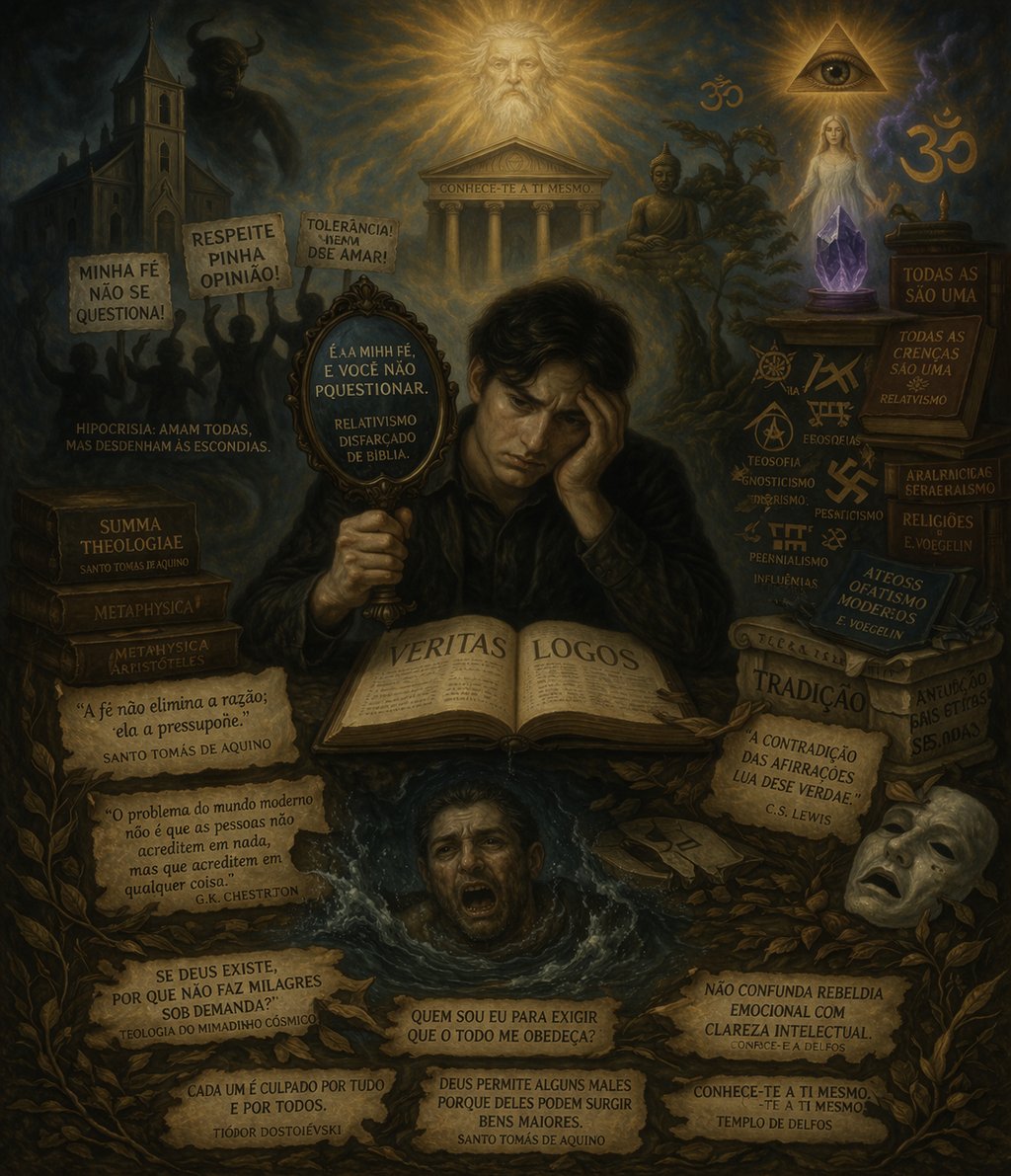
At the center of contemporary faith, there is a hidden scandal, and the curious thing is that it has become so common that almost no one notices it anymore: for many people, religion has turned into a fortified personal opinion, a room locked from within where reason is only admitted upon request and, even then, risks being rejected as an intruder. To a large extent, this distortion was driven by modern Protestantism, which turned religious experience into an unconditional subjective right. The individual has not studied theology or philosophy, cannot differentiate formal logic from devotional shiver, has no notion of what they are asserting or reacting to, but declares, with the hysterical confidence of someone who confuses conviction with volume: "it's my faith, and you can't question it." And then the usual emotional blackmail begins. If you question, you have become prejudiced. If you discuss, you have become intolerant. If the contradiction is evident, one is already labeled as a religious persecutor. It is relativism disguised as a verse, adorned with a facade of piety and a vise of immunity.
This, beside being irritating, is a lack of intellectual honesty. Theology, according to the classical definition, is the study of God. And study is not taking a loose sensation and calling it depth. Logos is not a fervent emotion, personal intuition, or sentimental opinion cloaked in sacredness; logos is organized reasoning, clarity, form, order. Saint Thomas Aquinas makes this evident at the beginning of the Summa Theologica: faith does not annul reason; it presupposes it. This is fundamental. When a discourse about God ignores the basic laws of logic, it has already crossed the boundaries of theology and fallen into the most common category of devotional delirium. Whoever says "don't discuss my faith" is revealing more than they would like. They are affirming, without realizing it, that their faith cannot withstand questioning. And faith that crumbles in the face of a question is not a virtue. It is superstition elevated to self-esteem.
It's easy to identify the type. It is common to find a young Protestant full of slogans, ready-made phrases, and a superficial collection of internet clippings, proclaiming that "all Christian religions should love each other," while sneering at Catholicism behind its back, using WhatsApp memes, out-of-context verses, and an excessive confidence of someone who has never read what they criticize. In this case, the hypocrisy is not accidental, but rather structural. The serious Catholic, when truly serious, does not pretend to accept Protestantism theologically just to appear polite at an ecumenical meeting. The lax Catholic, who fears appearing firm, and the relativist Protestant, who resorts to superficial cordiality for not being able to face a genuine confrontation, are the ones who enact this artificial harmony. The truth, as simple and difficult to accept as it may be, is the following: religions diverge because they make incompatible claims. And when one tries to cover this up with gentle words, what remains is not peace, but emotional embellishment.
Therefore, religions should confront each other not with violence or physical brutality, but with reasoning, study, and intellectual courage. The debate between religions is not an unfortunate incident in history; it is a duty of reason. If all interpretations of Christ were equally true, then none of them would be. If every interpretation is valid, then truth has already died, and they just forgot to inform the choir. With the insight of someone who understood modern madness more deeply than the moderns themselves, Chesterton ironized: "the problem with the modern world is not that people don't believe in anything, but that they believe in anything." And believing in anything is not having an open mind. It's mental disorder disguised as tolerance.
The farce worsens when the person, pressured by criticism, tries to evade and declares, with an improvised pose of depth: "I have no religion, I have philosophy." It is almost moving. He doesn't understand what religion or philosophy is, but he uses these terms as a rhetorical shield, as if he were taking two bricks and calling them a fortress. Protestantism is a complete religion, whether they like the term or not. It had a historical origin with Luther and possesses doctrines, dogmatic formulations, rites, calendars, diffuse authorities, mechanisms of exclusion, symbolic condemnations, and, despite all the resistance to the term, tradition. And tradition was not created by Rome just to provoke evangelicals on the internet. The concept of tradition predates Christianity. Since Antiquity, the term has been used to describe the constant transmission of content over time, from generation to generation, from master to disciple, from rite to rite, from form to form. Denying this is not courage. It is historical illiteracy disguised as spiritual authenticity.
It is at this moment that the situation stops being merely absurd and becomes dangerous. When the objective doctrinal authority is dismantled, the idea arises that all religious interpretations are equally acceptable. And if all interpretations of Christ are valid, then paganism is too; if everything is valid, nothing is; if all forms are legitimate, none have real authority. This mental broth, gradually dissolved over centuries of religious subjectivism, has served as fertile ground for contemporary theosophy, parlor esotericism, misunderstood perennialism, and that superficial mysticism in which Jesus, Buddha, and an energy crystal share the same altar, as if contradiction were a superior virtue. This is not a controversial provocation, intended to shock an impressionable teenager. Historically, it is sufficient to examine the studies on the Theosophical Society in the 19th century and its effect on certain intellectual circles in Germany to understand that doctrinal dissolution has quite concrete symbolic implications.
From these combinations, dangerous connections arise. Certain currents of German historiography and imagination blended theosophy, Aryan mythology, and distorted philosophy, resulting in influential esoteric sects, such as those linked to Guido von List. Reducing Nazism to this would be intellectually dishonest, as the true history is more complex and less dramatic than simplifiers tend to make it seem. Although these currents were not the only ones responsible for the rise of Nazism, they contributed by providing symbolic repertoire, imaginary language, and a mystical atmosphere for the regime. It would also not be fair to attribute an automatic complicity with Nazism to the perennialist school. For example, René Guénon explicitly rejected racialism. However, there is a common point that must be faced without fear: the dissolution of objective religious truth in favor of a "diffuse universal revelation," vague enough to accept everything and, for that very reason, incapable of judging anything.
The same happens with modern apophaticism, often misinterpreted by those who like to play with words they haven't studied. From Pseudo-Dionysius to Saint John of the Cross, classical negative theology did not deny the possibility of truth, but admitted that human language has limits when it comes to the divine mystery. This contrasts quite a bit with the assertion that nothing can be clearly said about God and that every formulation is equally imperfect, equally valid, and equally dispensable. In some of its contemporary strands, Protestantism has taken this logic to the extreme, resulting in a faith without content, flexible enough to be filled by any ideological passion of the moment. A religion without content does not remain empty for long. It is often dominated by political messianisms. A typical example of this is communism: a secular and apophatic eschatology that promises salvation in the future, mentions collective redemption, creates figures of saints, demons, heretics, and faithful, but never fully and acceptably establishes what it promises. Eric Voegelin referred to this phenomenon as "political religions," using surgical precision.
Therefore, the practical lesson does not require sugary diplomacy, but rather bravery. Never become a religious relativist. If you practice a religion, have the sincerity to declare that it is true and that others are mistaken in some fundamental aspect. This is not aversion. This is basic intellectual honesty. Study, discuss, and read critiques of your own faith with the same attention you give to defenses. If you are Protestant, read Thomas Aquinas before criticizing him. If you are Catholic, understand Luther before judging him. The rest is just confessional bravado. Those who do not accept debate do not possess faith, but rather emotional attachment. And emotional attachment, when disguised as doctrine, tends to cause more harm than any declared heresy.
It is prudent to be wary of those who claim that the Holy Spirit reveals contradictory things to each person, as if heaven were a gathering of personal opinions. In this scenario, there are two alternatives, and both are bad: either the Holy Spirit has turned into the devil and is intentionally deceiving us, or we are facing a reconditioned gnosis, which trades reality for an internal theater and calls it depth. As C.S. Lewis stated, "a contradictory truth ceases to be truth." Lewis, "a contradictory truth ceases to be truth." And that is enough. Faith without coherence is not a high mystery. It's chaos. And spiritual disorder, like any serious disorder, first demands from the mind and then from life. Before ruining the path, it dulls the judgment.
The situation doesn't end there, as the same mentality resurfaces when the topic shifts to contemporary atheism, this atheism that presents itself as rational maturity, but which, in reality, often amounts to nothing more than a metaphysical tantrum with a modern diction. A question haunts him incessantly: if God exists, why doesn't He perform miracles on demand to heal his personal frustrations and his wounded vanity before the mirror? It is the theology of the cosmic spoiled child. In this caricature, God is portrayed as a customer service manager of the universe, always available to hear complaints like "my life didn't turn out the way I wanted, therefore the Absolute Being doesn't exist." I understand this thot because I have been thru it. I have already sat in that crooked chair. I was once an atheist at that superficial level, then I explored alternative religions, dabbled in shelf mysticisms, experimented with that market of plastic transcendences, and only returned to the serious metaphysical question when intellectual honesty became more unbearable than the comfort of self-deception.
In many cases, the contemporary atheist does not deny the existence of God for being excessively rational, but for being excessively egocentric. He does not assert, rigorously: I have not found sufficient reasons. What he expresses, even if he doesn't formulate it that way, is that God did not act as I expected. The attitude is more resentful than skeptical. There is an aspect of psychological luciferianism in it, in its most basic sense: it does not necessarily seek to deny God, but to subjugate Him. There is a longing for a domesticated Absolute, submissive, willing to present itself when called, perform tricks when prompted, and demonstrate its presence in public like a magician surrounded by an audience. As if the Creator of space-time had to participate in a virtual discussion, go to Avenida Paulista with a megaphone, or shape all of reality to cater to the drama of a wounded consciousness. The appropriate question was never "why doesn't God do what I want?". The right question is much more humiliating and, therefore, much more useful: who do I think I am to believe that the Whole owes obedience to the nothing that I am?
The ancient "know thyself," inscribed on the temple of Delphi long before the atheist forums and their short-comment gurus, returns with vigor. The lack of proportion, and not just information, is what afflicts the atheist. He often ignores, perhaps intentionally, that in classical theology, from Plato to Aristotle, from Augustine to Thomas Aquinas, God is not simply some being in the universe, nor a powerful character wandering among galaxies; He is the very foundation of being. A God who transcends the limitations of time and space does not cater to temporal whims like a grumpy old man sitting on a cloud, responding to human requests on a first-come, first-served basis. When Boethius describes eternity as "the total, simultaneous, and perfect possession of endless life," that is exactly what he means: God does not experience reality in fragments, as we do. He knows it completely. Demanding that this God intervene in a specific way to address my personal insecurities is akin to rebelling against the ocean for not molding itself to the shape of your cup.
When discussing evil, deaths, tragedies, and injustices, the atheist generally behaves like an irritated spectator in front of a poorly written script, ignoring a fundamental aspect: he is part of the story; he is neither above nor outside of it. In the third chapter, a death can be seen as absurd, purposeless, cruel, and unacceptable. In chapter fifty, it can be seen as an essential condition for a complete series of goods that no one in chapter three could imagine. When addressing divine providence, Thomas Aquinas argues that God allows some adversities because greater benefits can arise from them, even if these benefits are not visible to those who see only the fragmented present. The butterfly metaphor is imperfect, but it illustrates our limitation well: a small event can completely change what is to come. The hasty atheist reduces the complexity of reality, distorts everything that doesn't fit into his instant indignation, and, with the grotesque calm of an enraged chimpanzee, declares: if God were good, this wouldn't have happened. It is a phrase that seems to have a strong moral until intelligence awakens it.
The conception of God that resides in the mind of the contemporary atheist is, most of the time, lamentable. A combination of Santa Claus, a football referee, and a cosmic office boy. If you answer the call, there is. If you don't comply, you have been dismissed by contemporary conscience. And the most interesting thing is that this same atheist, so firm in his refusal, rarely demonstrates the intellectual courage to seriously explore other religious traditions. He does not delve deeply into studies of Hinduism, does not genuinely engage in pagan rituals, does not dedicate himself to profound spiritual practices, does not, in short, follow the paths he despises. He is a couch atheist, a meme skeptic, and a footnote critic. The honest atheist exists, but they are uncommon. This one, at least, goes thru the process: researches, enters, experiments, makes mistakes, returns, reflects, compares, suffers, and matures. If, after all, he still considers himself an atheist, at least he is not intellectually dishonest. However, the majority opt for the comfortable cowardice of denying without informing themselves, labeling this laziness as lucidity.
From this laziness arise grandiose nonsense, such as the idea that the biblical God is merely a poorly made mix of pagan gods. A statement of this kind may impress the unwary, but it falls apart when confronted with centuries of philosophy, theology, philology, and comparative history. When addressing the logos spermatikos, an idea derived from Stoicism, Thomas Aquinas highlights that God manifested Himself partially in various cultures. What happens, according to him, is not a problem with the revelation itself, but rather with the way human beings distort it. This does not diminish Christian monotheism; on the contrary, it strengthens it. Partial revelations do not exclude the possibility of a complete revelation; on the contrary, they prepare understanding, refine symbols, and organize expectations. The childish objection questions why God did not reveal Himself perfectly from the beginning, if He is perfect. It implies an instantaneous narrative, without process, without pedagogy, without human development, as if the collective soul of the species were capable of absorbing the entirety all at once, without compromising its own vessels. Moreover, religions help educate coexistence with diversity, preparing the symbolic, intellectual, and philosophical ground for future understandings. Those who demand immediate completeness do not demonstrate depth, but rather a lack of ability to think historically.
For example, primitive Judaism did not have a fully established idea of messianism from the beginning, as it developed later. There was refinement, tension, development, and historical purification. And this trajectory was related to Greek concepts, such as Plato, Aristotle, the Socratic logos, and, behind them, with even more remote traditions. This is not about contamination. It is a historical manifestation of reason. Christianity does not emerge in a vacuum, as if it had appeared ready from the sky in an intellectual desert. It emerges in a world that, in a way, was already ready to welcome it, debate it, define it, and share it. Disregarding this is to simultaneously neglect history, sociology, philology, and philosophy. Without a doubt, it is a feat, but a feat of folly.
When an atheist, without any method, demands that the Bible be interpreted strictly literally, as if it were a children's book made to meet the hermeneutical expectations of a lazy modern reader, what he reveals is not a commitment to truth, but a lack of reading skills. Reading ancient texts without considering the historical method, literary genre, cultural context, and symbolic mediation is a sophisticated form of illiteracy. It's like wanting to read Herodotus as if it were a weather report and then laughing because it didn't "match the data." Chesterton made an important observation: "the problem is not that the Christian takes the Bible too seriously, but that the critic takes it too little." And it is always easier not to take it seriously. The mocker doesn't need to study; they just need to pose.
In fact, the contemporary atheist generally does not deny God in a strong sense; he rejects the notion of transcendence because that idea removes him from the center of the universe. That's what hurts. According to the Thomistic view, human free will does not conflict with divine sovereignty, but presupposes it. God provides opportunities, sustains existence, broadens horizons, and allows trajectories; and human choices, both individual and collective, indeed contribute to the construction of the world. Providence is not a rigid path, a trajectory without deviations, but a malleable symphony in which each instrument has its importance. Dostoevsky expressed this in an intense, almost unbearable phrase of such truth: "everyone is guilty for everything and for everyone." And it is exactly this type of commitment that the contemporary man refuses. He tends to blame chance, the system, matter, childhood, genetics, and even the moral weather of the century. Anything, as long as he doesn't have to confront his own involvement in the disaster.
Thus, the God of the Bible is not a makeshift mythological creation to frighten ancient tribes. It is the God that philosophical reason learns to identify as the foundation: Aristotle's Unmoved Mover, Plato's Good in itself, the One that does not compete with the world, for it sustains it. Before the consolidation of the Greek philosophical language, Abraham was already operating within this logic of transcendence. And the names — Elohim, Adonai — do not refer to multiple gods, as the pseudo-scholarly person who read two notes on the internet and came out thinking they are superior might believe; they are different linguistic forms referring to the same foundation of being. This is evident to anyone who has a minimum of seriousness in ancient history. The problem is that seriousness requires effort, and the contemporary man prefers to appear free exactly where he succumbs the most to laziness.
Ultimately, the criticism of religious relativism and contemporary atheism is not a purposeless outburst of bad mood. It is an attempt to bring reality back in a context where only sensitivity, posturing, and conceptual disorder are valued. Don't confuse emotional rebellion with intellectual clarity. Do not convert your lack of reflection into a moral distinction. Do not use the word faith to protect superstition, nor the word reason to conceal resentment. If you are going to profess a religion, have the courage to defend it when questioned. If you are going to deny God, do it seriously, thoughtfully, boldly, and at a cost. The rest is just narcissism disguised as philosophy. And the world is already too full of people who consider their own navel as the cosmos.
BIBLIOGRAPHIC REFERENCES
AUGUSTINE, Saint. The City of God: Part I (Books I to X). Petrópolis: Vozes, 2017.
AUGUSTINE, Saint. Confessions. Petrópolis: Voices, 2020.
AQUINO, Thomas Aquinas. Summa Against the Gentiles. São Paulo: Loyola, 2015. 4 v.
AQUINO, Thomas Aquinas. Theological Summa. São Paulo: Loyola, 2003. 9 v.
ARISTOTLE. Nicomachean Ethics. São Paulo: Edipro, 2018.
ARISTOTLE. Metaphysics. Petrópolis: Voices, 2024.
BEZERRA, Cícero Cunha. Dionysius the Pseudo-Areopagite: Mysticism and Neoplatonism. São Paulo: Paulus, 2009.
BIBLE. Portuguese. Jerusalem Bible. São Paulo: Paulus, 2003.
BLAVATSKY, H. P. The Secret Doctrine: Thought, 1980. v. 2.
BLAVATSKY, H. P. Isis Unveiled: Thought, 1991. v. 1.
BOETHIUS. The Consolation of Philosophy. São Paulo: WMF Martins Fontes, 2023.
CHESTERTON, G. K. Heretics. Campinas: Ecclesiae, 2011.
CHESTERTON, G. K. Orthodoxy. Campinas: Ecclesiae, 2013.
CRUZ, São João da. Dark Nite. Petrópolis: Voices, 2025.
DOSTOEVSKY, Fyodor. The Brothers Karamazov. São Paulo: Martin Claret, 2019.
GOODRICK-CLARKE, Nicholas. Las raíces ocultas del nazismo: cultos arios secretos y su influencia en la ideología nazi: NYU Press, 1992.
GUÉNON, René. The Crisis of the Modern World. Lisbon: Vega, 2013.
JUSTIN OF ROME. I and II Apologies; Dialog with Trypho. São Paulo: Paulus, 2014.
LEWIS, C. S. The Abolition of Man: Thomas Nelson Brazil, 2017.
LEWIS, C. S. Pure and Simple Christianity: Thomas Nelson Brazil, 2017.
LIST, Guido von. El secreto de las runas: Tradiciones internas, 1988.
LUTHER, Martin. On Christian Freedom. São Leopoldo: Sinodal; Porto Alegre: Concordia, 1989.
PLATO. The Republic. São Paulo: Edipro, 2020.
PSEUDO-DIONYSIUS THE AREOPAGITE. Complete Works of Pseudo-Dionysius the Areopagite: BAC, 1990.
VOEGELIN, Eric. The Political Religions. Lisbon: Vega, 2002.