


The Spirit that Lies: Sola Scriptura, Cheap Gnosis, and the Sects that Turn Faith into Slavery
When the faithful believe that the Holy Spirit whispers the truth to them without study or tradition, every heresy transforms into "revelation" and every exploitation becomes a "divine mission." What begins as freedom of interpretation culminates in servitude, with consumed bodies, domesticated consciences, and the name of Christ used as a pretext for villainy.
Gabriel G. Oliveira
3/31/202611 min read
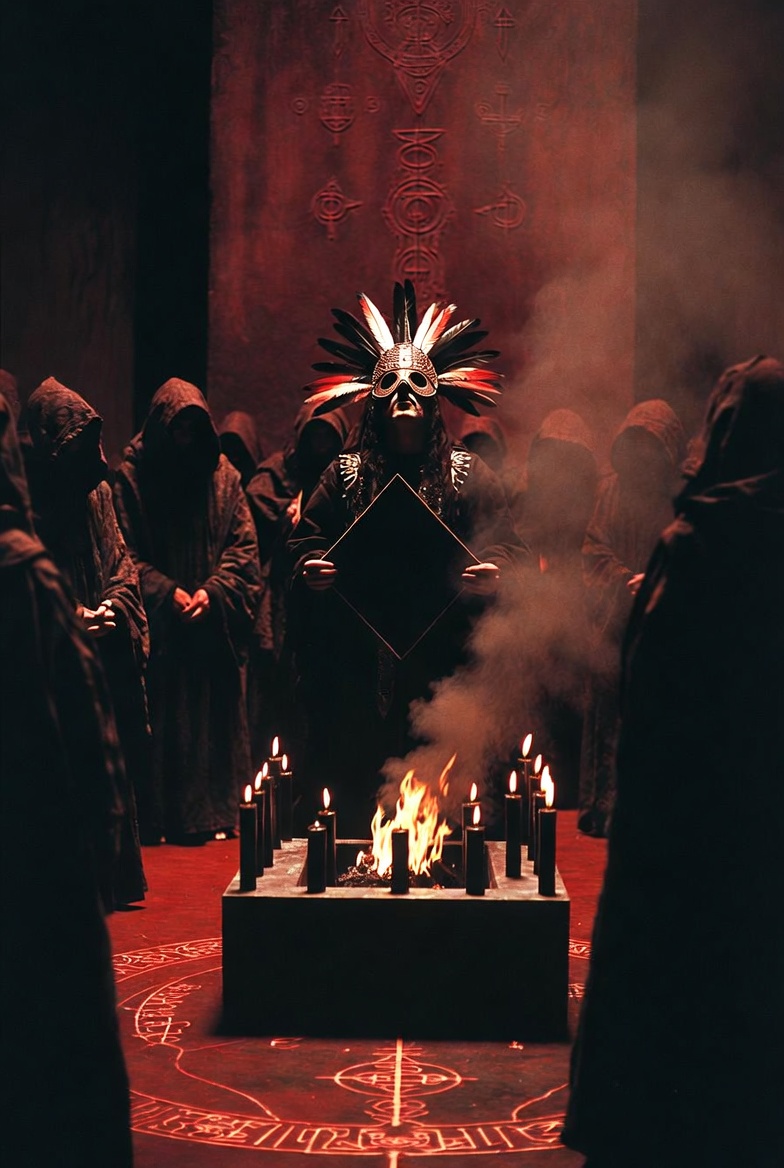
The Occultisms Originated from Protestant Relativism
The most efficient way to destroy the religious intelligence of a people is not to convince them that there is nothing above them. It is to suggest, with a gentle voice and a face of pity, that they themselves can occupy the center of the interpretation of the sacred without any preparation, without discipline, without tradition, without memory, and without the slightest modesty to suspect themselves. The truly lethal illusion does not kill transcendence; it kidnaps it. It puts the key to heaven in the unstable hands of those who have barely learned to read their own lives with any attention and then call it spiritual freedom. At this point, faith has already begun to rot, because what appears under the name of revelation almost always turns out to be nothing more than inflated subjectivity, devotional solipsism, and vanity with the scent of cult.
That's where a good part of the delusional sects that infest the contemporary Christian scene comes from. They do not arise out of nowhere, as if they were exotic accidents in a healthy world. They grow in soil previously fertilized by a poorly digested and caricatured thesis: the idea that Scripture alone, read by anyone under the supposed immediate assistance of the Holy Spirit, is enough for the truth to become clear and sufficient. On paper, this seems noble. In practice, it is a factory of arbitrariness. Because, the minute any internal reading, any emotional impact, any strong impression can be sold as enlightenment, the sacred text ceases to be a measure and becomes raw material for competing delusions.
The contradiction is so obvious that it becomes offensive. If the Holy Spirit authenticates mutually exclusive interpretations, then truth has become theater and logic has been invited to exit thru the back door to avoid embarrassing the guests. If one community affirms one thing and another, in the name of the same Christ, affirms the opposite, there is no hermeneutical miracle there; there is contradiction. And contradiction is not depth, it is failure. Either one admits that the criterion was never truly the Spirit, but the interpreter's feeling and the charisma of the most convincing leader, or one transforms the Spirit itself into a cosmic caricature that sanctions opposing absurdities with equal serenity. Neither of the two options is intellectually honest, but many people prefer the comfortable dishonesty to the discomfort of thinking.
The problem worsens when this logic descends from the abstract plane and begins to organize entire communities. The man who claims to reject traditional mediations, ancient teachings, and rigorous intellectual disciplines does not become freer; he almost always becomes more manipulable. He leaves an institutional authority that at least carried memory, rules, disputes, and historical checks to fall into the hands of an improvised, local, emotional, and invasive authority. It is the old farce of autonomy preached by those who only want to change the name of the owner. The faithful imagine they have escaped tutelage and, without realizing it, hand over their conscience to a soul manager who regulates what they should feel, confess, fear, desire, reject, and offer. The mediation does not disappear. It only gets worse.
Luther and Calvin, with all the problems that can be attributed to them, still belonged to a world where catechisms, confessions, and serious theological disputes served as a restraint. There was an effort at form. There were limits. There was, at the very least, the shame of not calling any internal impulse a final revelation. The subsequent vulgarization dissolved that structure and preserved only what was most flammable: the excited individual, the rhetoric of authenticity, and the Bible turned into a malleable mass for the day's religious improvisation. The result was a sentimental heteronomy disguised as direct contact with the divine. It seems like spontaneity, but it's just subjugation with a soundtrack.
In this environment, the relativism that is so often denounced in the secular world enters the temple thru the side door, in a suit and with biblical language. Because, if the enlightened subjective experience is enough, then the doctrinal boundaries begin to dissolve at a comical speed. Syncretism ceases to be a problem and gradually becomes a logical consequence. If someone mixes Christ with orishas and claims to have felt spiritual confirmation, by what internal criterion would this be rejected? If another person combines Christianity with Nordic grimoires from the Galdrabók and claims to have been touched by a higher revelation, what is the real objection beyond the personal taste of the competing pastor? If a Buddhist incorporates Jesus into their own cosmology and claims to have found a higher layer of truth, on what grounds do you say no? When the objective criterion has been eroded, only a dispute of emotional intensity remains. Each group calls its vertigo discernment and begins to treat incoherence as a diversity of divine action. It's improvised theosophy with a revivalist accent.
The most ironic thing is that this type of spirituality is sold as an antidote to modern confusion, when in fact it reproduces it on a liturgical scale. The person who claims to combat relativism ends up feeding a metaphysical carnival in which everyone is their own pope until they find someone with a firmer voice to outsource their judgment. Truth ceases to be something to which man submits with reverence and becomes a magic mirror that reflects, with sacred language, the face he already wanted to see. It is not transcendence. It's narcissism with religious vocabulary. And narcissism, when it dons the garb of holiness, becomes more dangerous, not less.
This same logic explains why so many seemingly devout communities turn into environments of capture. When vulnerable people, tired, in need of belonging, wounded by ordinary life, and hungry for meaning come into contact with a structure that promises mission, purity, direction, and election, the mix can become explosive. It is not necessary for the leader to start out monstrous. It is enough for him to get used to interpreting the needs of others as raw material for power. From then on, transcendence ceases to be a horizon of human transformation and becomes an instrument of psychological fixation. Faith, which should order the soul to truth and goodness, degrades into a technique of recruitment, retention, and exploitation.
The case of the Christian Church Translating the Word, formerly called Evangelical Community Jesus, the Truth that Marks, exposes this in a brutal manner. Operation Canaã, in its phases of 2013, 2015, and, with special emphasis, the "Final Harvest" of 2018, shed light on an interstate structure that, according to the Ministry of Labor's inspections, kept hundreds of people in conditions analogous to slavery. The company Nova Visão, linked to the group, was found with 565 workers, of which 438 did not have signed work contracts and 32 adolescents were engaged in prohibited activities, distributed among farms in Mynas Gerais and Bahia and urban structures in São Paulo. The material fact is already serious in itself. But the symbolic data is even more revealing: many reported working "for the cause," "for the faith," "for the community." The abuse did not come as abuse. It came as a calling.
That's where human deformation shows itself in its most efficient form. The exploited does not need to be handcuffed if convinced that their wear is holy. The body can be consumed with an almost liturgical serenity when the mind has learned to call exhaustion surrender, dependence communion, and obedience spiritual maturity. This helps to understand why the legal gray area does not always coincide with moral clarity. The Public Civil Action 0010237-56.2016.5.03.0024 was dismissed by the 24th Labor Court of Belo Horizonte in 2020, a decision upheld by the TRT-3. This judicial outcome does not erase the investigations, the charges, or the documented pattern of exploiting vulnerabilities. It only shows, with the coldness inherent to the process, how formal consent and psychological subjugation can coexist without legal language being able to encompass the full depth of the problem. The faithful often do not perceive themselves as victims. And that is precisely the most refined victory of the mechanism.
The same machinery appears, with a different esthetic, at the Harmonia Foundation of Arts and Transcendental Knowledge, in São Thomé das Letras. In 2024, the Federal Police launched a new front of Operation Canaã to investigate labor analogous to slavery and sexual abuse against women. The accusations came from former members, as almost always happens when the group spell begins to lose its power and the person, with painful delay, relearns to name what they lived thru. Previous reports from the Ministry of Labor had already pointed to exhausting work hours, document retention, moral harassment, and the abusive use of the volunteer figure. The word "volunteer," in this context, functions like many social euphemisms: a delicate way to hide brutal relationships. Contemporary evil rarely enters thru the door shouting its own name. He prefers status, therapeutic discourse, mystical scenery, cultural appearance, and a vocabulary so sweet that violence takes time to be felt as violence.
Transcendence, when instrumentalized, offers an extraordinary advantage to the abuser: it allows very concrete asymmetries to be covered by sublime language. Exploitation comes to be read as a process, submission as discipline, humiliation as purification, unilateral renunciation as proof of inner greatness. There is no need for horns, smoke, or demonic theatricality. All it takes is a sufficiently engaging narrative, a sufficiently cohesive group, and people sufficiently exhausted to trade autonomy for belonging. There are evils that advance in boots; others prefer handmade sandals, incense, and the promise of holistic healing.
Scientology offers the technified mirror of the same vise. Thetans, the state of Clear, Operating Thetan, the E-meter: all of these compose a ladder of improvement where moral pain is converted into a technical problem, the conversion becomes an existential upgrade, and humility gives way to a methodical inflation of the self. It is an almost liturgical structure of progressive self-importance. The creature is no longer called to recognize limits, guilt, dependence on reality, and the need for inner rectification; it is trained to interpret itself as a developing potential, almost a divinity in the process of unlocking. It is the old temptation as always, just with the appearance of spiritualized science and laboratory language. The seriousness of moral reform is exchanged for a narcissistic engineering of personality.
The Superior Universal Lineament, associated with the figure of Valentina de Andrade, takes this logic to a particularly dark heterodox extreme. "God, the Great Farce" proposes an anti-religion that accuses the Judeo-Christian God of imposture and offers, in its place, an alternative cosmology, elitist and reserved for the initiated, with superior intelligences like "Zuita" occupying the role of revealing mediator. Historically, the group has been linked, in the press and in investigations, to the cases of Altamira and Guaratuba, in the context of the Evandro case. Valentina was acquitted in the Altamira trial in 2003, and subsequent confessions by Francisco das Chagas muddled a significant part of the previous narrative. The picture, therefore, demands precision: there are serious suspicions and historically contested connections, not a conviction settled in all spheres. Even so, the symbolic pattern remains eloquent. When a cosmology desacralizes the common human, divides the world between superior initiates and deceived masses, and presents ordinary morality as a prison for the naive, the ground is prepared for horror to find imaginative justification.
It is here that moral philosophy becomes necessary again, because without it everything dissolves into descriptive sociology, journalistic curiosity, or diffuse indignation. The central point is not just that there are abusive groups. That is the most obvious level of the issue. The central point is that, in all these cases, the structure of the error has the same anatomy: objective truth is replaced by unbridled subjective enlightenment; practical prudence is ridiculed as coldness or disbelief; the ethics of virtues give way to obedience to the leader, the system, or the promise of elevation; the human purpose, which should guide the individual toward growth in reason, justice, and temperance, is sacrificed on the altar of mission, anointing, secrecy, belonging, or spiritual enhancement. In simple terms: the person stops being shaped for the good and starts being used for the functioning of the machine.
This does not occur only in extravagant sects, with esoteric names or a marginal appearance. It can occur in perfectly recognizable environments, with open Bibles, emotional praises, charitable works, and an appearance of normality. It is precisely for this reason that the issue is serious. The criterion for discernment cannot be the esthetic surface of the group, nor the degree of eccentricity of the vocabulary, nor the fact that it uses Jesus, energy, spiritual science, cosmic revelation, or ancestral tradition as symbolic cover. The criterion needs to be harsher and simpler: is this structure ordering the person toward reality or training them to inhabit a fiction functional to power? Is it forming character, judgment, responsibility, self-control, and love for the truth, or is it dissolving all of that into emotional submission, interpretative dependence, and pride disguised as choice?
When the answer is the second, the appropriate name is not just doctrinal deviation. It is human deformation. Because the damage goes beyond intellectual error. It affects the very ability of the individual to perceive what is happening to them. And there are few miseries more dangerous than the one in which the victim learns to call their prison a vocation. At that point, the leader no longer needs to watch so closely; the group watches for him. The faithful correct themselves, accuse themselves, surrender themselves, and, if necessary, accuse the dissident who dared to regain their judgment. The system becomes self-sustaining because it has hijacked the person's moral categories and reorganized them for its own benefit.
That's why criticism cannot be cowardly or overly ceremonious. There are times when overly polite language functions as esthetic complicity. When an "enlightened" reading legitimizes the exploitation of bodies, when a cosmology transforms pain into a technology of control, when the supposed spiritual freedom produces a heteronomy deeper than the one it claimed to combat, calling this merely a "religious divergence" is a refined form of blindness. There are things that need to be named with harshness because their verbal sweetness is part of the mechanism of concealment. Not all tolerance is virtue. Sometimes it is just the fear of appearing severe in a time that has lost the taste for truth and exchanged discernment for etiquette.
Radicalized popular Protestantism did not invent all these pathologies on its own, but it provided, in many contexts, the ideal fertilizer for them to thrive. Pious anti-intellectualism, hermeneutic relativism, and poorly directed spiritual hunger compose a dangerous mix. Add to that the charismatic figure who knows how to organize the desires of others, and the rest almost takes care of itself. The vulnerable surrender time, money, body, family, and conscience to structures that promise heaven and demand earthly servitude. The name of Christ, the Spirit, Zuita, energy, or higher consciousness becomes an alibi for what, at its core, remains the same old trickery: using the human thirst for meaning as fuel for power.
In the end, the truly uncomfortable diagnosis is this: ruin rarely begins with vulgar atheism. Often it begins with spirituality without form, without criteria, without discipline, and without intellectual humility. It begins when man no longer wants to obey the truth, but to possess the truth as an extension of his own internal state. It begins when elevated symbols cease to point to the real and start to function as anesthesia for the mind and armor for the will to power. It begins when freedom is redefined not as the ability to adhere to the good, but as a license to call any impulse a revelation. And it almost always ends the same way: with real people broken, exploited, and confused, while the pulpit, the guru, or the system scream "persecution" to avoid facing the mirror. The most dangerous lie has never been the one that denies heaven. It was the one that taught ill-prepared men to confuse their own fever with the voice of God.
BIBLIOGRAPHIC REFERENCES
ANDRADE, Valentina de. God, the Great Farce, 1998.
AQUINO, Thomas of. Theological Summa. São Paulo: Loyola, 2003.
ARISTOTLE. Nicomachean Ethics. Lisbon: Quetzal, 2004.
BIBLE. Portuguese. Jerusalem Bible. São Paulo: Paulus, 2002.
BRAZIL. Ministry of Labor and Employment. Operation New Canaan: Christian Church Translating the Word – The Truth that Marks: Ministry of Labor and Employment, 2018.
BRAZIL. Ministry of Labor and Employment. Inspection Report: Foundation of Harmony in Arts and Transcendental Knowledge. Belo Horizonte: Ministry of Labor and Employment, 2020.
BRAZIL. Federal Police. Federal Police combats slave labor and sexual abuse: Federal Police, 2024.
CALVINO, João. The Institutes. São Paulo: Cultura Cristã, 2022.
FLOWERS, Stephen. The Galdrabók: an Icelandic grimoire. York Beach: Samuel Weiser, 1989.
HUBBARD, L. Ron. Dianetics: The Modern Science of Mental Health. Los Angeles: Bridge Publications, 2002.
HUBBARD, L. Ron. Cienciología: Los Fundamentos del Pensamiento. Los Ángeles: Bridge Publications, 2007.
LUTHER, Martin. On the Bondage of the Will. In: LUTHER, Martin. Selected Works. v. 4. Debates and Controversies, II. São Leopoldo: Sinodal; Porto Alegre: Concórdia, 1993. p. 11-216.
MARIANO, Ricardo. Neopentecostals: Sociology of the New Pentecostalism in Brazil. São Paulo: Loyola, 2010.
