

There is no game to be played, don't be an idiot

Using the justification of "playing the game," many try to turn dishonesty into intelligence, when in fact they only reveal the corruption of their own character. This text reveals how fraud, cynicism, and moral cowardice disguise themselves as strategy, and why opposing them is the only way to maintain integrity.

Gabriel G. Oliveira

3/29/202613 min read
Não há jogo
Não há jogo

How to Treat Scoundrels

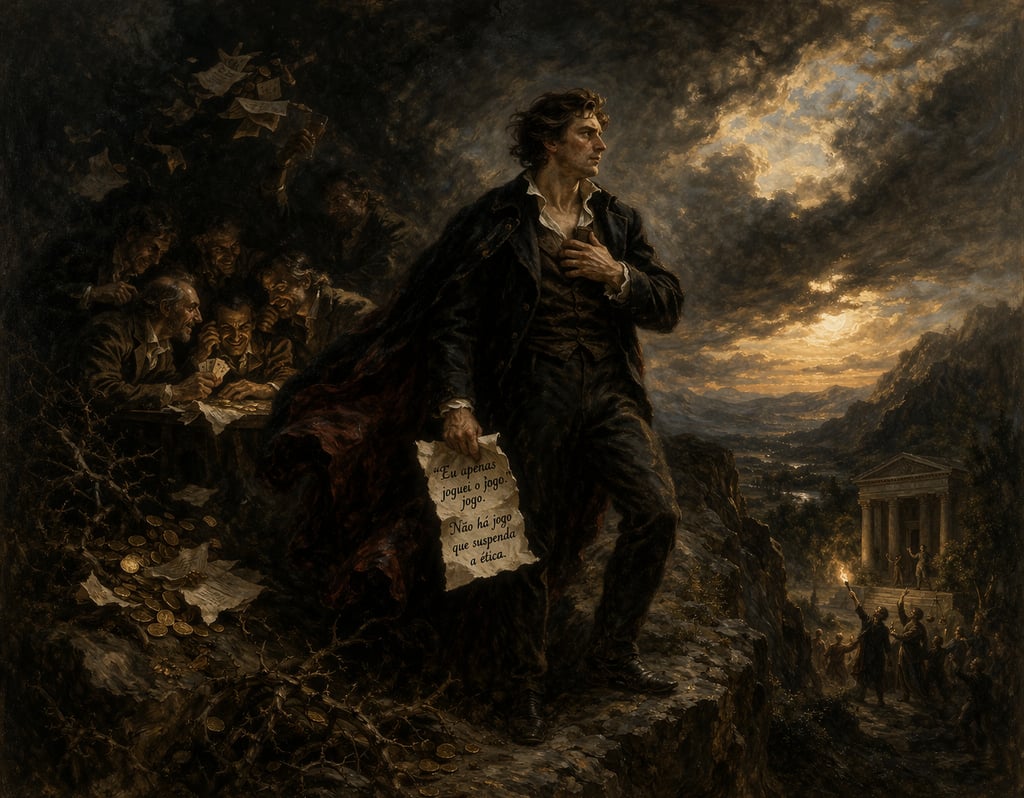
After a successful underhanded act, it is common to hear: "I just played the game." It is pronounced with a voice of practical wisdom, almost as if it were a natural law, as inevitable as gravity. Even so, few phrases reveal a significant moral deficiency so clearly. There is no game to play. Is there character, or isn't there? What follows is just an elaborate explanation to turn a vise into a virtue.

When someone, after deliberately harming a colleague, manipulating rules, sabotaging a job, or humiliating a subordinate, says they "just played the game," they commit an intellectual laziness and a serious moral failing: they pretend that reality forced them to be a monster. As if there were an invisible board where the only possible option was cheating. Aristotle warned that no one becomes unjust out of necessity, but rather out of habit (Nicomachean Ethics, V). However, if this is true, why do so many people insist on calling habit strategy?

The artifice is old and has a philosophical pedigree. Since Machiavelli, the idea that public life and, by extension, business, academic, and even personal life operate according to rules that have nothing to do with traditional morality has become a commonplace. In The Prince, effectiveness takes precedence over morality, and success over truth. Studying Machiavelli is not a problem; the problem arises when transforming his diagnosis into a way of life. In these situations, the man does not "play the game": he renounces moral judgment and considers it intelligence.

In certain cultures, this selflessness is still celebrated. Cunning comes to be considered a quality, trickery is seen as a form of practical genius, and those who are harmed are viewed as naive. Max Weber already observed that when ethics is replaced by a purely instrumental rationality, the world becomes inhabited by individuals who are efficient but devoid of substance (The Protestant Ethic and the Spirit of Capitalism). However, acting efficiently without an appropriate criterion is not progress; it is simply rushing toward a mistake.

The educational effect that this mechanism produces is the cruelest. When the victim discovers that the other "played the game," they begin to question whether their ethical stance was a mistake. Instead of clear indignation, the temptation to imitate arises. The man who was betrayed wonders if he should have been more suspicious, more severe, more cynical. Thus, the damage is both material and educational. C.S. Lewis argues that "education without values, however useful it may be, seems rather to make man a more intelligent demon than an angel" (The Abolition of Man). However, if the unjust prevails, why not follow it as an example?

The moral disorder remains exactly as it is. Evil does not spread only thru corrupt actions, but also thru the discreet conversion of the honest into cynics. Hannah Arendt dealt with an analogous concept in her analysis of societies where what is reprehensible becomes acceptable: in a context where lying is the norm, stating the truth comes to be considered an eccentric act (Between Past and Future). It is not necessary for everyone to be bad; it is enough that the good do not judge.

However, this does not mean that we should accept the passive position of the lamb being led to slaughter. Not entering the "game" of dishonesty and accepting to be crushed by it are two different things. The legal and moral tradition has always recognized the right to a rational defense. If you are facing fraud, persecution, or abuse, the correct response is not to glorify injustice or perpetuate it, but to document it. For that, there is evidence. That's what institutions were created for. When they fail to fulfilll their role, seeking formal justice is not an act of revenge; it is a way to restore order. As Thomas Aquinas reminded us, the law was made to contain vise when virtue is insufficient (Summa Theologiae, I-II, q. 95).

There is a clear and incisive argument that the rhetoric of "game" tries to conceal: those who act wrongly are not intelligent, they are irresponsible; those who justify evil as the norm of the system are not realistic, they are cowardly. G.K. Chesterton resurrected this type of people by saying that "the modern world is full of old Christian virtues gone mad," virtues taken out of their moral context and transformed into caricatures. The sagacity that justice lacks is not wisdom; it is a senseless sagacity.

Therefore, the maxim is clear and resembles a piece of advice for life: no match can compromise ethics. There are only those who prefer to give up their own conscience for a fleeting benefit. Don't be foolish enough to trust it, nor naive enough to follow its example. If you are a victim, gather evidence, report the failure, and demand compensation. If no one acts, seek legal support. Resisting the corruption of character is harder than just "playing the game," but it is the only way to avoid appearing victorious on the outside and hollow on the inside. As Solzhenitsyn said, "a lie can dominate the world, but only as long as people refuse to call it by its name."


BIBLIOGRAPHIC REFERENCES

AQUINAS, Thomas. Summa Theologica. Traducido por los Padres de la Provincia Dominicana Inglesa. Nueva York: Benziger Bros., 1947-1948. 3 v.

ARENDT, Hannah. Entre el pasado y el futuro: ocho ejercicios de pensamiento político. Edición ampliada. Nueva York: Penguin Books, 1978.

ARISTOTLE. Ética a Nicómaco. Traducido por Terence Irwin. 2ª ed. Indianapolis: Hackett Publishing Company, 1999.

CHESTERTON, G. K. Ortodoxia. Nueva York: John Lane Co., 1909.

LEWIS, C. S. La abolición del hombre; o, reflexiones sobre la educación con especial referencia a la enseñanza del inglés en los últimos años de las escuelas. Nueva York: Macmillan, 1947.

MACHIAVELLI, Niccolò. El príncipe. Traducido por George Bull. Londres: Penguin Books, 2003.

SOLZHENITSYN, Aleksandr. No vivas por mentiras. En: ERICSON, Edward E.; MAHONEY, Daniel J. El lector de Solzhenitsyn: escritos nuevos y esenciales, 1947-2005. Wilmington, DE: ISI Books, 2006.

WEBER, Max. La ética protestante y el espíritu del capitalismo. Londres: Routledge, 2001.

So how should I act...

Don't turn your bonds into a worldview

We all know this seduction, even if we rarely recognize it: taking what is defective, distorted, or loose within us and calling it a virtue for the sake of soul economy. To err is human; to acknowledge is almost noble. The real problem occurs when someone chooses to adorn the mistake and display it on the wall as if it were a trophy. Not turning one's own vises into a worldview is, perhaps, one of the most fundamental rules of moral hygiene and also one of the most forgotten. The accepted vise can still repent; the widespread vise becomes an ideology. As is well known, ideology is generally more rigorous than any individual sin. Isn't it curious how people forgive a mistake, but exalt the system that forgives it?

I started using this maxim as a kind of detector for evil people. It is essential to stay alert whenever someone tries to morally justify what is, in fact, a structural flaw: an internal limitation, a soul's apathy, or a spiritual cowardice. With the calm of someone who is not in a hurry to understand the world, Aristotle already warned in the Nicomachean Ethics that virtue is not found in words, but in habits: it is the consonance between appropriate reason and just action, not a sophisticated after all to justify wrongdoing. By reversing this order, the person not only makes a mistake; they establish a comfortable environment that allows the continuity of errors without disturbances. Who doesn't like a cozy home, even if it's built on sand?

I remember one of those conversations that start in theology and end in anthropology, and that are always the most enlightening. I was discussing with a Calvinist Protestant pastor about Gnosticism, a subject I have studied extensively and developed in Gnosis: the Origin of Chaos. Drawing from Hans Jonas, Eric Voegelin, and Olavo de Carvalho, I argue in this work that most of contemporary Protestantism is structured around Gnostic patterns, even tho the label is vehemently rejected. At a certain point, my interlocutor abandoned any attempt to maintain intellectual rigor and began to assert, with an almost pastoral tranquility, that the Jews have always been an essentially evil people. He even claimed that the God of the Old Testament was evil for ordering wars and cruel punishments. At that moment, theology had taken a backseat; what was being heard was psychology disguised as preaching.

It was enough to confront this statement with the historical context, which any reading, at least somewhat sincere, of the Hebrew Bible, confirmed by archeology and the historiography of the Ancient Near East, as demonstrated by William Dever and K. A. Kitchen makes it clear that a conducive environment is necessary for ethical irrationality to become visible. The enemy tribes of Israel practiced ritualized rapes, child murder, human sacrifices, and, on some occasions, religious cannibalism. Thus, with the almost naive simplicity of moral logic, I asked: what should the Jewish people have done? Witness their own destruction in the name of a theoretical pacifism that was never demanded of their oppressors? The answer, at that moment, was no longer relevant. The functioning was evident: personal antipathy toward any type of conflict was elevated to an indisputable moral principle. Cowardice, properly attired, was canonized. And since when has weakness, just by itself, been seen as sacred?

Here, we reach the crucial point. Pacifism is a virtue if it arises from strength and wisdom; if it arises from fear and the inability to judge the concrete, it is a vise, and dangerous, because it presents itself as a moral superiority. Thomas Aquinas, in the Summa Theologica, said that meekness is only true if it is driven by justice; otherwise, it is culpable omission. What I witnessed in that debate was the opposite: a carefully structured theology to validate moral evasion and the refusal to act with bravery, that courage which Aristotle positioned between recklessness and cowardice. To safeguard a sensitive belief, he transformed his own vulnerability into doctrine. It's curious how man can see as a principle what came from a shock?

At this point, gnosis returns, always complex and equally harmful. When it is said that good is insignificant, or that evil can be seen as a virtue depending on the point of view, or when God is blamed for being the source of evil, classical theology is abandoned and one enters the realm of gnosis. Eric Voegelin was clear in stating that Gnosticism is not just a heresy of the past, but a mental constant: whenever man rejects the order of being, he tries to recreate good and evil according to his psychological needs. By denying the ontological goodness of God, radical Calvinism becomes, even if involuntarily, more similar to the idea of a demiurge typical of Gnostic systems that Irenaeus of Lyons describes in Adversus Haereses. It is not a historical coincidence, but rather an internal coherence. As we have already mentioned, coherence does not imply truth.

On a smaller scale, this logic is reflected in everyday life. People who call their anger "holy wrath," their envy "zeal," their laziness "detachment," and their cowardice "humility." Nietzsche, who was not exactly a defender of Christian morality, perceived this with impressive accuracy when he stated in Beyond Good and Evil that "morality is often just a late rationalization of one's own instincts." Recognizing one's own flaws is, without a doubt, the first step toward clarity; transforming them into a basis for evaluating the world is the perfect path to total corruption. From there, everything becomes corrupted: ethics, belief, politics, and personal interactions. In the end, who needs the truth when a good explanation is available?

So, as a piece of life advice, not controversial, but from someone who has reflected deeply on the impacts of this distortion, be wary of those who turn their flaws into qualities. This person does not seek the truth, but rather justification for themselves. Societies formed by individuals of this type do not advance toward peace, but rather toward institutionalized falsehood. Virtue requires work, self-assessment, and, especially, the courage to admit that not everything in us deserves positive recognition. Just like G.K. Chesterton:

The deception does not lie in the man falling; the true deception is the man settling on the ground.

The first thing that must be done to turn hell into a respectable moral project is to ensure that scoundrels sit on the throne.


Don't be a coward

There are truths that disturb us not because they are unknown, but because they are excessively evident. One of them, according to Saint Thomas Aquinas, is that moral weakness does not stem from ignorance, but rather from capitulation. The weak man is not the one who does not know; he is the one who knows what he has to do and does not do it. Tradition calls this incontinence, an elegant term for a situation that is anything but elegant: reason standing, lucid, will sitting, fatigued. Aristotle portrayed it almost cruelly in his discussion of akrasia, someone who "judges correctly but acts wrongly" (Nicomachean Ethics, VII). It is not the darkness that is lacking, but rather the leadership. Reason sees everything, but governs nothing.

Aquino goes further and points out the internal engine of this defeat. Weakness occurs when the will, pressured by sensory inclinations, gives up governing and begins to submit. In the Summa Theologica (I–II, q.77), he argues that sin thru weakness occurs when passion "obscures particular judgment," leading the subject to be unable to apply in concrete action what he knows to be true in theory. Intelligence goes nowhere; it remains silent, like a voice of reason amidst the noise of everyone else. However, if this happens once, it can still be considered an accident; when it happens repeatedly, it becomes a habit. Habit, as Thomas was aware, has the capacity to both instruct and misinstruct practical reason.

Therefore, it should not be surprising that Aquinas is especially severe with carnal vices. In the Summa (II–II, q.153), lust is treated with an almost clinical realism, rather than as a whimsical ascetic condemnation. According to him, sexual pleasure "intensely absorbs the soul," diverting attention from reason and keeping the will focused on the present. The loss is both moral and intellectual. The man who surrenders to luxury not only loses chastity but also the sense of measure. It offers pleasure, but requires clarity in return. Those who pay often only realize this later.

Avarice takes the same course, only using cutlery. II–II, q.148, Aquinas observes that excessive eating and drinking influence, by their very nature, the constitution of the body and, therefore, reason. This goes beyond health; it is a matter of internal hierarchy. A body that is driven by desire will hardly accept being guided by reason. Aristotle had already warned that certain pleasures "corrupt judgment" (Nicomachean Ethics, VI), and Thomas merely organizes this ancient idea: those who completely surrender to the pleasure of taste hardly develop a desire for truth. Reason is not fought; it is lulled until it falls asleep.

However, not all weakness originates from the stomach or the flesh. There are vises that disguise themselves better and, therefore, gain more respect. Acedia, according to what is presented in II–II, q.35, is not merely laziness, but a sadness for the spiritual good. It is the fatigue before the fatigue that requires effort from within to without. It is defined as clarity, pragmatism, and even humility, but, in reality, it results in slackness, disinterest, and often cowardice. In II–II, q.133, Aquinas characterizes it as a humiliation of the soul before what is grand. Man does not see himself as insignificant; he chooses to be insignificant. This means that interest rates will be high.

Envy completes this unfavorable image of inner fragility. In II–II, q.36, Aquinas refers to this as a sign of a lack of magnanimity, that is, of greatness of soul. The envious do not suffer because of their own evil, but rather because of the good of others, as this forces them to confront what they could be and are not. Eric Voegelin described this phenomenon as a "rebellion of the soul against the order of being." Envy has this function: it tries to make the world inferior so that it doesn't have to elevate itself. It's not ignorance, it's intentional refusal, even if camouflaged.

Tomás calls all these behaviors peccata ex infirmitate, or sins of weakness. They are different from sins of malice, as they do not love evil as such; but they only give in to pleasure or fear, contrary to their judgment. But the final result is equally harmful. To man, little by little, what can happen to him animalistically begins to happen: he starts to react to stimuli, no longer acting as a man, guided by reason. The Thomistic formula is severe, almost ruthless: when reason is not in control, man "follows what he feels, not what he understands" (Summa, I–II, q.77, a.2). And if that is the case, why are we surprised by the outcome?

There one understands an ancient social phenomenon, predating any psychological laboratory: the intuition of the relationship between external disorder and internal fragility. Over time, entire nations have come to the conclusion that the body and face become a kind of moral autobiography. Not because every appearance necessarily indicates a flaw—that would be cowardly and unjust—but because habitual actions tend to leave marks. Aquinas asserts that habitual actions generate habits, and these form the soul and the body (I–II, q.51). What is outside does not show what is inside, but often murmurs something about it.

Thus, it is not surprising that so many cultures are wary of those who seem out of control, careless, or who express constant resentment. The impression of self-control is, even if imperfectly, linked to human credibility. A slovenly body, a hesitant gaze, and a permanently sour esthetic communicate, whether we like it or not, a probable story of surrender. With the delicate brutality typical of the greats, Shakespeare had Julius Caesar declare: "I like fat men; lean and hungry men are dangerous." He exaggerates, like any great playwright, but he mentions that ancient intuition that the body communicates, even if it doesn't tell the whole story.

At no point can this justify a lack of attention; all of this requires transparency. Moral life is not a theater of appearances, but appearances are not irrelevant. Often, they represent decisions that are not visible. Who knows if it is not enough to retain the essential, as a way of life: to master oneself is not to repress oneself, it is to free oneself; to organize desires is not to impoverish existence, it is to make it intelligible; to strengthen the will is not to be unflexible, it is to be worthy. Saint Thomas did not want saints just for show, but whole people, body, will, and reason in perfect balance. When they are together, it's curious how even the face seems to know firmly where it is going.


BIBLIOGRAPHIC REFERENCES

AQUINO, Thomas of. Summa Theologica. Nueva York: Benziger Bros., 1947-1948. 3 v.

ARISTOTLE. Ética a Nicómaco. 2ª ed. Indianapolis: Hackett Pub. Co., 1999.

BIBLE. Hebrew. Biblia Hebraica Stuttgartensia. 5th revised edition. Stuttgart: German Bible Society, 1997.

CARVALHO, Olavo de. The Garden of Afflictions: from Epicurus to the Resurrection of Caesar: an essay on materialism and civil religion. 2nd ed. São Paulo: É Realizações, 2000.

CHESTERTON, G. K. Ortodoxia. Nueva York: John Lane Co., 1909 [©1908].

DEVER, William G. ¿Qué sabían los escritores bíblicos y cuándo lo supieron?: lo que la arqueología puede decirnos sobre la realidad del antiguo Israel. Grand Rapids, Mich.: Eerdmans, 2001.

IRENEUS OF LYON. Contra las herejías. Nueva York: Paulist Press, 1992.

JONAS, Hans. La religión gnóstica: el mensaje del Dios ajeno y los comienzos del cristianismo. 2ª ed., rev. Boston: Beacon Press, 1963 [©1958].

KITCHEN, K. A. On the reliability of the Old Testament. Grand Rapids, Mich.: W.B. Eerdmans, 2003.

NIETZSCHE, Friedrich. Beyond good and evil. Buffalo, N.Y.: Prometheus Books, 1989.

SHAKESPEARE, William. Julius Caesar. Walton-on-Thames, Surrey; London: Thomas Nelson and Sons; Bloomsbury Publishing, 2011.

VOEGELIN, Eric. Science, politics and gnosticism: two essays. Chicago, Ill.: Regnery Gateway, 1968.

VOEGELIN, Eric. The new science of politics: an introduction. Chicago: University of Chicago Press, 1952.