


Tomás de Aquino Vs Immanuel kant
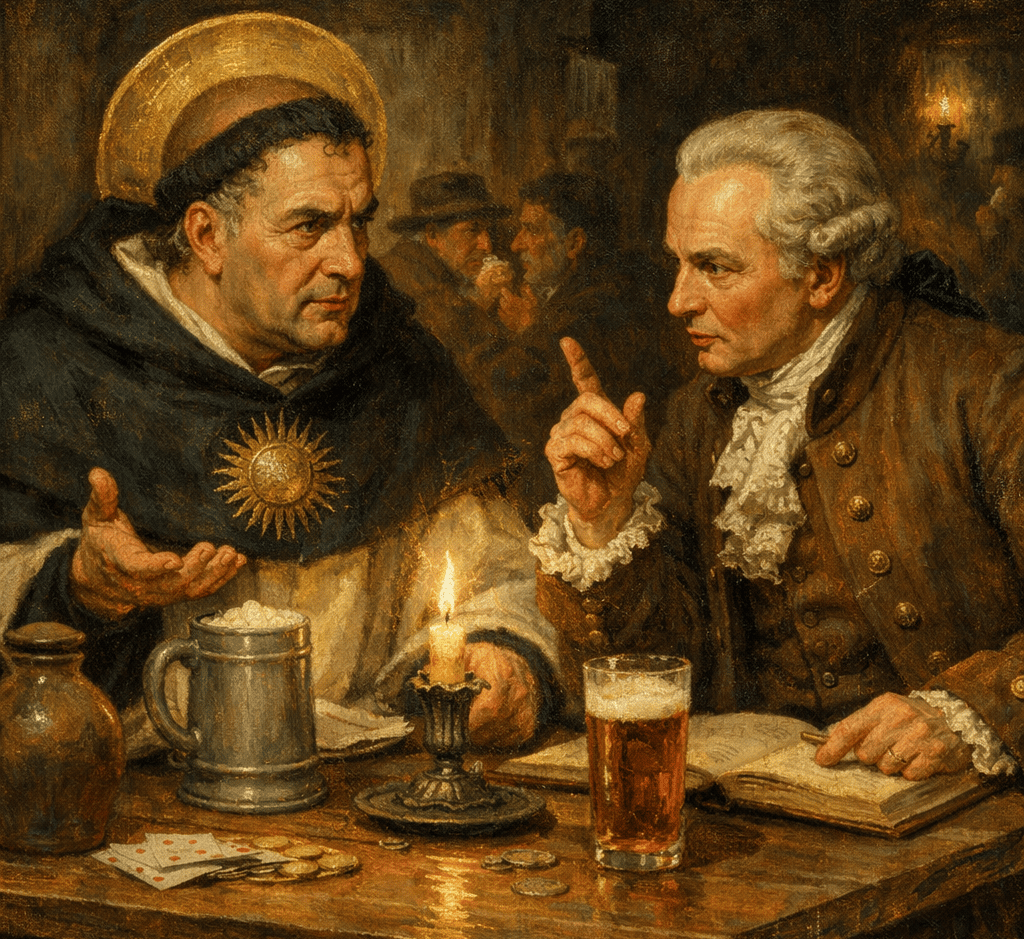
This debate arises from a genuine conversation in a bar about a fundamental theme of philosophy: whether human beings understand reality as it is or if they merely organize phenomena according to the structure of their own mind. The debate confronts the classical tradition (Socrates, Plato, Aristotle, and Thomas Aquinas) with Kant's theses on knowledge, identity, causality, and freedom.
Gabriel. G. Oliveira
3/16/202618 min read
A debate with a good friend
What follows is the result of a genuine dialog, one of those that begin with fatigue from human noise and end up touching on topics that most avoid because they require more than a superficial opinion. Bruno and I were in a bar, surrounded by banality, when the conversation slipped into a always controversial point: whether reality is something that the intellect can grasp, even if in a limited way, or if what we call the known world already reaches us so shaped by the mind that we never experience the real as real. It was from that point that questions arose about synthetic a priori judgments, identity over time, causality, evidence, object, morality, and freedom.
Thus, the debate is not about a pointless quarrel with Kant for fun in the university environment, nor is it a performance to display erudition in a bar. It occurs because there is a deeper problem behind these questions: whether human beings know being or merely organize phenomena; whether truth depends first on reality or the structure of the subject; whether the identity of things resides in them or is merely a mental construction; and whether human freedom is realized in real good or in empty autonomy. In other words, the dialog focuses on the very possibility of truth, world, and moral life, which is precisely the type of theme that seems abstract until the moment it begins to influence everything.
The bar was filled with that human noise that has always bothered me a little more than perhaps it should. Glass clinking on damp wood, loud laughter from an empty table inside, a waiter crossing the narrow aisle with the face of someone who had long lost faith in humanity, a silent television in a corner pouring images of a game that no one was really watching. It was the kind of place where banality seemed to want to prevail by exhaustion. And, even in the midst of that setting designed to stifle any contemplative impulse, there was Bruno, three years older, studying philosophy while I opted for business administration, with an expression of someone who had finally discovered a convincing justification to turn beer into metaphysics and pose into method.
He swirled the glass, threw a half-smile of academic provocation, the kind that many mistake for intelligence because they still can't tell irony from depth, and shot the phrase like someone casting bait and already expecting to catch the fish.
— Ah, because I only like deep and intellectual dialogs; I can't stand small talk. Alright, then let's go for it, friend. Clarify something for me: how can synthetic judgments a priori exist? Come on, folks, it's just a basic philosophy question.
I looked at him, then at the bar, and finally back at him, as if pondering whether it is more valuable to save a soul or to topple a system. Because there are occasions when the distinction between the two is minimal.
— Bruno, the first problem with your question is that it begins the debate by granting Kant a space that I am not willing to concede so readily. And that is precisely the subtle trick of modern philosophy when it seeks to appear inevitable: it presents the issue in such a way that the opponent's defeat is seen as a historical setback. Kant considers the possibility of synthetic a priori judgments as the central point of the Critique, as he seeks to demonstrate how universality and necessity are present in mathematics, in certain principles of physics, and in the conditions of experience, avoiding both dogmatic rationalism and skeptical empiricism. All of this is serious. The question is not trivial. However, the Aristotelian-Thomistic response begins earlier and, by starting earlier, sees more. The human intellect understands the real, not just the way the mind structures it. It knows the being as being, albeit in a progressive, abstract, limited, and laborious manner, without that youthful illusion of philosophical omniscience. The intellect does not create being; it apprehends it cognitively. Intelligence extracts the intelligible form from the sensible object. It does not establish intelligibility from nothingness over an amorphous chaos, acting as a transcendental secretary of the universe. Aristotle elaborates a metaphysics based on substance, form, matter, act, and potency, for he understands that, by dissolving the real in the mind, it is possible to preserve a system, but the world has already been lost.
Bruno laughed with the expression of someone who was already ready to respond even before hearing the complete answer. This is also a quite common university habit: the person doesn't listen, just waits for their turn to seem intelligent.
— However, that still does not answer. Kant asserts that some structures are not derived from experience, as the very possibility of experience depends on them. Space and time are considered forms of sensibility, while causality, substance, and unity are seen as categories. Without this, there is no object for us. How is it possible to preserve necessity and universality without Kant's Copernican revolution?
I answered slowly, both to be clear and to irritate him. There are beneficial irritations.
— Preserving the world before preserving knowledge. This is the complete point. Kant, in trying to escape from Hume, ends up paying a very high price for the flight. He does, in fact, recover the necessity, but he mainly shifts it to the structure of the cognizing subject. Instead of asserting that the intellect is proportional to being, he maintains that experience already emerges configured by transcendental conditions of subjectivity. The cost is high, even if it is presented in respectable German. You preserve the science of the phenomenon, but compromise intellectual access to the being of things as things. For an Aristotelian-Thomist, this represents an unnecessary amputation disguised as rigor. Aristotle did not need to assert that the mind legislates nature to elucidate science. He considers that there are forms, natures, principles, and causality in the real, and that intelligence, by abstracting, reaches the universal from the singular. Thomas simply elevates this to metaphysical maturity: truth is the conformity of the intellect with reality, and not the conformity of reality with the transcendental conditions of the subject. This distinction may seem abstract until you realize that one of the positions still trusts in the real, while the other keeps it under control.
Bruno leaned forward.
— Alright, but Hume eliminates causal necessity in the empirical realm. Kant responds: causality is a necessary condition for the possibility of experience. How are you going to respond? With depth? With format? With a beautiful medieval term?
Before answering, I took a sip. Not because I needed time to think. Just because some answers require calm.
— With metaphysics, Bruno. What the 18th century tried to classify as superstition ended up being relearned thru other means, sometimes simpler and more confusing. Hume can only dismantle causal necessity because he has previously restricted knowledge to the flow of impressions and habitual associations. He impoverishes before he destroys. Kant recognizes that this destroys science and hastens to preserve necessity, but he shifts it to the transcendental structure of knowledge. From the beginning, the Aristotelian rejects the Humean mutilation. Causality is not, above all, a psychological habit nor a subjective way of organizing information. It is the structure of the real that the intellect grasps thru movement, transformation, creation, corruption, dependence, and contingency. What changes requires comprehensible principles. Act and potential. Content and form. Material cause, formal cause, efficient cause, and final cause. No, this is not scholastic ornamentation to impress freshmen. This represents a serious attempt to explain why something is the way it is, why it changes, and why it remains. Kant rebuilds the bridge after accepting that the city was already in flames. Despite the historical limitations they faced, Aristotle and Thomas did not hand the city over to the barbarians and then called the rationing of critical lucidity.
With the enthusiasm of someone who believes that by quickly changing the question, the previous one disappears, he tapped his finger on the table.
— So, another one. What keeps the essence of something over time? Tell me.
— It depends on the type of thing, and that alone already demonstrates the primacy of classical metaphysics over modern formalism. Because the real is not a uniform mass awaiting proper classification. Aristotle stated that changes can be accidental or substantial. A pomegranate ripens and changes its color: the subject remains, the accident transforms. A seed transforms into a tree: there is evolution according to its form and potential. A living animal maintains its identity not thru the immobility of each material particle, which does not even occur biologically, but thru the presence of a substantial form that organizes the matter, characterizing that being as a specific type of entity. Matter refers to individuation, while form relates to the intelligibility of what the thing is. Thomas clarifies this even more precisely: essence is what defines a thing as it is; existence is what allows that essence to manifest. In simpler and more sincere terms, identity is not a sophisticated mental artifice, nor a label that consciousness uses to organize scattered flows and avoid panic. Identity is related to the ontological structure of being. The real has a habit of not depending on our conceptual gymnastics to remain as it is.
Bruno raised an eyebrow, as if to question exactly the point where he believed metaphysical language would fail.
— Therefore, is identity a characteristic of the object?
— Identity precedes its poorly structured dilemma. Before I express the judgment "A is A," the thing is already identical to itself. The mind identifies, categorizes, and evaluates. It does not invent the principle of identity as if the universe were waiting for permission from consciousness to avoid disintegration. This is a common modern vise: because it is present in the intellect, it is believed that intelligibility comes from the intellect as an essential source for the constitution of the known being. It does not appear. The concept is a mental form of understanding; the basis of the truth of the concept lies in the thing. Otherwise, all science would be nothing more than a coherent architecture of appearance. Beautiful, elegant, occasionally functional, but still superficial. And then you can have method, formalization, critical apparatus, seminar, committee, everything. It just doesn't have reality. However, the world resists. It corrects, refutes, belittles bad theories, and punishes epistemological fantasies. The real does not submit to our categorical system. Those who think this way tend to spend too much time reading comments and too little time observing what really exists.
A nearby table erupted in laughter over some nonsense that no one would remember the next day. The kind of laughter that reveals a complete lack of inner necessity. Bruno didn't even move.
— Don't run away. Tell me if identity is a characteristic of the object or a creation of the mind. Let's go for it. Speak.
— From the beginning, it's a poisoned distinction. If you impose the choice in these terms, you have already distorted the answer before receiving it. The explicit apprehension of identity, in the form of a formulated judgment, is an act of the mind, evident. However, the being is the ontological foundation of identity. A dog remains this dog due to the existence of a real subject that persists under variable accidents and the presence of a form that defines it as a kind of living being, and not because my consciousness chose to unite scattered perceptions with a transcendental line and subsequently named this objectivity. This was explained by Aristotle thru the distinction between substance and accident. Substance is autonomous; accident depends on something external. This is not a logical toy created to provide work for a scholastic commentator. It is a description of the way of existence. The issue is that modernity became so enamored with its own consciousness that it began to view the world as if it were a department subordinate to it.
He smiled like a teacher who believes he has finally caught the student.
— Moreover: how do you demonstrate that something is real before presenting the proof of that something? You know that's possible, right?
— Yes, and your question falls into a common confusion between formal demonstration and primary evidence. Not all knowledge begins with a discursive proof, and only those who are excessively bound to the method believe that reality needs to wait for deduction to begin to exist. There are both the principles per se nota, which are known by themselves at least to some degree in relation to their terms, and the initial data of the sensitive and intellectual experience of the being. No one exhibits the principle of non-contradiction without first employing it. No one expresses being in general without first encountering entities. Before systematizing, the intellect encounters the real. Thomas never claimed that everything begins with a deduction floating above the world; on the contrary, our knowledge starts with the senses and rises thru abstraction. Every demonstration is based on something previously established: an entity, a principle, an evidence, or an original presence of the real. Kant, by converting the conditions of objectivity into transcendent conditions of the subject, tips the balance excessively. The activity of the intellect is not denied by the Thomist. He simply refuses to venerate this activity as if it were essential for the being known as a being. Distinguishing cognitive mediation from transforming the mind into a kind of customs of the universe is a significant difference.
Bruno crossed his arms.
— But for you, what is evidence? This happens because, for Kant, the known object is already under a priori conditions. You cannot escape this. Everything you present to me already reaches me filtered.
— Yes, filtered. Produced, no. Evidently influenced by the human way of knowing. Therefore, it is not reduced to a mere phenomenon without achievable metaphysical intelligibility. That is the Kantian exaggeration. No one serious denies that we acquire knowledge thru human faculties. Thomism has never been that photographic naivett that some moderns create to ridicule a straw man. Abstraction is action. Judgment is action. Reasoning is an operation. However, from "there is a cognitive operation" one does not deduce "the known being, as known, is merely a constituted phenomenon." The intellect acts by abstracting the intelligible form, but it does not create the object. And here arises Kant's elegant contradiction. If human intelligence were completely imprisoned in its constitutive forms, without access to being, the transcendental discourse would lose its foundation. Because the thesis that "we only know phenomena" does not apply only to a personal phenomenon of mine. It seeks to be relevant to the structure of the relationship between knowledge and reality. Well, that already constitutes a robust metaphysical statement. Modernity always presents the same play: it expels metaphysics thru the front door and brings it back in thru the back, disguised as criticism and using more modest terms to simulate humility.
Bruno made an expression as if he had discovered a shortcut thru the side.
— And what about Plato? Are you going to tell me that Plato agrees with you against Kant? Because Plato is not a naive realist regarding the sensible world. Moreover, if you want to invoke Socrates, even worse: questioning, irony, aporia, none of that metaphysical catechism certainty.
— You are confusing depth with instability, which is a rather contemporary mistake and, to be honest, somewhat juvenile. Socrates is not useful for unraveling the truth; he serves to shake false security. He disturbs to purify, not to celebrate the collapse. Despite all the inherent problems of the theory of Forms, Plato maintains a fundamental conviction: the intelligible is more real, not less. The mind does not create the order of being; it ascends to it. Aristotle rejects the excessive separation of Forms proposed by Plato, but maintains the core of realism: the intelligible is not a subjective prison, but a dimension of the real that can be understood by the intellect. Thomas Christianizes and purifies all of this: the form does not exist in an independent heaven, it gives meaning to the substance; the created being possesses essence and act of being received; and truth remains the relationship between the intellect and the real. Yes, there are internal corrections in this entire Socratic, Platonic, Aristotelian, and Thomistic arc. There is no living tradition without purification. However, there is a clear unity against Kantianism: being is intelligible, and the intellect is ordered to being. Not to transcendental vanity in itself.
He didn't let go.
— And contemporary science? You mentioned the use of science. Doesn't science precisely eliminate classical metaphysics? Wasn't that the aspect since modernity?
I laughed, for this issue carried centuries of lazy simplification.
— This is one of the favorite myths of those who have read too much theory and too little practice. Contemporary science has eliminated a significant amount of misinterpreted Aristotelian physics, ancient cosmology, empirical errors, and excessive reliance on schemes that needed correction. Excellent. Good. However, it did not eliminate the metaphysical question. In fact, it depends on it all the time, even when it pretends not to depend on it. Scientific practice presupposes organization, consistency, clarity, invariability, structure, permanence in relationships, distinction between appearance and explanation, and difference between model and represented reality. It assumes that there is something to be known and that this something is not simply an effect of our categorical mood. Even contemporary approaches to scientific realism and structural realism assert that our best theories reflect something true about the structure of the world, and not just about the internal organization of experience. This, evidently, does not restore Aristotle's physics, but advances in a direction much more favorable to metaphysical realism than to the strict Kantian confinement. Respectable science did not teach us that everything boils down to appearance organized by the mind. It previously taught us that the world is intelligible enough to be explored and resilient enough to debunk our illusions.
Bruno interrupted:
— However, structural realism does not preserve Aristotelian substance.
— It is not necessary to preserve all aspects of Aristotelian physics to convince me that transcendental subjectivism is excessive. That is the crux of the matter. Subsequent scientific progress did not lead humanity to conclude that it only understands appearances formed by the mind. Instead. Many strands of the philosophy of science argue that predictive success, mathematical stability, the preservation of structure in theoretical changes, and experimental resistance indicate the existence of a structured and independent world, to which our theories partially, correctable, imperfectly, but truly adapt. You may not have returned to 1274, and no one sensible is demanding that. However, it is not necessary to remain in Königsberg as if the history of thot had come to an end there by an academic decree.
He smiled sideways, as if trying to divert the subject to avoid facing the heart of the matter.
— You know that Kant did not deny the existence of the external world, right?
— It's obvious that I know. That straw man is too vulgar to be considered. The problem is more subtle and, therefore, more serious. Kant recognizes the existence of the thing-in-itself, but considers it unknowable in that state. Result: what we know objectively is the phenomenon manifested in the forms of sensibility and the categories of understanding. However, the metaphysics of the being as being remains compromised. The Thomist asserts something different: we have a limited, analogical, and imperfect knowledge, which begins with the senses and rises intellectually. However, this knowledge connects us to reality itself, and not to a closed theater of formed appearances. Human limitation does not require metaphysical agnosticism. It requires ontological humility, intellectual rigor, and conceptual patience. Things less exciting than a Copernican revolution, I acknowledge. However, generally more authentic.
A waiter left two beers without asking for permission. Bruno thanked with an automatic gesture, keeping his gaze fixed on me. It was curious how real life kept intruding on the conversation to remind us that the world hadn't paused its existence while we were talking about it.
— And the moral of the story? Are you going to tell me that Kant fits in here too? Because I want to see you deal with autonomy, dignity, and the categorical imperative without turning it into a moral discourse.
— I don't need to preach because the Kantian problem in morality is the same as in the theory of knowledge, just with a different appearance: excessively formalistic, not very natural, with less ultimate purpose and less real good. The classical and Thomistic tradition questions the essence of man, his nature, his purpose, what activates his powers, and what directs him toward the good. Kant defends an ethics based on pure practical reason, autonomy, and the formal universality of the maxim. This results in an admirable ethics in certain aspects, especially against weak sentimentalism and superficial utilitarianism, but at the cost of a teleological emptiness. In the classical sense, the action considered good is not limited to that which follows a universalizable form. It is the one that enhances rational nature according to the truth of the good. The will does not elevate itself by floating above nature as pure self-legislation. It is dignified by conforming to the real good. The moral law does not arise from the will as an empty sovereignty; it emerges from the understanding of the good, which is embedded in the order of being and in rational nature. The modern listens to this and considers it servitude. The problem is that he has already become accustomed to considering any internal variation that has the appearance of choice as freedom.
Bruno responded promptly:
— At this point, you have fallen into heteronomy.
— No. I fell into metaphysics. Heteronomy would be an external imposition that violated the essence of the agent. However, for Thomas, natural law is the participation of the rational being in the eternal law. Simply put, reason identifies in the human being an objective disposition toward good. Following the good is not servitude, it is perfection. Only a modern individual highly trained to conceive freedom as indifference or empty self-assertion is capable of looking at dependence on truth and interpreting it as slavery. On the contrary. Without the truth of being, freedom becomes a creation without purpose, a potential without action, a choice without criteria, and a movement without form. It ends up becoming, in the end, what modern man most hesitates to acknowledge: a person surrounded by choices and eager for guidance.
He looked me in the eyes, now without irony, as if the conversation had stopped being a display of attitude and started touching where it really mattered.
— So you are claiming that Kant is a greatly misunderstood savior? A brilliant man who endeavored to preserve Hume's knowledge, the morality of empiricism, and the religion of rationalism, however, might have cut too much?
— Precisely. And that is the valid criticism, not the distorted one. Kant is too grand to be reduced to an internet meme and, at the same time, too erroneous to receive automatic reverence from an awestruck student. He recognizes human disaster, seeks to preserve necessity, science, and morality, but restructures everything based on a transcendental philosophy in which the legislating subject has an excessive role. The classical tradition would argue that he did not need to modify access to the real in this way. It was necessary to reestablish a solid metaphysics of being, causality, substance, form, purpose, and truth. In this regard, Aristotle and Thomas remain more relevant than many of Kant's critics would like to acknowledge. The current continuity of discussions about substance, realism, structure, causality, and nature indicates that the end of metaphysics has always been anticipated. Modernity loves to declare authors dead to whom it still needs to respond.
For a moment, the bar seemed to retreat. The noise, of course, persisted. But distant. As if, when the thot touches something truly serious, it generates a kind of internal silence that even the most unbearable background music cannot break. It's unusual. And precisely because it is rare, it tends to cause more discomfort than persuasion.
Bruno ran his hand over his face.
— Ok. So, answer me directly, without resorting to Latin or scholasticism: why do you believe Kant is wrong?
Before speaking, I finished the glass, more to appreciate the gesture than out of dramatic necessity.
— Because he seeks to explain the conditions of knowledge while maintaining objectivity, but does so at the cost of excessively shifting the origin of intelligibility to the subject; and, in doing so, he precisely weakens what is essential for the complete sustenance of philosophy and science: the primacy of being over knowing.
He remained silent. And his silence, at that moment, carried more weight than any answer.
I continued, now without hurry, as the most important things had already been said; the rest was just for her to process.
— Socrates would have questioned more, for he understood that the beginning of wisdom is the ruin of false security. Plato would have elevated his vision to the intelligible world, for he understood that human beings do not feed solely on sensible superficialities and structured opinions. Aristotle would have demanded definition, cause, substance, and act, for he understood that without the structure of the real, there is no science, only the management of phenomena. Thomas would have differentiated essence from existence, emphasizing that intelligence is destined for the being, and not to spin aimlessly within itself, like an animal trapped in a wheel. And the Church, in its highest intellectual body, from Augustine to Thomas, from Boethius to the great later commentators, never considered reason as a prisoner of the real, but as a force directed toward the truth. Contemporary science, in its best functioning, also does not assert that the world is merely a well-structured appearance. Instead, it demonstrates that there is an objective order, a resistant structure, a regularity that does not depend on will, and a reality that requires man to learn from it, rather than merely legislate over it with the pomp of someone who discovered their own subjectivity yesterday and already wishes to transform it into a tribunal of the cosmos.
Bruno smiled, but now with a tired look, as if he had realized that the conversation had left the superficial realm and entered the uncomfortable area where ideas begin to demand accountability.
— You know this would lead to a semester-long fight, right?
— Better this than drowning in idle chatter.
The table next to us resumed their loud laughter over some trivial matter. The waiter began to collect the empty bottles. The outside world continued as always, indifferent to the philosophical trends of the century, academic vanity, the sophistication of systems, and the intellectual charm of any conceptual prison. And perhaps that was precisely what bothered the bar Kantianists the most. The real persists in its bad tendency to exist before our conditions of possibility.
BIBLIOGRAPHIC REFERENCES
AQUINO, Thomas of. Summa Theologica. Translation by Alexandre Corrêa. São Paulo: Loyola, 2005.
AQUINO, Thomas of. The Being and the Essence (De ente et essentia). Translation by Carlos Arthur Ribeiro do Nascimento. São Paulo: Loyola, 2002.
ARISTOTLE. Metaphysics. Translation by Giovanni Reale. São Paulo: Loyola, 2002.
ARISTOTLE. Physics. Translation by Lucas Angioni. Campinas: Editora Unicamp, 2009.
ARISTOTLE. Categories. Translation by Edson Bini. São Paulo: Edipro, 2010.
ARISTOTLE. Nicomachean Ethics. Translation by Antonio de Castro Caeiro. São Paulo: Atlas, 2009.
AUGUSTINE, Saint. Confessions. Translation by J. Oliveira Santos. São Paulo: Paulus, 2017.
AUGUSTINE, Saint. The City of God. Petrópolis: Voices, 2012.
BOETHIUS. The Consolation of Philosophy. Translation by Carlos Arthur Ribeiro do Nascimento. São Paulo: Martins Fontes, 2012.
CHESTERTON, Gilbert Keith. Orthodoxy. São Paulo: Ecclesiae, 2017.
CHESTERTON, Gilbert Keith. The Everlasting Man. São Paulo: Ecclesiae, 2014.
KANT, Immanuel. Critique of Pure Reason. Translation by Valério Rohden and Udo Baldur Moosburger. São Paulo: Abril Cultural, 1999.
KANT, Immanuel. Critique of Practical Reason. Translation by Valério Rohden. São Paulo: Martins Fontes, 2002.
KANT, Immanuel. Groundwork of the Metaphysics of Morals. Translation by Paulo Quintela. Lisbon: Edições 70, 2007.
PLATO. The Republic. Translation by Maria Helena da Rocha Pereira. Lisbon: Calouste Gulbenkian Foundation, 2001.
PLATO. Phaedo. Translation by Carlos Alberto Nunes. Belém: EDUFPA, 2011.
PLATO. Timaeus. Translation by Carlos Alberto Nunes. Belém: EDUFPA, 2001.
REALE, Giovanni; ANTISERI, Dario. History of Philosophy: Antiquity and the Middle Ages. São Paulo: Paulus, 2003.
GILSON, Étienne. The Spirit of Medieval Philosophy. São Paulo: Martins Fontes, 2006.
GILSON, Étienne. Philosophy in the Middle Ages. São Paulo: Martins Fontes, 2007.
COPLESTON, Frederick. History of Philosophy: From Kant to German Idealism. São Paulo: Loyola, 2001.
COPLESTON, Frederick. History of Philosophy: Greece and Rome. São Paulo: Loyola, 2001.
HEIDEGGER, Martin. Kant and the Problem of Metaphysics. Lisbon: Edições 70, 2003.
VOEGELIN, Eric. The New Science of Politics. Brasília: University of Brasília Press, 1982.
VOEGELIN, Eric. Order and History. São Paulo: Loyola, 2010.
POPPER, Karl. The Logic of Scientific Research. São Paulo: Cultrix, 2007.
KUHN, Thomas. The Structure of Scientific Revolutions. São Paulo: Perspectiva, 2017.
LADYMAN, James. Comprender la filosofía de la ciencia. London: Routledge, 2002.
WORRALL, John. Realismo estructural: ¿lo mejor de ambos mundos? Dialectica, vol. 43, p. 99–124, 1989.