


When Power Forgets the Good: Machiavelli, the Death of Virtue, and the Labyrinth of Modern Conscience
Where does the foolishness in modern administration come from? A philosophical critique of Machiavellian ethics and the modern tradition that removes God and virtue from the core of human existence. The text exposes how the subjectivism from Machiavelli to Marx converts power into a criterion of truth and destroys the ethical consciousness of the human being, amidst authentic discussions, intellectual history, and moral analysis.
Gabriel. G. Oliveira
3/15/202631 min read
Machiavellianism and Human Stupidity
Machiavelli's mistake is not a technical management error. It is more serious. It is a mistake of the soul, of human perspective, and of worldview. When the error reaches this level, everything else rots along with it, for technique never resolves a metaphysical rot; at most, it camouflages it with spreadsheets, protocols, and appearances of competence. For this reason, Machiavelli should not be interpreted as a practical guide for any type of administrator, whether public, private, school, domestic, or any other. He who turns to Machiavelli to learn how to govern is already starting off defeated, for he accepts the idea that power can be legitimized by effectiveness and that virtue can be reduced to a mere ornament for public discourse. From that point on, my friend, there is no administration. Only the management of degradation exists.
The heart of the matter is simple, despite being wrapped in centuries of pedantic rationalization. By removing God from the ethical horizon, there is no neutrality left; there is only the human assuming the throne. And when man assumes this throne without referring to an objective perfection, he does not become freer. He ends up becoming more surrendered to his own passions, fears, and interests, and, worse yet, he starts to consider this as realism. This is the great fraud. Vise disguises itself as lucidity, cowardice presents itself as prudence, and manipulation is offered as political intelligence. It is at this point that God is philosophically killed, not in Nietzsche's dramatic outcry, but much earlier, at the moment when ethics stops focusing on the perfect being and begins to revolve around human convenience.
For this reason, discussing Machiavelli is not limited to the political sphere. It is a discussion about the consequences of replacing the idea of perfection with that of utility. In an objective ethics, the human being does not create the good; they identify it, even if imperfectly, and seek to organize their life toward it. In a subjective ethics, on the other hand, the individual accepts nothing but themselves; they negotiate, rename, adjust, relativize, and ultimately consider their own will as the criterion. For those who appreciate slogans, it may seem like emancipation, but in reality, it is just a sophisticated regression. It is man abandoning the measure by the height of the real and starting the measurement by the width of his own whims.
The child understands this before any university professor starts citing German authors. She doesn't write in Latin, doesn't draft treaties, can't differentiate metaphysics from anthropology, but she understands. She understands that harming an innocent person is, by nature, something wrong. He notices that theft is not "a social construct" when her toy disappears. It is noted that evil exists before any doctrine presents a theoretical veneer to try to absolve the guilty. It is evident that it requires education, practice, guidance, example, and reference. I am not idealizing the child as a little Buddha in a diaper. I am asserting something different: the human being has a real understanding, even if initial, of good and evil. And without this, moral education would not be viable.
It is precisely for this reason that this absurd discussion about good and evil being "dualism" should be discarded. No, distinguishing good from evil is not a form of gnostic dualism. Gnostic dualism is different: it is conceiving equivalent and almost symmetrical principles, as if evil had the same ontological density as good, and both needed each other to exist. This is a distortion of thought, not serious metaphysics. In the classical and Christian tradition, evil is not considered a god opposed to God; it is understood as deprivation, disorder, parasitism, and rupture. Whoever confuses this either read it wrong or didn't read anything and is just repeating a ready-made phrase with the self-confidence of fools, which has always been one of the most stable forces in history.
When Saint Alphonsus Liguori emphasizes the formation of conscience and the seriousness of sin, he is not creating a moral theater to dominate the faithful. It starts from the premise that the human being is capable of clouding their own conscience, distorting their own judgment, and becoming accustomed to vise to the point of considering mud as clarity. This is what modernity, despite its libertarian appearance, has achieved the most. It did not exempt man from error; it gave error a sophisticated appearance. Moral subjectivation did not result in solid autonomy. It instituted a license for rationalization. And the result is evident to anyone with two eyes and a minimum of honesty: individuals increasingly skilled at justifying the unjustifiable, as long as it brings them benefits, status, pleasure, or psychological relief.
Thomas Aquinas acts as a barrier against this delusion, for in his philosophy, reason is not used to create morality on demand, but to recognize the order of being and the purpose of human actions. The good does not arise from my desire. The good is not what brings me advantages. The good is not an imposition of will devoid of content. The good is everything that enhances nature according to its purpose. This does not magically resolve all concrete situations, of course, as life is not limited to a blackboard, and prudence is necessary precisely because of the complexity of reality. However, this avoids the great fraud: the idea that, because it is difficult to apply, the criterion no longer exists. Modernity committed exactly that fraud and then had the audacity to consider itself mature.
When someone claims that God is "far above" human morality to the point where good and evil become indecipherable, that person is not expressing transcendence. It generated sacred arbitrariness. And sacred arbitrariness is the quickest way to turn God into an incomprehensible demiurge, a lord of whims, a force capable of both glorifying justice and sanctifying cruelty. That was it. In that case, there was no theology left, but rather cosmic tyranny. That is why this Protestantism, which diminishes free will and makes God's moral order unfathomable, easily falls into absurdities. If there is no comprehensible order of good and if divine will can transcend any cognizable criterion, then any atrocity can be justified as purpose. At this stage, one is already close to gnosis. One is immersed in it, just with less historical honesty and more underlined Bible.
Here, the question of free will is not a devotional aspect. It is a metaphysical defense that prevents the conception of God as the positive author of evil. If man is not truly free and if evil is inherently part of the order due to an absolute will that defines it, then moral discourse turns into theater and God becomes a tyrannical figure. And then they still demand that the person accept this as if it were a demonstration of respect. It's not about reverence. It's chaos. It is a demonic confusion, using the precise expression that Olavo de Carvalho employed in the title of one of his books about Machiavelli. When the moral order becomes opaque, politics quickly begins to call violence zeal and oppression duty.
History is full of this type of atrocity committed under the guise of religious faith. Protestant governments that imposed conversion under penalty of death did not arise out of nowhere as an accident without origin. They result from a logic in which human access to the moral order is fragmented, and power authorizes itself to act violently in the name of a good that it itself controls. If I cannot clearly understand the order of good, but I can see myself as part of a higher plan, then any atrocity becomes justifiable. The thot is always the same: I killed for love, I pursued for purity, I censured for salvation, I destroyed to protect. Hell appreciates this type of rhetoric, as it allows the executioner to have a good night's sleep.
It is in this context that Machiavelli thrives. He doesn't appear out of nowhere. He is a sequence. First of all, it is a continuation of the sophist. The sophist had moved philosophy from the love of truth to the skill of triumphing in arguments. The essential thing ceased to be adjusting the soul to reality, but rather mastering language to make an impact, gain support, and obtain benefits. Machiavelli applies this to the exercise of power. What was once a verbal sophism transforms into a state sophism. It doesn't matter if the action is intrinsically low; what matters is that it contributes to the consolidation of the prince. It doesn't matter if the act corrupts the city; what matters is that it maintains the control machine. Moral truth is no longer the measure of power. Practical truth becomes measured by power. And this inversion is detrimental from the very beginning.
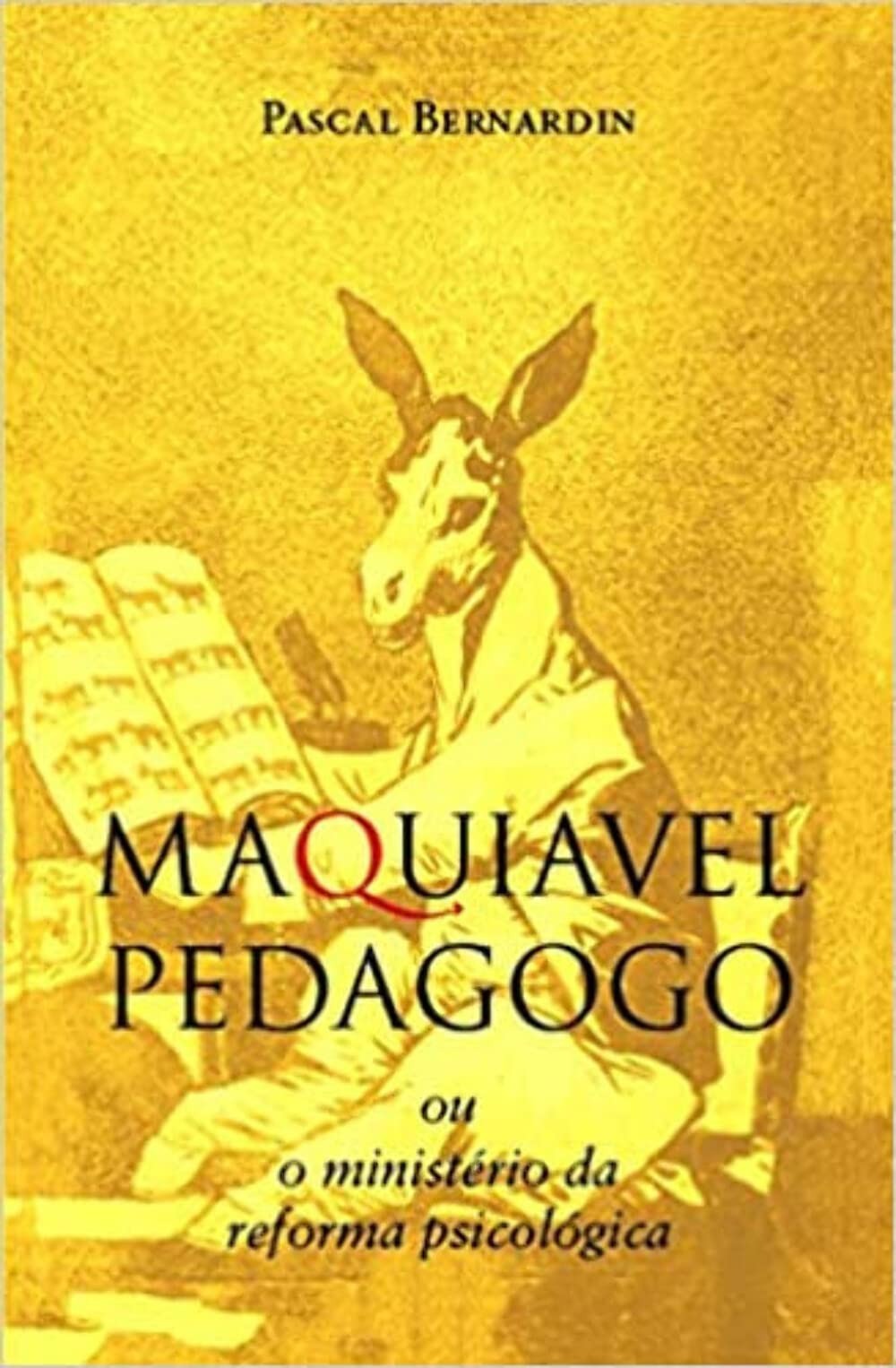
For this reason, it is absurd to hear an administrator cite Machiavelli as if he were a rigorous, mature, and disillusioned author, almost a doctor of politics. Doctor nothing. Machiavelli is an educator of cynicism. He teaches intelligence to submit to vise, referring to it as historical lucidity. Pascal Bernardin, in Machiavelli the Educator, clearly understood that the issue is both political and formative. There is a complete pedagogy of degradation present: to habituate the mind to the notion that manipulation is common, that lying is functional, that morality is for the naive, and that the competent ruler is the one who knows how to balance violence, image, and convenience. This does not develop leaders. It forms operators of decay.
The old justification that Machiavelli merely portrayed the world as it is is also nothing more than a simple maneuver. This justification is adored by every corrupt person. "I'm just being realistic." "That's how things happen." "You are quite idealistic." It's curious how their realism always ends up favoring the lowest part of human nature. It is never realistic to acknowledge the demand for virtue, the rigidity of internal discipline, the gravity of justice, the price of honesty. No. Modern realism has a peculiar tendency to assert that vise is inescapable, while virtue is merely an adornment. What a convenient coincidence. It's not about analysis. It's a capitulation with technical terminology.
The distinction between the virtuous king and the Machiavellian prince is not of a literary nature, but of a civilizational order. There were holy kings, extremely just rulers, and political structures based more on honor, liturgy, moral duty, and a sense of balance than on that hysterical calculation of control that many today confuse with governance. Economic growth in societies with a Catholic ethic was not the result of well-executed Machiavellianism. In many cases, it resulted from an objective moral order, although imperfect in human practice, but objective in its criteria. The problem is that modernity likes reinterpretations of the past based on categories that are already poisoned.
It is at this point that Max Weber is wrong from the beginning. When addressing certain dynamics of capitalism as if its superiority were related to the Protestant ethos in opposition to Catholicism, he is generally analyzing economic structures formed by Protestant and rationalist assumptions, and then referring to their effects as a comparative measure. This is a confusion of cause, form, and name. One cannot claim that an economy is Catholic simply because there are Catholics living in an economy that is philosophically Protestantized. The basis of the matter is important. The categories are relevant. The essence of order is significant. If the structure has already been reconfigured according to principles that eliminate moral teleology and subject life to calculation, it is useless to simply apply demographic statistics and pretend that this has resolved the metaphysics.
At various moments, Adam Smith demonstrates this change by seeking to reconcile economic freedom with a moral context that is no longer based on the old classical teleological order, but on a sensibility influenced by a new anthropology. The issue is not limited to the market, as the simple-minded often claim, nor solely to religion, as others try to disguise. The issue lies in the type of man who maintains the economic order. If man is no longer evaluated by virtue, the economy transforms into a technique of desire; if politics is no longer evaluated by justice, it becomes a technique of control; if education is no longer evaluated by truth, it turns into a technique of producing adherence. In this regard, Machiavelli is not an isolated author. It is a milestone.
He is one of those individuals who take a latent corruption and make it official. The political vise already existed before him. The man did not become miserable in Florence. However, one thing is the practical misery of incompetent rulers within a moral order that still judges them. Moreover, there is the problem of transforming this failure into doctrine, granting it the status of intelligence, and teaching it as if it were a superior art of governance. It is this second aspect that Machiavelli addresses. He does not create the disease, but he gives it method, verbal dignity, and the ability to be culturally transmitted. From that point on, evil gains a manual, and the manual begins to educate people who consider themselves too smart to be good.
It is for this reason that he is a sophist in the fullest sense. The sophist seeks to win; the philosopher seeks to understand. The sophist seeks impact; the philosopher seeks conformity with being. The sophist controls the discourse to influence opinion, while the philosopher refines the discourse to uphold the truth about reality. Machiavelli is a sophist armed with the State. I don't care how disturbing this is for those who call him a pragmatic genius. Sometimes, a man's genius boils down to making the error more attractive. And it is at this point that modernity stands out: taking old corruptions, refining them conceptually, and presenting them as intellectual courage.
The impact of this displacement is significant, for when man becomes the final measure, the entire notion of perfection deteriorates. It is no longer about directing the soul toward what surpasses and judges it. It refers to validating passions, interests, and projects thru an adapted moral language. Perfection transforms into performance, virtue into reputation, prudence into image strategy, justice into a tool of faction, and courage into authorization for brutality. Man no longer ascends to the good; instead, he adapts the good to fit himself. It is at this point that modern mass misfortune begins.
Because Machiavelli is not confined to Machiavelli. This is the aspect that many people do not realize. He continues. He remains in Descartes, in a different way. It continues in Kant, in a different way. It remains in Hegel, in Marx, in Gramsci, each with their own language, their conceptual theater, and their specific type of damage. I am not asserting that they are all the same, as if the history of ideas were a sequence of identical dominoes. I assert that there is a constant process of subjectivation and displacement of the objective moral order. In Machiavelli, this manifests in power; in Descartes, in knowledge and the connection between mind and reality; in Kant, in the structure of morality; in Hegel, in history; in Marx, in the complete restructuring of the human being; in Gramsci, in culture and education as instruments of molecular transformation.
For example, many teachers treat Descartes as a great hero of reason, although he is responsible for much of the subsequent confusion. To escape skepticism, the individual decides to take refuge in a method so artificial that it ends up fleeing the world and enclosing itself in its own mind. "I think, therefore I am" has become an intellectual medallion for many people who never understood the strange operation behind it. It's not that the phrase is false as a minimal observation. The issue is the shift in focus it establishes when considered the basis of knowledge. Reality is no longer the primary horizon, and consciousness begins to act as a preliminary court for everything. The door to subjectivism is thrown wide open, and then no one understands why the West began to live surrounded by people who believe that feeling something intensely is enough to make it true.
The irony is that this method, presented as a triumph of clarity, generates an immense metaphysical fog. Man transforms into an almost thinking ghost immersed in a bodily machine. The ontology of the body loses density, and the mind is considered a separate substance, almost an entity detached from the world. Done: Cartesian dualism was established, which would later affect everything, from politics to popular psychology, from superficial spirituality to the most absurd identity theories. The distinction between body and essence, between lived experience and mental self-concept, acquires philosophical legitimacy. Centuries later, the world is full of people fervently claiming that they were born in the wrong body, as if all metaphysics could be dismantled by a well-presented subjective outburst in therapeutic language.
The most curious thing is that Descartes believed he was overcoming skepticism, but in reality, he contributed to the creation of an environment conducive to new forms of skepticism and solipsism. The contemporary man becomes a prisoner of his own interiority and begins to negotiate reality according to what his mind is capable of accepting with "clarity and distinction." This is just the beginning of the party. Subsequently, complete systems of reality restructuring based on categories generated by subjectivity will emerge. The individual no longer wishes to know being. He wishes to ensure a method that allows him to reconstruct the world from himself. The temptation of Eden, always with new disguises, persists: not to obey the order, but to establish it.
Kant, therefore, assumes the role of a bureaucrat of moral abstraction. It is surprising that there are still people who consider Kantian ethics a lofty continuation of Aristotle's. This is typical of those who have read the names but not the structures. Morality, according to Aristotle, is conceived from the human purpose, the formation of character, prudence, and the golden mean, always considering the concreteness of life and the flourishing of the soul. Kant converts morality into a formal machine of universalization, a tribunal of duty stripped of the concrete density of existence. The result may impress a teenager who appreciates rigorous logic, but in real life, it soon reveals its grotesque flaw: the inability to deal with moral complexity without resorting to absurdities.
To discredit this claim, the classic example suffices. If you harbor an innocent friend and a pursuer appears asking where he is, the Kantian formula tends to suffocate the specific situation under a general rule. Aristotle would not act that way, as he believes that prudence is not relativism, but rather a moral intelligence that relates to reality. Courage, justice, friendship, concrete responsibility, and the purpose of the act are relevant. In this context, lying is not seen as a corrosion of the moral order, but as a cautious response to an injustice that is occurring. Moral life is not an exercise for a good German student. It is about the struggle of the soul in real-life situations.
Moreover, Kant distorts morality by excessively dissociating reason and inclination, as if compassion compromised the purity of the act and only impersonal duty could ensure ethical integrity. This represents a limited conception of the human being. Aristotle understands that virtue requires the orderly integration of reason, habit, affection, and action. The virtuous man is not a legalistic robot who follows rules without considering the heart. It is a person whose soul has been shaped to love the good with discernment and to act correctly with appropriate pleasure. Kant produces a rigid moralism, capable of being institutionalized and, in essence, extremely dangerous, for the individual who learns to venerate the abstract form of the norm tends to become blind to the real violence committed in its name.
This line, not by chance, ends up finding space in political systems that demand the submission of the individual to rational structures considered superior. Contemporary subjective ethics has this detrimental irony: it begins by extolling the independence of the individual and ends up subjecting them to the abstraction of the State, History, Class, General Will, Reason, Party, Technique, or Market. Man believes he is emancipated, but ends up more domesticated than before. He left God and fell into the machine. I left metaphysics and entered social engineering. Left virtue and entered behavior management. A great deal, indeed.
Hegel exacerbates the situation by conceiving history as an absolute process of self-unfolding, while Marx brings it to the material and revolutionary plane, transforming the historical structure into a field of immanent redemption. Politics ceases to be a caution regarding human nature and becomes an instrument to create a new human being. When this happens, there are no more serious limits. Everything can be set aside in favor of the future. In the name of synthesis, everything can be reduced. Every tradition becomes an obstacle, every mediation turns into a delay, and every organic bond is seen as an oppression to be overcome. And the funniest thing is that they still refer to it as science. Ancient religion promised heaven; ideological modernity promises a paradise on earth, managed by bitter people with laboratory language.
Gramsci deeply understands this movement and, therefore, turns to Machiavelli with an almost obscene naturalness. He understands that lasting power is not based solely on coercion, but also on cultural formation, language, education, mental habits, and the symbolic reconfiguration of the perception of reality. In other words, it is not enough to simply command; it is necessary to shape the way people perceive the world. This is deep, sophisticated, and pedagogical Machiavellianism. The prince transcends the figure of a physical ruler and spreads as a diffuse logic in institutions, schools, universities, the press, curricula, and popular sensibility. The conquest ceases to be merely territorial and becomes ontological, for the purpose is not only to control behavior but also to transform what people consider normal, just, possible, desirable, and even thinkable.
That is why many ideas in contemporary educational thot are influenced by Gramsci, even when his name is not mentioned. The school ceases to be a space where the spirit is introduced to the real world, where deep intellectual training is carried out, where moral maturity is promoted, and where language is learned as a means of accessing truth. It transforms into a factory of politically advantageous sensitivities. The student is no longer considered someone who needs to be elevated to reality, but rather as a flexible material for the construction of a worldview. And notice the irony: all of this is presented with the language of liberation. The person is manipulated into thinking they are being liberated. It is a form of servitude that has learned to employ protest t-shirts and therapeutic language.
Paulo Freire, in various applications of his work in Brazil, fits into this context as a component of a pedagogy that prioritizes the formation of ideological consciousness over contemplative intelligence. I am not here simplifying or asserting that all critical education is automatically Gramscian. That would be careless. I assert that there is a predominant axis of formation in which objective truth loses its centrality, and education is seen as a means for the political repositioning of subjectivity. This undermines the spirit of the student. He unlearns to observe and starts to distrust according to the script. Unlearns to think and learns to align. Unlearn to love the real and learn to turn everything into a conflict of narratives. Then, this is called historical consciousness. I call this intellectual mutilation with pedagogical recognition.
The most concerning thing is that this entire line does not remain solely in the realm of ideas. It creates human types. The Machiavellian, the enchanted Cartesian, the legalistic Kantian, the historicist Hegelian, the eschatological Marxist, the cultural Gramscian are all, to varying degrees, manifestations of a soul distorted by the same seduction: adapting the real to a model that justifies human will detached from the order of being. Some do it for the sake of efficiency, others for the sake of certainty, others for the sake of reason, others for the sake of history, and others for the sake of future justice. The name changes. The intoxication persists. There is always the same desire to exchange reality for a mental map cloaked in moral authority.
It is at this point that gnosis returns, and it does so with a frequency that borders on the comical. Because whenever someone has that inner epiphany of "now I understand the secret code of the world, now I've left the Matrix, now I've seen what others don't see, now I can reorganize everything," you can be sure: the gnostic temperature has risen. Gnosis is not just an ancient religious system with strange denominations and exotic cosmologies. It is a habitual mental configuration. It is about the rejection of reality in favor of a supposedly superior key of interpretation, held by a few, which justifies a complete break with the established order. She loves to disguise herself as liberation. In practice, she almost always ends up ignoring the real man.
For this reason, subjective ethics produces gnosis with great ease. When there is no longer an objective order of good to which the soul must adjust, the individual needs a new source of legitimation. And this source becomes inner illumination, historical consciousness, revolutionary will, absolute authenticity, the creative force of the self, psychological insight, trauma elevated to a moral tribunal, or any other contemporary entity that plays the role of replacing being with sovereign interpretation. At this point, man no longer wishes to be adjusted by reality. He wants to fix it. Does not wish to be instructed by the truth. Wants to create truth. Does not wish to seek quality of life. Wants to allow their own deformation and call it emancipation.
In this context, Machiavellianism goes beyond mere political cynicism. It is a phase of modern gnosis. It is the point at which it is concluded that the objective moral order is insufficient for matters of power and, therefore, needs to be diminished. From that point on, the ruler stops asking: "Is this just?" Question: "Does this preserve me?" Doesn't question: "Does this improve the city?" Question: "Does this assure me?" Does not question: "is this in accordance with the truth of man?" Question: "Is this effective?" And that's it. The "works" becomes an idol. And like every idol, it requires human sacrifice.
At this point, some try to justify Machiavelli, claiming that he merely distinguished private morality from public morality. As if that were a solution and not a death sentence for politics. If public morality can act based on criteria different from basic human morality, then what you are asserting is that power has been authorized to be less virtuous than the common man. Observe the monstrosity. The family man must be honest, the friend must be loyal, the judge must be just, but the ruler, who is the one whose choices affect many people, would be allowed to act according to a lower moral standard? This is not refinement. This represents the institutionalization of vise. It is about converting the degrading exception into a state norm and then calling it political maturity.
It is interesting to note that, at various times, ancient paganism had healthier intuitions than that. Not because paganism, as a structure, has reached the purity of Christian theology. It did not succeed. Frequently, the gods were depicted in an anthropomorphic, passionate, ambiguous, and, on some occasions, even monstrous manner. Olavo de Carvalho was correct in pointing out that many of these gods resembled demons or deeply unstable intermediary entities more than the entirely good God of the Christian tradition. Even so, modernity, with all its presumption, often dismissed the sincere effort at moral objectivity by some pagan philosophers.
The Stoics are a curious example precisely for that reason. They are, evidently, not Christians. Their cosmology presents serious difficulties; their monism and materialism create confusing paths. His conception of pneuma, of logos permeating nature, and of divinity immanent in the cosmos diverges significantly from the distinction between creator and creature in Christian thought. However, it is undeniable that there is a robust attempt to conceive an objective rational order, a comprehensible nature, and an ethical life in accordance with the logos. This places them on a higher level compared to many contemporary moralists who consider themselves sophisticated for being able to quote two words in German and three in French, while they sink into an elegant subjectivism.
It is also true that Stoicism, particularly in its later reception, had a great influence on various esoteric, hermetic, and occult currents. This is easy to notice. The concept of correspondence between things, a logic or symbolic intelligibility present in nature, the notion that myths contain truths that require a deeper interpretation—all of this contributed to the development of later traditions of esoteric reading of the world. The intrinsic interest in language, the origin of names, and the relationship between word and nature echoes clearly in various subsequent magical and hermeneutic currents. One thing is to acknowledge this kinship; another is to romanticize it.
This happens because stoicism, when removed from its philosophical context and inserted into the current self-help market, transforms into a spectacle. The philosophy that addressed the cosmos, the soul, the rational order of the world, death, fate, and inner discipline has been reduced to cliché phrases, videos with robotic narration, and muscular statues teaching abandoned men to pretend they have overcome romantic humiliation. It is one of the saddest and funniest things at the same time. A complex philosophical tradition has been reduced to a moral supplement for wounded egos. And they still refer to it as the return of ancient wisdom. No. This is ancestral wisdom making a fool of itself on TikTok.
Even tho it is about Stoicism, there is a fundamental difference in relation to Machiavelli. Despite its limitations, Stoicism is based on the notion that human beings must adapt to a rational order superior to their individual will. Machiavelli does the opposite: he subjects practical order to the desire for power. The Stoic often makes mistakes by getting too involved with the cosmos; the Machiavellian errs by exaggerating strategic will. One seeks to preserve inner life thru conformity with order, while the other sacrifices that order in favor of manipulating the exterior. It's not the same. And those who level everything out of comparative laziness end up not understanding anything.
The phrase "do what thou wilt shall be the whole of the Law," often associated with Aleister Crowley, effectively illustrates this modern shift. Yes, then he adds "love is the law, love under will," seeking to create some kind of internal control, counterbalance, or structure. However, the damage caused by the first formula is clear. Desire approaches the throne dangerously. The person begins to think that the authenticity of their desire gives them ontological legitimacy. This creates an almost ideal condition for moral satanism, even when it is presented with terms like self-knowledge, personal destiny, or the discovery of the true self. When the will becomes law unto itself, the human being stops seeking the good and begins to seek the absolution of their own impulse.
In Machiavelli, this manifests in a less ceremonial and more political manner, but the underlying logic is similar. In the occultist's register, it's not about "do what you will." In the prince's register, it is "do what preserves your power." However, the essence of the operation remains the same: the objective moral order is subordinated to a strategy of self-assertion. The love of good does not control the will; the will uses everything and, if possible, even the language of good. It is not by chance that regimes, parties, ideologues, and leaders of all kinds constantly talk about justice, peace, people, freedom, and the common good, while at the same time promoting exactly the opposite. They have learned to employ the lexicon of virtue without submitting to it. This is the authentic legacy of Machiavelli.
The speech of Baldwin IV in Kingdom of Heaven helps clarify this more forcefully than many academic works. By questioning "What man is the man who does not make the world a better place?", he reaches the heart of pre-modern politics in its highest moral expression. It is not enough to merely endure. It is not enough just to endure. It is not enough to win. Authority is only valid when it is related to the improvement of order, the protection of the innocent, justice, possible peace, and the progress of the city. Baldwin, the leper king of Jerusalem, suffers from decomposition in his body, yet maintains a political dignity far superior to that of many healthy and well-placed rulers of today. His illness is less degrading than the spiritual health of the cynics.
The story of Baldwin, indeed, challenges contemporary pragmatism. A sick, young, and physically weakened king, surrounded by intense pressures, manages to represent a more dignified image of royalty than most current managers filled with MBAs, metrics, leadership slogans, and airport negotiation books. Because the tool is not what makes the difference. It is part of the soul. The man who sees power as an obligation to a higher authority may even fail politically, but his attitude will remain human, understandable, and subject to moral evaluation. The man who sees power as an art of self-preservation tends to rot, even when he "succeeds." And sometimes it works for a period, which is even more problematic, as the temporary success of the vise tends to impress the naive.
It is at this point that the debate about Thomas Aquinas' "five ways" takes on greater relevance than one might assume. Not because they are a kind of academic trick to "prove God," as if it were an equation presented on the board. It's not quite like that. They are logical paths, metaphysical reasoning that point to the need for a final foundation for being, movement, causality, contingency, degrees of perfection, and final order. They do not replace the beatific vision, do not exhaust the divine mystery, nor turn God into an empirical object. However, from a philosophical standpoint, they show that reality does not exist in a self-sufficient manner and that the understanding of being indicates something beyond the world itself. And this is enough to dismantle many modern trends.
The fourth way, particularly, directly addresses the heart of this discussion, as it deals with levels of perfection. When we identify varying degrees of truth, goodness, nobility, or perfection in things, it refers to a maximum, an origin thru which these levels are understandable. The idea of perfection is not created by man out of nothing. He understands it in an analogous way, for reality itself allows this hierarchy. And if there is a supreme good, a fullness of perfection, ethics is not left without support. It has a horizon. It has dimension. It has a reference. Man may fail to use it, may distort it, may reject it, but cannot, honestly, pretend that it does not exist just because he longs for a world where his passions are forgiven.
Without this, management is reduced to a mere technique of institutional survival. A company managed in this way may even prosper, a government may even stabilize, an organization may even thrive for a period, but all of this will occur within a deterioration of standards that sooner or later will demand its cost. The Machiavellian leader does not create a community; he generates dependence. He does not generate genuine loyalty; he provokes calculated fear or adherence out of self-interest. Does not set an example; teaches subordinates to lie more effectively. He does not establish a fair order; he generates an ecology of cynicism in which everyone eventually understands that moral language is merely superficial and that the real game is different. Next, crises of trust, internal collapses, strategic betrayals, and breakups that cynics often call unforeseen events arise. These are not surprises. They are the poisoned fruits that the soil has produced.
That's why I find it funny when someone tries to present Machiavelli to administrators as if it were just realism devoid of sentimentality. No, my friend. It is the worst kind of sentimentality: the sentimentality of a wounded ego that prefers a manipulable world to an authentic one. The Machiavellian is less rigid than he appears. He simply does not accept depending on virtue, as it demands an internal transformation, restraint, sacrifice, humility, patience, and structure. And all of this belittles the anxious desire for control. Therefore, he labels as naivett what actually incriminates him. He calls idealism what evaluates him. He calls what he disapproves of moralism. And so it continues, employing irony as a protection to avoid acknowledging that it has exchanged the complexity of virtue for the cunning of vise.
It is in this aspect that the psychology of modern Machiavellianism helps to clarify many issues. Current research on Machiavellian traits, including the group known as the "Dark Triad," reveals individuals more prone to manipulation, instrumentalization of others, strategic coldness, and deliberate use of relationships to achieve benefits. I am not turning psychological literature into gospel, as descriptive psychology does not prevail over ethics. However, as an auxiliary tool, it is useful. And what it describes confirms a very old moral intuition: when the other ceases to be an end in themselves and becomes a means, the soul has already begun to deteriorate. The modern Machiavellian is not just an extremely intelligent person. Often, they are a morally mutilated person who has learned to transform their own mutilation into a social skill.
That's why business literature that glorifies coldness, total emotional detachment, reputational calculation, and fear-based management bores me before it incites anger. Everything is quite predictable. The same old human misery, but with a more elaborate PowerPoint. The person calls cruelty meritocracy, manipulation scenario analysis, cowardly omission emotional intelligence, and functional lies strategic communication. And, as always happens when evil gets a badge, he considers himself sophisticated. The devil appreciates people who consider themselves sophisticated while practicing the vulgar. It makes his job much easier.
The crucial point is still this: virtue and vise are not terms from an outdated catechism. They are concrete categories of human life. A virtuous administrator is not a stained-glass saint who smiles in the face of the company's bankruptcy. It is a person capable of directing resources toward truly positive ends, maintaining justice in relationships, exercising authority without humiliation, correcting without cruelty, acting with prudence without becoming cowardly, resisting the temptation of petty advantages, and understanding that every administrative decision is also a moral decision, as it shapes people, habits, and environments. The vicious administrator may even achieve immediate results, but they end up creating an internal culture of deformation. And a distorted culture charges interest.
It is for this reason that no respectable administration should consider Machiavelli as a master. It can be interpreted as a symptom, evidence of degradation, or a partial diagnosis of the power techniques employed by corrupt men. One can even dedicate themselves to studying it to identify the enemy, just as one studies poison to avoid ingesting it. However, considering it as a guide is something different. That is already surrender. In that case, the person has already chosen efficiency without truth instead of order with justice. And when someone chooses this, sooner or later they realize that efficiency also abandons them, for lies corrode even the means used to succeed.
The same applies to the modern sequence that follows it. Descartes should not be considered irrelevant, but rather approached with caution. Kant should not be venerated as the moral pinnacle, but subjected to rigorous scrutiny. Hegel should be observed as one observes an architect of historical delirium. Marx should be understood as the social translation of a skyless eschatology, while Gramsci is the cultural strategist who recognized that the most effective revolution is not the one that occupies the palace, but the one that transforms the soul of society to the point where the palace collapses on its own. All of this is the result of the same underlying disease: the replacement of the objective order of good with human constructions that claim to be salvific.
In short, what Machiavelli proposes is that man cease to be good and become merely effective. Although it may seem trivial, it is a complete mutilation of politics, administration, and human dignity. When effectiveness becomes the final criterion instead of the good, human beings learn to admire themselves for surviving, even if it makes them unworthy. He learns to call his own deterioration maturity. Learn to call neglecting your conscience strategic vision. Learn to label cowardice as prudence and cruelty as courage. And, moreover, learn to transmit this behavior to others. A civilization decays not when it abandons the discourse on virtue, but when it continues to proclaim it while choosing to live otherwise.
That's why Machiavelli is not a good example for a master of administration. Not for being "excessively controversial," "excessively harsh," or "excessively misunderstood." No. He is not good because he teaches the ability to dissociate intelligence from goodness, the power of justice from the purpose of moral governance. And whenever this separation is accepted, the result is the same: first, an apparent efficiency; then, a real degradation; first, the fascination of the weak; then, the suffering of the innocent; first, the admiration of the cynic; then, the ruin of the entire house. The man who learns to govern against virtue may even conquer the world for a time. However, he has already lost himself in the first move.
I learned early on that many people talk about administrative philosophy with the same confidence as a parrot repeating difficult words. The sound is pleasant, the conviction is strong, but the substance... well, the substance is almost never present. One of the first occasions when this became so evident that it became comical occurred in a management classroom, in one of those subjects where the teacher decides to address leadership, power, and "political realism." In this context, someone ends up mentioning Machiavelli as if he were the patron saint of effective management.
While the professor spoke enthusiastically about the "practical benefits" of Machiavellian ethics for administrators and managers, I was sitting at the back of the room, listening to the lecture. The word ethics was already distorted, but he spoke with such certainty that most of the room ended up accepting it. To them, that seemed sophisticated: pragmatic politics, firm leadership, strategic vision, that kind of thing.
There was a moment when I raised my hand.
— Professor, there is a significant distinction between objective ethics and this kind of Machiavellian thinking.
He responded with immediate confidence.
— No, it's not that simple.
And then the example emerged.
He began to explain that a company could enter into an agreement with an environmental agency, such as IBAMA or a state environmental department, in which it would commit to maintaining a reforested area, planting trees, and preserving part of the vegetation, while economically exploiting another part of the land.
According to him, this would be an example of Machiavellian ethics in administration.
I kept watching him for a few seconds.
Inside, I was already laughing.
Not out of unnecessary arrogance, but because it made no philosophical sense at all.
I raised my hand again.
— Professor, this is not Machiavellianism.
He made a displeased expression.
— What do you mean by that?
— First, because Machiavellianism is not exactly an ethics. It's exactly the opposite. It is a lack of ethics. In this case, the logic is not "doing good to achieve a good," but rather justifying any means, as long as it preserves or expands power.
The room fell silent.
I proceeded.
— The example you presented is, without a doubt, an example of objective ethics. There is an agreement with a legitimate authority, a public commitment, and a concrete benefit being generated: reforestation, environmental conservation, and controlled economic use of the land. This is not at all Machiavellian.
He tried to respond quickly.
— No, but note that, in practice, companies…
Still calm, I interrupted.
— Professor, Machiavellianism would be something different. For example, the company could sign the agreement, devastate the entire area, and then falsify environmental reports claiming that the trees are still there and that reforestation has been carried out. Or plant a few trees just for inspection and then remove everything to maximize immediate profit.
Some students started to laugh.
I proceeded.
— That would indeed be Machiavellianism. You cause significant harm to the environment and commit institutional fraud to gain a personal benefit. The appearance of good is employed only as a tool.
He remained silent for a few seconds.
So he tried to change the course of the conversation.
— But note that, in administrative practice…
I said:
— Professor, the first example you gave depicts a legitimate collaboration between financial interest and environmental commitment. This is completely aligned with objective ethics. Thomas Aquinas, for example, would easily understand this in the context of the common good.
He began his speech addressing topics such as regulation, bureaucracy, and the functioning of public institutions.
None of that addressed the philosophical question.
So I declared:
— Professor, you are altering the reasoning. Initially, the example was Machiavellianism. You are only referring to administration now.
The room fell into a somewhat uncomfortable silence.
He took a deep breath, looked at the clock, and uttered the typical phrase of every teacher when the discussion got out of control.
— Well... let's put philosophy aside and get back to the practice of administration.
And changed the subject.
The class continued.
However, the episode remained etched in my memory because it revealed something I had previously noticed and would continue to notice many times afterward: many people talk about Machiavellianism without even understanding what the word really means.
For many managers and entrepreneurs, "being Machiavellian" has become just a somewhat glamorous synonym for being strategic. As if it were a refined way of practical intelligence.
However, what Machiavelli really suggests is something different.
He suggests that moral fraud be legitimized in favor of political effectiveness.
He suggests that the ruler resort to lies, manipulation, and cruelty when necessary to maintain power.
This does not represent an alternative ethics.
This represents a violation of ethics.
It is interesting to observe people who consider themselves conservative, Christian, or defenders of tradition adopting this Machiavellian discourse without realizing that they are betraying the moral foundation they claim to uphold.
He is the businessman who preaches about God on Sunday and, on Monday, justifies the strategic cheating.
This is about the manager who mentions Christian principles and then praises the psychological manipulation of an employe.
It is the individual who claims to protect Western civilization while proudly reproducing the logic that internally deteriorates it.
And then, I remember that class.
Of the silence present in the room.
From the teacher's confusion when trying to avoid the question.
And I notice something simple.
The issue of modern Machiavellianism is not limited to being morally condemnable.
This happens because often the people who defend it don't even know what it is.
BIBLIOGRAPHIC REFERENCES
AQUINO, Thomas of. Summa Theologica. São Paulo: Loyola, 2005.
AQUINO, Thomas of. Summa Theologica. São Paulo: Loyola, 2017.
ARISTOTLE. Nicomachean Ethics. São Paulo: Martin Claret, 2009.
ARISTOTLE. Nicomachean Ethics. São Paulo: Edipro, 2021.
ARISTOTLE. Metaphysics. São Paulo: Loyola, 2002.
ARISTOTLE. Metaphysics. São Paulo: Loyola, 2019.
AURELIUS, Marcus. Meditations. São Paulo: Edipro, 2020.
BERNARDIN, Pascal. Machiavelli the Pedagogue. Campinas: Ecclesiae, 2012.
BIBLE. Holy Bible. Translation by João Ferreira de Almeida. Barueri: Brazilian Bible Society, 2011.
BLAVATSKY, Helena Petrovna. The Secret Doctrine. São Paulo: Madras, 2018.
CARVALHO, Olavo de. Machiavelli or the Demonic Confusion. Campinas: Vide Editorial, 2020.
CHESTERTON, Gilbert Keith. Orthodoxy. São Paulo: Ecclesiae, 2017.
CHESTERTON, Gilbert Keith. The Everlasting Man. São Paulo: Ecclesiae, 2014.
CHESTERTON, Gilbert Keith. What's Wrong with the World. Campinas: Ecclesiae, 2013.
CROWLEY, Aleister. The Book of the Law (Liber AL vel Legis). São Paulo: Madras, 2011.
DEE, John. Cinco Libros de Misterio: Libro de Fuentes Originales de la Magia Enochiana. York Beach: Weiser Books, 2003.
DESCARTES, René. Discourse on the Method. São Paulo: Martins Fontes, 2011.
DESCARTES, René. Meditations on First Philosophy. São Paulo: Martins Fontes, 2018.
EPICTETUS. Manual (Enchiridion). São Paulo: Edipro, 2019.
FRANKL, Viktor E. Man's Search for Meaning: An Introduction to Logotherapy. Petrópolis: Vozes, 2008.
FREIRE, Paulo. Pedagogy of the Oppressed. Rio de Janeiro: Paz e Terra, 2019.
GRAMSCI, Antonio. Prison Notebooks. Rio de Janeiro: Civilização Brasileira, 2014.
GUÉNON, René. The Crisis of the Modern World. São Paulo: Irget, 2012.
GUÉNON, René. The Reign of Quantity and the Signs of the Times. São Paulo: Irget, 2017.
GUÉNON, René. General Introduction to the Study of Hindu Doctrines. São Paulo: Irget, 2010.
GUÉNON, René. The symbolism of the cross. São Paulo: Pensamento, 2005.
GUÉNON, René. The King of the World. São Paulo: Pensamento, 2006.
GUÉNON, René. Traditional Forms and Cosmic Cycles. São Paulo: Irget, 2015.
HEGEL, Georg Wilhelm Friedrich. Phenomenology of Spirit. Petrópolis: Vozes, 2014.
HEGEL, Georg Wilhelm Friedrich. Encyclopedia of Philosophical Sciences in Compendium. São Paulo: Loyola, 2012.
Saint John of the Cross. Dark Nite of the Soul. São Paulo: Paulus, 2002.
KANT, Immanuel. Critique of Pure Reason. Petrópolis: Vozes, 2015.
KANT, Immanuel. Groundwork of the Metaphysics of Morals. Lisbon: Edições 70, 2007.
LIGÓRIO, Afonso Maria de. Moral Theology. Brasília: Centro Dom Bosco, 2021.
LIGÓRIO, Afonso Maria de. Practice of the Confessor to Properly Serve Souls. São Paulo: Ecclesiae, 2018.
MACHIAVELLI, Niccolò. The Prince. São Paulo: Penguin Companhia, 2010.
MARX, Karl. Capital: Critique of Political Economy. São Paulo: Boitempo, 2017.
MARX, Karl. Contribution to the Critique of Political Economy. São Paulo: Expressão Popular, 2008.
MARX, Karl; ENGELS, Friedrich. The German Ideology. São Paulo: Boitempo, 2007.
SENECA, Lucius Annaeus. Letters to Lucilius. São Paulo: Edipro, 2019.
SMITH, Adam. The Wealth of Nations. São Paulo: Edipro, 2017.
WEBER, Max. The Protestant Ethic and the Spirit of Capitalism. São Paulo: Companhia das Letras, 2004.
ZENON OF CITIUM. Fragments. En: LONG, A. A.; SEDLEY, D. N. Los filósofos helenísticos. Cambridge: Cambridge University Press, 1987.
ZOHAR. The Book of Splendor: Fundamental Texts of Kabbalah. São Paulo: Pensamento, 2012.