


Which aspects of New Age movements were harmed by appropriating dangerous philosophies, such as Luciferianism and Satanism, while also adding a touch of moral relativism?
The text analyzes how the collapse of objective truth, the rise of relativism, and the spirituality of bricolage have paved the way for increasingly radical manifestations of religious and moral chaos. From the New Age to contemporary Satanism, passing thru the Order of Nine Angles, this text traces the lineage of a culture that, by replacing truth with fascination, enabled the creation of true spiritual monsters.
Anônimo
4/4/202615 min read
What the New Age Movements Screwed Up When They Embraced Dangerous Philosophies, Luciferianism, and Satanism with a Touch of Moral Relativism
There are moments when the mistake is not recognized as such. It does not appear as a caricature, with sharp teeth and a bright sign indicating that it is there to mutilate the soul. He arrives courteously, with a therapeutic approach, smiling, diverse, fluid, "open." He does not state: "abandon the truth." He says it in a softer, more seductive, and therefore more risky way: "build your own." Don't state: "disregard tradition." Whisper: "take from it only what makes sense to you." It doesn't ask for a loud and public renunciation. It is enough for man to get used to replacing the question "is this true?" when asking "does this serve me?" Once this transformation occurs, most of the rest becomes viable.
From that moment on, the narrative involving New Age, contemporary Satanism, and the Order of Nine Angles ceases to be a series of peripheral curiosities and transforms into a single cohesive intellectual drama. For the problem was not limited to the presence of bizarre cults, niche occultisms, or commercial center spiritualities. The heart of the matter is even deeper and, in a way, more degrading: contemporary man has gradually been taught to see his own interiority as a self-sufficient source of truth. The text that you, Gabriel, shared hits the nail on the head on this point by emphasizing the importance of intellectual honesty, loyalty to truth, opposition to absolute relativism, and criticism of the presumption of knowledge; there lies, with respect to morality and philosophy, the necessary counterbalance to combat the same process that, in its culturally milder manifestation, results in spiritual eclecticism and, in its darker form, can generate sectarian and violent syntheses.
Let's perhaps start with what is furthest away: Satanism. Over the centuries, most of what was called "Satanism" consisted less of a real religion and more of an accusation, a projection, an instrument of persecution or moral panic. Britannica points out that, for most of the history of Christianity, the claims that certain people intentionally worshiped the Devil were, for the most part, unfounded or baseless. Only from the 20th century onward can we more clearly observe the emergence of new religions that openly identify as satanist or luciferian. This fact, which at first glance is merely historical, reveals itself spiritually: the image of Satan does not immediately become a religion; rather, it is culturally recontextualized. And it was precisely this that the 19th century achieved by reintroducing Satan, within a part of romantic sensibility, as a symbol of revolt against arbitrary authority. Even before organized religion, figures like Byron, Shelley, and Victor Hugo, with all their esthetic fervor, had already prepared the esthetics of Luciferian insubordination.
In the 20th century, this concept became more clearly defined with the creation of the Church of Satan, led by Anton LaVey in San Francisco in 1966, and the subsequent publication of The Satanic Bible in 1969. Britannica makes it very clear that LaVeyan Satanism was, formally, atheistic: Satan was not a being to be venerated, but a symbol of self-assertion, elitism, rebellion, and celebration of the animal nature of human beings. This is crucial to avoid a lazy confusion: not all contemporary Satanism is theistic, not all use of the satanic image automatically implies a sacrificial cult, and not all provocation against religion results in criminal militancy. In contemporary Satanism, there is true diversity: there are schools that focus on symbolism, others that dedicate themselves to rituals, some that are progressive, others esoteric, and still those that adopt a clearly supernaturalist approach.
However, the internal differences do not invalidate the broader genealogy. What is important to understand here is that modernity enabled a satanic use of the image precisely at the moment when the symbol ceased to be controlled by a shared tradition. That is: Satan was only repurposed as a spiritual symbol when Western culture had become accustomed to reconfiguring images, stories, and archetypes outside of their original context. This is very similar to the functioning we will find later in the New Age: the distinction between tradition and application, between origin and reuse, between truth and appropriation.
The New Age, in turn, symbolizes the soft, positive, and commercial version of this same phenomenon. Britannica describes the movement as something that spread among occult and metaphysical communities in the 1970s and 1980s, in anticipation of a "New Age" of love, light, peace, and transformation, offering a foretaste of this thru healing, self-transformation, and expanded consciousness. It also characterizes it as a highly varied set of beliefs and practices, which blended astrology, communication with spirits, the use of crystals, yoga, meditation, new forms of shamanism, psychological therapies, and altered states of consciousness. The encyclopedia itself notes a crucial fact: many of these practices have come to be seen as remarkable techniques, separated from their original contexts, and can be applied outside the historical and metaphysical realm where they were developed. This detail is insignificant only to those who are not attentive; from a philosophical perspective, it represents almost the entire issue.
A new religious anthropology emerges when a spiritual practice is taken out of its original context and placed in another. It is no longer conversion, but selection. It is no longer about submitting to an objective truth, but rather about a subjective curation. Man no longer bows before a tradition that corrects him; he consults traditions as one consults shelves. He selects a symbol here, a technique there, a form of expression over there, a comforting touch further on, and creates for himself a mobile, personal, emotionally practical, and intellectually relaxed cosmology. His file mentions this almost surgically when criticizing "disposable" religion, the exchange of truth for comfort, the exaggerated trust in one's own thoughts, and the risk of replacing "I know that I know nothing" with a false sense of knowledge. In another part, he states that intellectual honesty requires exactly the opposite: admitting limitations, avoiding superficiality, and not compressing reality to the proportions of one's own ego.
It is at this point that relativism ceases to be an academic theory and transforms into a spiritual tool. In its most destructive meaning, relativism is not simply the obvious recognition that there are differences of opinion among people. It is the idea, whether explicitly or implicitly, that there is no truth that is objective enough to evaluate beliefs; therefore, the definitive criterion is oriented toward the individual. When this happens, religion as a whole transforms its essence. It ceases to be a means of adapting the self to reality and becomes a tool for adjusting reality to the self. The text precisely addresses this aspect by reproving the "relativism camouflaged as compassion" and asserting that, when the notion of objective truth is dismantled, everything becomes equally available and equally fragile.
That is, New Age is not, in any way, violent, but it is vital to understand the extreme sects that came later. It's not that all eclectic spirituality ends in horror, but rather because it establishes a mindset as normal: the belief that the sacred can be constructed. Once this act gained cultural acceptance, the distinction between a "harmless" synthesis and a monstrous synthesis ceased to be a matter of form and became a matter of content. The method remains the same: cut, join, make absolute. What changes is the material. In many cases, the content will be emotional, therapeutic, pseudo-oriental, and commercially oriented. In other cases, it may be apocalyptic, elitist, anti-Jewish, nihilistic, or a violent transgression. Here is where the Order of Nine Angles makes its presence felt, not as a direct creation of crystals and incense, but as a radical descendant of the same universe in which the religious structure became comprehensible.
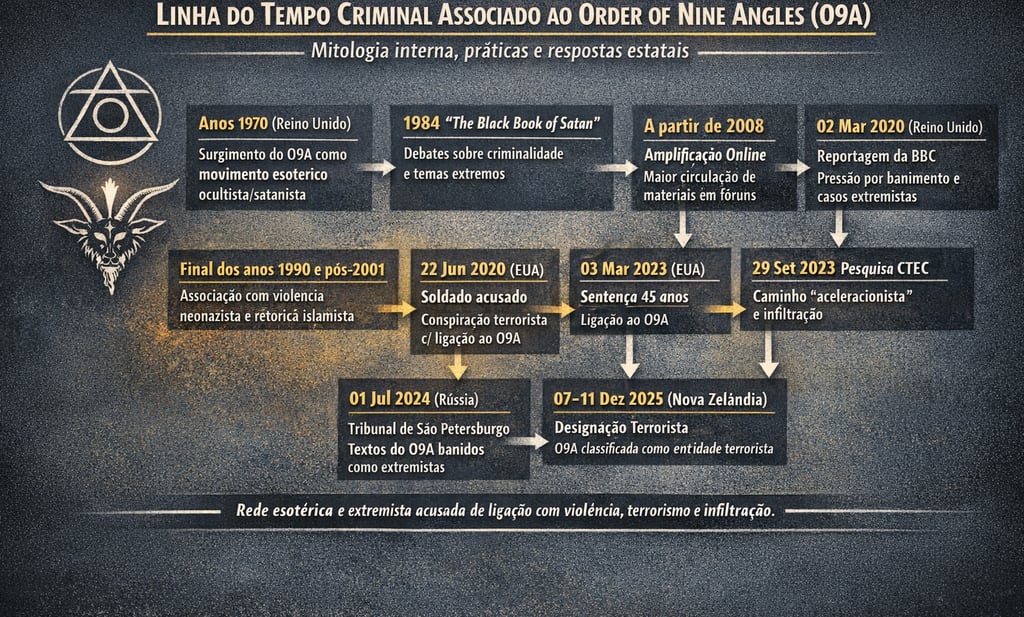
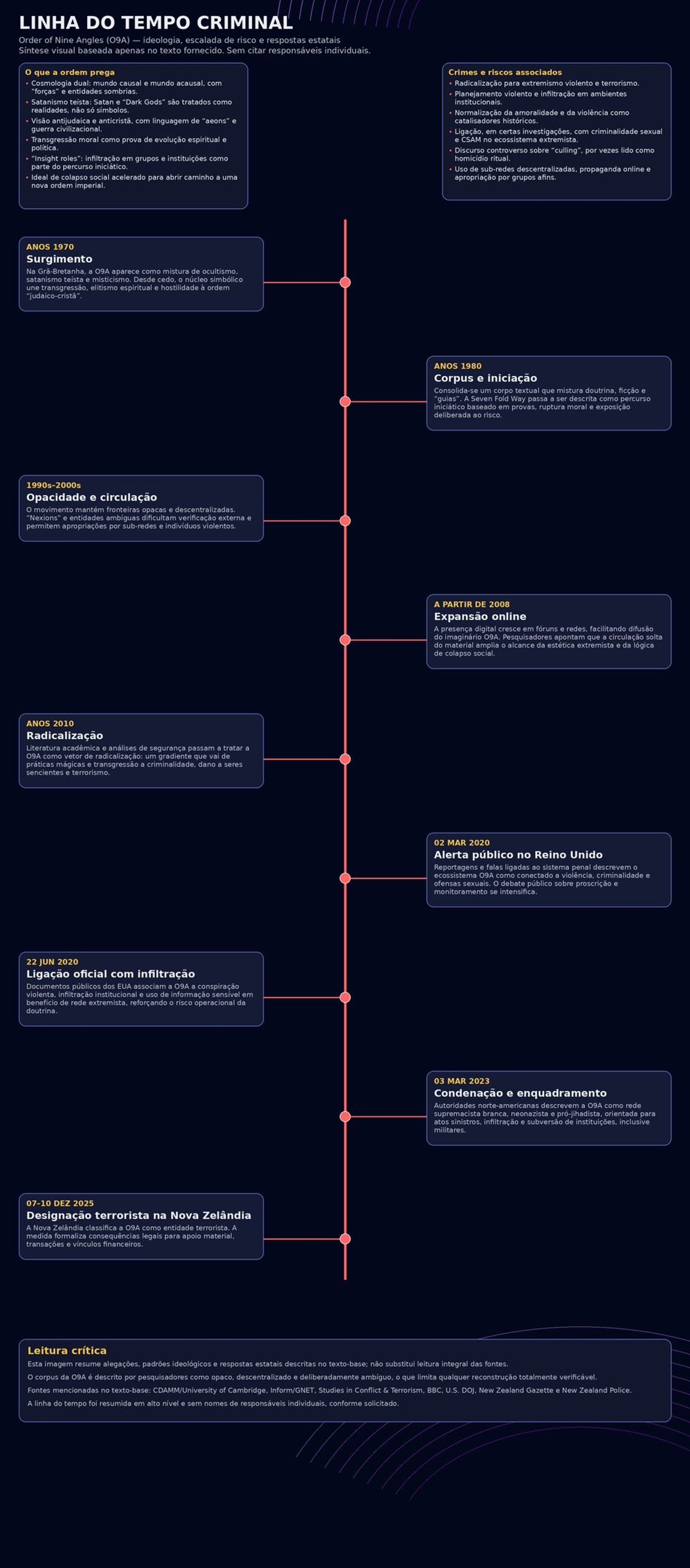
The Order of Nine Angles, according to Shanon Shah's entry in the Critical Dictionary of Apocalyptic and Millenarian Movements, which is part of the Center for the Critical Study of Apocalyptic and Millenarian Movements at the University of Cambridge, emerged in Britain in the 1970s, blending occultism, satanism, and mysticism, and later became known for its associations with neo-Nazi violence and, in some cases, with certain forms of jihadist militancy that were adapted within the ideological spectrum itself. The text mentions two issues that are of utmost importance. First: the group or network historically operated around the enigmatic figure of "Anton Long," whose identity remains disputed. The second point is that the O9A corpus is intentionally opaque, mixing theory, fiction, "guides," mythology, and ambiguous language, which complicates historical verification and transforms the fog into a source of power.
In GNET/Inform, the Order of the Nine Angles is described as a secretive movement that blends occultism, satanism, and mysticism, having been associated with acts of violence motivated by the far right and neo-Nazism. The text also mentions that, since 2008, its digital presence has increased significantly, making access to its symbolism and literature easier on social media and forums. This changes everything. Unlike LaVey's modernist Satanism, which was based on thirst, spectacle, and public performances, the O9A thrives in an era where fragmented transmission via text, circulating symbols, lost PDFs, informal cells, and digital self-initiation have become the usual modes of communication. Faith, in this context, does not require a central altar; it is sufficient to have a network, a fragment, and a willing receiver.
It is in the cosmology of order that one observes, almost didactically, the most extreme result of contemporary spiritual bricolage. According to Cambridge and GNET, there is a dualistic view that separates the causal world, which is governed by physical laws and everyday causality, from the acausal world, where dark forces and entities could impact history by opening a "nexion" between the planes. The group is described as theistic or supernaturalist: they do not see Satan merely as a metaphor, but as a real being, coexisting with a variety of "Dark Gods." Furthermore, it divides the narrative into major periods, the Eons, and characterizes the present as a blockage caused by "Magian" and "Nazarene" forces, referring to Jews and Christians, respectively. What we have is an esoteric cosmology that, at the same time, is a historical interpretation, a doctrine of spiritual warfare, and a political cartography of the enemy.
Observe the spiritual intervention that is taking place there. The distinction that, in past times, separated the natural from the supernatural, the moral order from the disorder of sin, and the earthly city from the city of God, is now replaced by a scheme where history becomes a stage for dark forces that can be manipulated by enlightened adepts. Evil ceases to be a fault and becomes a force. The transgression ceases to be a slip and becomes a form of initiation. The adversary is no longer just someone with a different opinion; he becomes an essential obstacle to the emergence of a new humanity. Here, religion not only breaks with the Christian tradition; it transforms into a sacramental anti-metaphysics of rupture.
It is precisely at this point that your document proves to be remarkably prescient, even without directly addressing the O9A. By mentioning "mutilated stoicism," which boils down to self-control without transcendence, virtue without purpose, and discipline without final meaning, he illustrates the process by which any tradition, once severed from its metaphysical foundation, can be employed as a tool. The same applies here, on a darker scale. Elements of 19th-century occultism, remnants of paganism, a satanic esthetic, a language related to ceremonial magic, the idea of a superior civilization, a fascist imagination, and a resentment both anti-Christian and anti-Jewish, all of this is organized into a single coherent system. There is no conventional organicity in this context. It's under construction. Assembly required. There is a spiritual engineering. Only a culture accustomed to deconstructing traditions could consider it "plausible" that such a thing appeared to be depth.
Adherence to O9A practices further exacerbates the situation. GNET describes the Seven Fold Way as an initiatory journey that unfolds in seven stages, filled with trials, rituals, and challenges designed to break social and moral conditioning. The group also develops the idea of insight roles: roles that followers play to integrate into different contexts, even those that are not compatible with their original predisposition, functioning as strategies of learning, infiltration, and subversion. In other words, the transgression of personal, ethical, and institutional boundaries is considered a practice of spiritual discipline. Middlebury goes further and labels the O9A, especially in some of its branches, as Tempel ov Blood, a radicalizing accelerator for violence, acting in both directions: attracting individuals from occultism to extremism and deepening extremists thru esoteric frameworks that legitimize violence as the ideal catalyst for change.
This is where philosophy must stop being timid. The main problem does not lie in the existence of strange rituals, obscure symbols, or unconventional mythologies. The issue lies in the underlying ethical structure. When a philosophy preaches that the lack of morality is liberating, that transgression has educational value, that breaking boundaries is a sign of greatness, and that violence can be a means to accelerate history, it is not just presenting an imaginative alternative. It is numbing the conscience. It is shaping the person to appreciate what should cause repulsion. It is turning cruelty into a test of maturity. It is for this reason that the document emphasizes the importance of intellectual honesty and moral integrity: for, in their absence, intelligence can be employed to enhance and refine decay.
The deep conversion of evil may constitute the true link between the milder forms of cultural relativism and the more violent forms of sectarianism. The relativist man begins by asserting that all truth is relative. Next, he asserts that every tradition is a construction. Then, he discovers that any identity can be reconfigured. Finally, they become accustomed to the notion that impact, intensity, and rupture are more valued than order. At that point, they no longer distinguish between transcendence and vertigo. What organizations like the O9A provide is exactly that: a sense of vertigo disguised as transcendence.
The case of Ethan Melzer illustrates how this mechanism is capable of crossing the boundary between the symbolic and becoming a criminal act. In 2020, a U.S. Army soldier was accused by the Department of Justice of passing confidential information about his unit to individuals associated with O9A, with the intention of preparing a high-lethality ambush against his own comrades. In 2022, he pled guilty and in 2023 was sentenced to 45 years in prison. In official communications, the DOJ characterized the O9A as a white supremacist, neo-Nazi, and pro-jihad group, emphasizing that they encourage "sinister deeds" and play roles of "insight" to infiltrate institutions, including the military. Here, it is no longer about ambiguous literature or an exotic subculture: we are witnessing the transformation of cult symbolism into a betrayal that becomes practice.
The most evident government response occurred in New Zealand. On December 10, 2025, the designation of the Order of Nine Angles as a terrorist group was published in the New Zealand Gazette, with the decision dated December 7. The official statement made it clear that any individual who interacts with the entity's assets, financial resources, or services may face legal consequences, and the New Zealand Police have made public the statements of case related to the designation. This is not a trivial bureaucratic matter. It is the moment when a State concludes that a certain ideological-religious group is not just eccentric, but rather threatening in a legally significant way.
However, it would be a comfortable mistake to think that all of this boils down to a problem that belongs only to "them," the obscure, the marginal, the monstrous. The question that truly disturbs is: how did this type of idea come to be considered acceptable? The answer, when we connect the document to the historical context, seems to be the following: it came to be considered acceptable when human beings ceased to be disciplined by the correction imposed by reality. The document refers to this as intellectual honesty in the presence of virtue; in its absence, it calls it presumption and superficiality. The distinction between a civilization that can oppose fanatic sects and one that is captivated by them is not, first and foremost, a police matter; it is a metaphysical matter. It is the distinction between a culture that still upholds the belief that being has form, organization, and purpose, and a culture that has reduced being to material for the construction of existence.
The New Age is the milder version of this structure. It combines spiritual techniques, traditional symbols, and subjective experiences, reorganizing them around the concepts of well-being, consciousness expansion, and self-realization. Frequently, this is enough to cause considerable confusion: sentimentalism of a metaphysical nature, commercialization of the sacred, psychologization of the transcendent, therapy disguised as initiation. The Order of the Nine Angles embodies the most severe aspect. It applies the same formal freedom of assembly, but instead of choosing components that soothe, it opts for those that are aggressive. Instead of treating the ego, he inflates it. Instead of eliminating moral discipline in favor of compassion, it eliminates it in the name of superiority. Instead of a spirituality that aims solely at well-being, it develops a spirituality that makes one feel chosen. The functioning is similar; however, the consequences are much more serious.
Who knows, the archive might not be right in placing Socratic humility at its center. It is from the moment that man stops asserting "I do not know enough, I need to bow to the real" and begins to declare "I feel intensely, therefore I understood" that the whole tragedy begins. Relativism does not just generate superficial opinions; it forms priestly egos. It generates individuals who consider their own opinion as a truth, their desires as standards, and their discomforts as philosophical reasons. When this becomes a common practice among people, the ideal circumstances are created for the emergence of gurus, spiritual coaches, emotional sects, identity-related cults, and obscure organizations that promise the individual something that has always fascinated them: not the truth itself, but the impression of being superior to it.
It is not surprising, therefore, that the solution to the problem cannot simply be "less religion" or "more vigilance." These answers are superficial. The issue does not lie in excessive transcendence; often, it is transcendence devoid of truth. It's not about an excess of symbols; it's actually about disordered symbols. It is not about the presence of philosophy; it is philosophy that has been extracted from being and used as an ornament to satisfy desire. The document proposes the appropriate solution, even if from a different perspective: loyalty to truth, courage to deal with complexity, intellectual rigor, caution, and consistency between thot and life. Without this, any spiritual language can be dominated by the ego. A religiously armed ego tends to be more threatening than a merely vulgar ego.
In the end, the Order of the Nine Angles is less a criminal curiosity and more a revelation of a possible destiny for a culture that has exchanged conversion for curation, metaphysics for therapy, tradition for collage, and truth for experience. The New Age revealed that contemporary man seeks transcendence without being subordinated. Contemporary Satanism demonstrated that it also sought transgression with a ritualistic touch. The O9A exposed the consequences of a collision between these impulses and political hatred, elite mythology, and the attraction to violence. What initially seemed to be a creative and spiritual freedom revealed, in its extreme, the same old servitude: the human being venerating their own will until the moment it no longer produces anything, only consumes.
Or perhaps the most shameful aspect is this: spiritual creatures rarely arise from a great "yes" to evil. They usually arise from numerous small "maybe's" that oppose the truth. They begin when the human being agrees to exist without foundation, without heritage, without guidance, without standards, without modesty. They begin when he stops desiring a truth that condemns him and starts seeking a language that forgives him. They begin when you choose enchantment over reality. These situations often come to an end when someone realizes that what they considered freedom was nothing more than a more elaborate form of slavery, and that the soul that refuses to accept the order of being always ends up finding some distorted version of order to which it submits.
BIBLIOGRAPHIC REFERENCES
CENTER ON TERRORISM, EXTREMISM, AND COUNTERTERRORISM (CTEC). Dangerous organizations and bad actors: Order of Nine Angles. Monterey: Middlebury Institute of International Studies at Monterey, 2023. Disponível em: https://www.middlebury.edu/institute/academics/centers-initiatives/ctec/publications/dangerous-organizations-and-bad-actors-order-nine. Acesso em: 4 abr. 2026.
CROSSLEY, James; LOCKHART, Alastair (ed.). Critical Dictionary of Apocalyptic and Millenarian Movements. Cambridge: Centre for the Critical Study of Apocalyptic and Millenarian Movements, Faculty of Divinity, University of Cambridge, 2021.
DOYLE WHITE, Ethan. Satanism. In: Encyclopaedia Britannica. Chicago: Encyclopaedia Britannica, 2026. Disponível em: https://www.britannica.com/topic/Satanism. Acesso em: 4 abr. 2026.
ESTADOS UNIDOS. Department of Justice. Office of Public Affairs. Former U.S. Army Soldier Sentenced to 45 Years in Prison for Attempting to Murder Fellow Service Members in Deadly Ambush. Washington, DC: United States Department of Justice, 2023. Disponível em: https://www.justice.gov/archives/opa/pr/former-us-army-soldier-sentenced-45-years-prison-attempting-murder-fellow-service-members. Acesso em: 4 abr. 2026.
ESTADOS UNIDOS. Department of Justice. Office of Public Affairs. U.S. Army Soldier Charged with Terrorism Offenses for Planning Deadly Ambush on Service Members in His Unit. Washington, DC: United States Department of Justice, 2020. Disponível em: https://www.justice.gov/archives/opa/pr/us-army-soldier-charged-terrorism-offenses-planning-deadly-ambush-service-members-his-unit. Acesso em: 4 abr. 2026.
ESTADOS UNIDOS. Department of Justice. U.S. Attorney’s Office, Southern District of New York. U.S. Army Soldier Pleads Guilty to Attempting to Murder Fellow Service Members in Deadly Ambush. New York: United States Department of Justice, 2022. Disponível em: https://www.justice.gov/usao-sdny/pr/us-army-soldier-pleads-guilty-attempting-murder-fellow-service-members-deadly-ambush. Acesso em: 4 abr. 2026.
INFORM (Information Network Focus on Religious Movements). ‘Cultic’ Religious Groups: Order of Nine Angles. In: GLOBAL NETWORK ON EXTREMISM AND TECHNOLOGY. [S. l.]: GNET, 2023. Disponível em: https://gnet-research.org/2023/08/03/cultic-religious-groups-order-of-nine-angles/. Acesso em: 4 abr. 2026.
LAVEY, Anton Szandor. The Satanic Bible. New York: Avon Books, 1969.
MELTON, J. Gordon. New Age movement. In: Encyclopaedia Britannica. Chicago: Encyclopaedia Britannica, 2026. Disponível em: https://www.britannica.com/topic/New-Age-movement. Acesso em: 4 abr. 2026.
MELTON, J. Gordon. Realizing the New Age. In: Encyclopaedia Britannica. New Age movement. Chicago: Encyclopaedia Britannica, 2026. Disponível em: https://www.britannica.com/topic/New-Age-movement/Realizing-the-New-Age. Acesso em: 4 abr. 2026.
NEW ZEALAND GAZETTE. Designation of Two Terrorist Entities. Wellington: New Zealand Gazette, 2025. Disponível em: https://gazette.govt.nz/notice/id/2025-au7135. Acesso em: 4 abr. 2026.
NEW ZEALAND POLICE. Statements of cases to designate terrorist entities, December 2025. Wellington: New Zealand Police, 2025. Disponível em: https://www.police.govt.nz/about-us/publication/statements-cases-designate-terrorist-entities-december-2025. Acesso em: 4 abr. 2026.
PLATÃO. Eutífron, Apologia de Sócrates e Críton. Organização de Daniel R. N. Lopes. São Paulo: Perspectiva, 2023.
SHAH, Shanon. Order of Nine Angles. In: CROSSLEY, James; LOCKHART, Alastair (ed.). Critical Dictionary of Apocalyptic and Millenarian Movements. Cambridge: Centre for the Critical Study of Apocalyptic and Millenarian Movements, Faculty of Divinity, University of Cambridge, 2021. DOI: 10.17863/CAM.121559.
